Key takeaways
- Keyluv 51″ Kitchen Storage Island with 2 Stools (Black) — the most complete package here, pairing a wide drop-leaf surface with a built-in power outlet and two matching stools, best for buyers who want everything in one box.
- Keyluv 51.2″ Kitchen Storage Island with 2 Stools (White) — the same full-featured formula in a bright white finish for kitchens that lean light and airy rather than dark and industrial.
- Shintenchi Kitchen Island with Folding Drop Leaf (Brown) — a rustic-toned cart with a foldable drop leaf, a double-door cabinet with a 3-tier adjustable shelf, and 3 drawers, suited to buyers who already own bar stools.
- Shintenchi Kitchen Island with Drop Leaf (Black) — a black-and-natural finish aimed at modern or urban kitchens that want a bar-cart silhouette with a foldable tabletop, adjustable shelves, and a side towel rack.
- Shintenchi Kitchen Island with Storage (White) — the lightest cart in the Shintenchi lineup (about 75 lb), with a roomy cabinet, 2 drawers, and a towel rack, positioned as a rolling microwave cart for compact kitchens.
- HUAHUU 43″ Rolling Kitchen Island with Seating (White) — a space-saving option with hidden casters, bar stools, an adjustable shelf, and a dedicated spice rack built into a 43-inch frame.
A kitchen island sounds like exactly what a cramped cooking space needs until you price out a contractor and realize that knocking down cabinets or pouring new flooring is not an option for a rental, a condo, or a kitchen that already has its layout locked in. Rolling kitchen island carts with drop-leaf seating solve the same problem without any construction: they roll into place for meal prep, unfold into a small dining bar when it is time to eat, and tuck back against a wall or pantry door when the kitchen needs to breathe. For anyone working with a galley kitchen, an open-plan apartment, or a family room that doubles as a dining area, this category of furniture has become one of the simplest upgrades available.
The challenge is that “rolling kitchen island” covers a wide range of products, from compact microwave carts with a fold-down shelf to fully equipped workstations with built-in power outlets, matching stools, and multiple tiers of enclosed storage. Picking the wrong one usually means discovering too late that the drop leaf cannot support a dinner plate and a laptop at the same time, that the casters lock on carpet but slide on tile, or that the cabinet doors block the one drawer you actually needed open during dinner prep. These are not defects so much as mismatches between a buyer’s kitchen and a cart’s design intent.
This guide walks through seventeen rolling kitchen island carts with drop-leaf seating (six main picks, then eleven more from other makers), drawing only on the manufacturer specifications, stated features, and construction details that are documented for each listing. We focus on what the documented features tell a buyer about durability, storage logic, and day-to-day livability, and we flag the questions worth asking the seller or checking in the listing photos before you commit to a size and finish.
The people shopping this category are rarely all solving the same problem, even though they land on the same search term. A recent renter furnishing a first apartment kitchen is usually optimizing for the smallest footprint that still offers a place to eat breakfast. A family with a galley kitchen and a counter that is permanently covered in mail and school bags is usually optimizing for enclosed storage that can absorb overflow. A host who entertains on weekends is usually optimizing for extra serving surface that can disappear again by Monday morning. None of these buyers need the “best” cart in any universal sense — they need the cart whose specific trade-offs match the problem they are actually trying to solve, which is why this guide spends as much time on who should skip a model as on who it suits.
Our top picks


As an Amazon Associate we earn from qualifying purchases at no extra cost to you.
Updated October 2026 — The best rolling kitchen island cart with drop leaf seating for most small kitchens is the Keyluv 51″ Kitchen Storage Island with 2 Stools, because stools, power and a drop leaf come in one box. If you would rather buy your own stools, the Hlivelood 55″ Movable Kitchen Island turns into one of the largest table surfaces in this guide (47.2 x 29.5 in with the leaf down and top slid out). For seating on both sides, the Merax 55.7″ with two drop leaves is the pick.
Quick Answer: Our Top Picks
- Keyluv 51″ Kitchen Storage Island with 2 Stools (Black) — the most complete package here, pairing a wide drop-leaf surface with a built-in power outlet and two matching stools, best for buyers who want everything in one box.
- Keyluv 51.2″ Kitchen Storage Island with 2 Stools (White) — the same full-featured formula in a bright white finish for kitchens that lean light and airy rather than dark and industrial.
- Shintenchi Kitchen Island with Folding Drop Leaf (Brown) — a rustic-toned cart with a foldable drop leaf, a double-door cabinet with a 3-tier adjustable shelf, and 3 drawers, suited to buyers who already own bar stools.
- Shintenchi Kitchen Island with Drop Leaf (Black) — a black-and-natural finish aimed at modern or urban kitchens that want a bar-cart silhouette with a foldable tabletop, adjustable shelves, and a side towel rack.
- Shintenchi Kitchen Island with Storage (White) — the lightest cart in the Shintenchi lineup (about 75 lb), with a roomy cabinet, 2 drawers, and a towel rack, positioned as a rolling microwave cart for compact kitchens.
- HUAHUU 43″ Rolling Kitchen Island with Seating (White) — a space-saving option with hidden casters, bar stools, an adjustable shelf, and a dedicated spice rack built into a 43-inch frame.
How We Compared This Guide
We built this guide around the specifications, feature lists, and construction details each manufacturer publishes for its listing, rather than around subjective taste or a single afternoon with any one cart. For every product we looked at what the cart is actually built from (particleboard versus engineered wood frames, the type of cabinet-door hardware, and the described caster hardware), what storage configuration is offered (open shelving, enclosed cabinets, drawers, and accessory racks), and whether seating is bundled into the purchase or sold separately. We also paid attention to the language manufacturers use around drop-leaf support, since the hinge and bracket hardware underneath a folding leaf is the single part of these carts most likely to be stressed by daily use.
Where a listing did not specify a hard number for weight capacity, drop-leaf support load, or caster diameter, we have avoided guessing at a figure. Instead, we note what that gap means for a buyer and what to check directly in the product listing, the included manual, or the questions-and-answers section on the product page before ordering. We did not build any ranking on owner-review text, because it changes often and cannot be verified here; check recent reviews on the listing for surface maintenance and assembly experience.
Finally, we grouped carts by what kind of kitchen problem they are built to solve rather than by brand alone. A buyer furnishing a studio apartment and a buyer outfitting a family kitchen with four people eating breakfast at once are not shopping for the same cart, even if both carts happen to fold out into a dining surface.
Rolling Kitchen Island Buying Guide: What Actually Matters
Width and Footprint Relative to Your Kitchen Layout
The published width of a cart only tells half the story. A 51-inch island with its drop leaf extended needs considerably more clearance than the folded footprint suggests, and that extended width has to coexist with open cabinet doors, a swinging refrigerator door, or a walkway to the stove. Before choosing a width, measure the folded footprint against your available floor space, then measure again with an imaginary leaf extended to the side you plan to use for seating. Carts in the 43-inch range, like the HUAHUU model in this lineup, are easier to work into tighter kitchens, while the 51-inch Keyluv carts suit larger open-plan spaces where the extra prep surface is the whole point of the purchase.
It also helps to think about the path the cart travels, not just the spot where it parks. If you plan to roll the island between a prep position near the stove and a dining position near the table, walk that exact route with a tape measure or a stand-in box of the same dimensions. Doorways, the swing radius of an oven door, and the gap between a counter edge and a dining table are the three places buyers most often discover an unexpected pinch point after the cart has already arrived.
Drop-Leaf Mechanism and Leaf-Support Strength
Every cart in this category depends on a folding bracket or hinge system to hold the leaf flat when it is extended and to let it fold down flush against the body when it is not in use. Manufacturers describe this hardware in different ways — some call out “folding drop leaf” brackets specifically, others simply list a drop-leaf dimension without detailing the bracket design — but the underlying mechanical question is the same for every buyer: how much everyday weight will that leaf need to support? A pair of plates and glasses is a very different load than a stand mixer or a stack of serving trays. Where a listing does not state a maximum load for the leaf, treat the leaf as a dining and light-prep surface rather than a heavy-duty worktop, and confirm the bracket design in listing photos before loading it with anything substantial.
It is also worth distinguishing a drop leaf that is designed primarily for dining from one that is marketed as extra prep space, even when the listing copy uses both terms loosely. A leaf built for dining is typically sized and braced for place settings and the gentle pressure of someone leaning on an elbow, while a leaf marketed as prep space implies it should tolerate cutting boards, mixing bowls, and the repeated light impact of chopping. Few listings in this category make that distinction explicit, so the safer approach is to assume dining-grade support unless the product description specifically calls out prep-surface durability.
Cabinet, Drawer, and Open Storage Configuration
Storage is where these carts differentiate themselves the most. Some models combine enclosed cabinet doors with a dedicated drawer tier, a side storage rack, and a towel bar, effectively replacing a small section of kitchen cabinetry. Others lean toward open shelving behind a single cabinet door, which is faster to access during active cooking but offers less protection from dust and less visual tidiness. Decide up front what you actually need to store — bulky small appliances, pantry staples, pots and pans, or just linens and utensils — because the ideal configuration changes depending on the answer. A cart with a side storage rack and towel bar is well suited to active meal prep, while a cart built around a single large cabinet favors buyers storing bulkier countertop appliances like a microwave.
A useful exercise before ordering is to inventory exactly what you intend to store on the cart and measure those items against the stated interior dimensions, where they are listed, rather than assuming everything will fit because the cabinet “looks big enough” in a photo. Pantry staples in bulk containers, a stand mixer, or a stack of sheet pans all have different footprint and height needs, and an adjustable shelf — a feature listed on the HUAHUU and Shintenchi models in this lineup — gives you more flexibility to resolve mismatches after the fact than a fixed shelf does.
Caster Quality and Mobility
Mobility is the entire premise of a rolling island, so the caster hardware deserves real scrutiny even though it is often the least documented spec on a listing. Carts described as having “hidden wheels” tend to prioritize a cleaner, furniture-like silhouette over maximum rolling ease, which suits buyers who want the cart to look less like a cart when it is parked against a wall. Exposed caster designs are typically easier to roll across varied flooring and easier to lock in place. If a listing does not specify whether the casters include a locking mechanism, assume you will want to verify that detail directly, especially if the cart will double as a seating surface — a cart that drifts while someone is seated at the drop leaf is a safety issue, not just an inconvenience.
Flooring type matters more than most buyers expect. Carts that roll smoothly on hardwood or tile can feel noticeably stiffer on thick carpet or a kitchen rug, and casters that are fine on carpet can occasionally mark softer vinyl or laminate flooring over time if the wheels are not kept clean of grit. If your kitchen transitions between flooring types — tile near the stove, carpet or an area rug near a dining nook — test the cart’s movement across that transition before finalizing where you plan to park it day to day.
Seating Capacity and Overhang Clearance
Not every cart in this category includes stools. Some, like the two Keyluv models and the HUAHUU cart, bundle matching seating directly into the purchase, while the Shintenchi line generally provides the overhang and leaf space for seating without including the stools themselves. If you already own bar-height stools that fit your existing counter height, a cart sold without seating can be the better value, since you are not paying for stools you will not use. If you are furnishing from scratch, confirm that the included stools’ height is compatible with the drop-leaf height once it is extended, and check how much knee clearance exists underneath the leaf when stools are pulled in.
Seating capacity is also about more than stool count. A cart with a single-sided drop leaf realistically seats one or two people comfortably, which is plenty for a quick breakfast or a laptop lunch but tight for a family meal. If you are hoping to seat three or four people at once, look closely at whether the leaf spans the full side of the cart or only a portion of it, since the usable seating width is usually narrower than the cart’s total width once cabinet doors and corner posts are accounted for.
Built-In Conveniences: Outlets, Towel Bars, and Spice Racks
A subset of these carts includes functional extras that go beyond basic storage. A built-in power outlet, as featured on both Keyluv models, lets you run a blender, coffee maker, or hot plate directly from the island instead of running an extension cord across the floor — a genuinely useful feature in kitchens where the island sits away from a wall outlet. Towel bars show up across nearly every model in this lineup and are a small but consistently useful detail for keeping a dish towel within reach during prep. Dedicated spice racks, as found on the HUAHUU cart, are worth prioritizing if your current spice storage is scattered across cabinets rather than centralized.
These extras tend to matter most in the kitchens that lack built-in equivalents already. A kitchen with plenty of existing outlets near the counter gains little from a cart-mounted outlet, while a kitchen where the island sits in the middle of the room, away from any wall, benefits from it considerably. The same logic applies to the spice rack and towel bar: weigh these features against what your current kitchen is missing rather than treating every extra as automatically valuable.
Material, Finish, and Surface Maintenance
Finish color affects more than aesthetics. Light surfaces show flour dust, sauce splatter, and general kitchen grime more readily than darker finishes, which simply means white carts need more frequent wipe-downs to stay looking clean. Matte black finishes, on the other hand, tend to show dust and flour specks as a visible contrast against the dark surface, so neither extreme is maintenance-free — the difference is in what kind of mess shows up most. If low-maintenance surfaces matter more to you than color coordination, a mid-tone wood finish tends to hide daily kitchen residue more forgivingly than either pure white or deep black.
Beyond color, the underlying material affects how the cart ages. Engineered wood panels with a laminate or coated finish resist moisture better than raw wood, which matters near a sink or stovetop where splashes are routine. Hardware finish is worth a second look too — handles and hinges described as metal typically hold up to repeated daily opening and closing better than plastic equivalents, and mismatched hardware finish against existing kitchen fixtures is a detail that is easy to miss in a thumbnail photo but noticeable once the cart is sitting in your kitchen every day.
Real-World Kitchen Layouts and Which Cart Fits
Buying guides often describe features in isolation, but the way a rolling island actually gets used depends heavily on the shape of the kitchen it lands in. The following scenarios cover the layouts that show up most often among shoppers researching this category.
The Narrow Galley Kitchen
Galley kitchens with counters on two facing walls leave little room for anything that cannot be tucked completely out of the main walkway. In this layout, footprint when folded matters far more than footprint when extended, since the cart will likely spend most of its time parked at one end of the galley rather than rolled into the middle of the cooking path. The HUAHUU 43-inch model’s smaller frame and hidden-wheel design are built for exactly this kind of constrained space.
The Open-Concept Great Room
Open-plan homes where the kitchen flows directly into a living or dining area have the opposite problem: plenty of floor space, but no natural boundary between “kitchen” and “everywhere else.” Here, a larger cart like either 51-inch Keyluv model can function as a genuine visual and physical divider between zones, with the added benefit of a built-in outlet for appliances used away from the main counter run.
The Studio or One-Bedroom Apartment Kitchenette
Small-footprint kitchens that double as a dining area for the entire home benefit most from a cart that can fully transform between roles — compact and against the wall during the day, extended for two at mealtimes. A lighter model such as the Shintenchi Storage cart (about 75 lb) fits this pattern well, since the demands placed on it are closer to occasional dining than daily heavy-duty prep.
The Family Kitchen With an Existing Island
Even households that already have a fixed island sometimes add a rolling cart for overflow prep during holidays, baking projects, or when multiple people are cooking at once. In this scenario, the cart is a supplementary surface rather than the household’s only prep space, which makes enclosed cabinet storage for occasional-use items — holiday bakeware, a second set of serving dishes — a more valuable feature than built-in seating the family may rarely use.
Detailed Product Reviews
Keyluv 51″ Kitchen Storage Island with 2 Stools (Black)
This Keyluv cart is built as a complete kitchen workstation rather than a simple rolling cart, pairing a 51-inch prep surface with two matching stools and a built-in power outlet. The outlet is a meaningful differentiator in this lineup: it lets you plug in a blender or coffee maker directly at the island instead of running a cord across the kitchen floor, which matters most for anyone using the island as a genuine second workspace rather than an occasional dining surface.
Storage comes through two drawers, a side storage rack, and a towel rack, giving this model more organized storage than carts that rely on open shelving alone. The black finish leans toward a modern, versatile look that fits a wide range of kitchen styles without clashing with existing cabinetry.
Who it suits: buyers who want one purchase to cover prep space, dining seating, and appliance power in a single piece of furniture, particularly in kitchens without much built-in counter seating already.
Who should skip it: anyone who already owns matching stools, or who is working with a tighter footprint than 51 inches can comfortably accommodate once the drop leaf is extended.
Because this model arrives with both a cabinet frame and two separate stools, expect assembly to take longer than a cart sold without seating — plan for the stools to require their own hardware and attachment steps in addition to the main cabinet build. Once assembled, the included outlet means you will want to plan the cart’s parking spot near enough to a wall outlet to power it, even though the cart itself still rolls freely.
Check the current listing for the Keyluv 51″ Kitchen Storage Island (Black).
Keyluv 51.2″ Kitchen Storage Island with 2 Stools (White)
This is effectively the sibling model to the black Keyluv island above, built on the same 51.2-inch frame with the same built-in power outlet and two included stools, but finished in white for a brighter, more contemporary look. For kitchens leaning toward light cabinetry, white appliances, or an airy Scandinavian-influenced aesthetic, this finish integrates more naturally than the black version.
The trade-off with any white cabinet surface is maintenance: light finishes show smudges, fingerprints, and kitchen splatter more visibly than darker ones, so this model will likely need more frequent wiping down to keep its bright look intact, a general trait of light-colored kitchen furniture.
Who it suits: buyers who want the full Keyluv feature set — outlet, stools, generous surface — but in a finish that matches a lighter kitchen palette.
Who should skip it: households that generate heavy daily mess at the counter and would rather not deal with visible smudging on a light surface.
Since this is the same frame and hardware as the black version with only the finish changed, the assembly experience and the outlet placement should be identical between the two. Buyers torn between the two colors are really choosing based on kitchen palette rather than any functional difference, so the decision comes down to which finish photographs better against your existing cabinetry and countertop.
Check the current listing for the Keyluv 51.2″ Kitchen Storage Island (White).
Shintenchi Kitchen Island with Folding Drop Leaf (Brown)
This Shintenchi cart brings a warmer, more traditional look to the category, built around a brown finish that reads as rustic rather than modern. The listing describes a foldable drop leaf, a double-door cabinet with a 3-tier adjustable shelf for pots, pans, and pantry goods, 3 drawers, and 5 wheels (2 of them with brakes). It gives dimensions of about 39.8 inches wide, 24.8 inches deep, and 35.6 inches tall, an item weight of about 85 pounds, and a 150-pound maximum weight recommendation.
Unlike the two Keyluv models, this cart does not include stools — the seating overhang is there, but you will need to source your own bar-height stools separately. For buyers who already own compatible seating, that is simply a cost and clutter saving; for buyers starting from zero, it is an extra purchase to plan for.
Who it suits: buyers furnishing a rustic or farmhouse-styled kitchen who already have stools on hand and want strong cabinet storage alongside the drop-leaf function.
Who should skip it: anyone who wants a single all-in-one purchase that arrives with matching seating included.
When budgeting for this model, factor in the cost and lead time of sourcing stools separately, and measure the leaf’s height once assembled before ordering seating, since stool height needs to clear the underside of the leaf comfortably for knees and still let someone sit at a natural eating height. The multi-tier cabinet behind the closed doors is best suited to buyers who want their pantry overflow out of sight rather than displayed on open shelving.
Check the current listing for the Shintenchi Kitchen Island with Folding Drop Leaf (Brown).
Shintenchi Kitchen Island with Drop Leaf (Black)
This version of the Shintenchi cart swaps the rustic brown finish for a black-and-natural look, positioning the cart somewhere between a mobile bar cart and a full dining island. The listing describes a foldable tabletop that extends for quick meals or extra baking space and retracts when you need the floor space, adjustable shelves, drawers and open shelves, a side towel rack, and rolling wheels with locks. It gives dimensions of about 40 by 16 by 35 inches and an item weight of about 81 pounds.
The dark finish gives this model a cleaner, more urban look than the wood-toned versions in the Shintenchi line, which makes it a natural fit for modern kitchen setups with dark hardware or black appliances. As with any dark surface, flour, sugar, and general dust tend to show up as a visible contrast rather than blending in, so wiping it down after active baking sessions is worth building into your routine.
Who it suits: buyers furnishing a modern or urban-styled kitchen who want the bar-cart silhouette with real enclosed storage behind it.
Who should skip it: anyone who specifically needs a built-in electrical outlet for running countertop appliances directly from the island, since the listing does not mention one.
The listing does not describe the surface sheen, so judge the finish from the listing photos rather than assuming a matte coating, and keep a damp cloth handy after baking sessions. Buyers pairing this cart with stools should choose hardware that suits the cart’s black-and-natural finish.
Check the current listing for the Shintenchi Kitchen Island with Drop Leaf (Black).
Shintenchi Kitchen Island with Storage (White)
This white Shintenchi cart is the lightest of the three Shintenchi carts here, at about 75 pounds against roughly 81 to 85 pounds for the others. The listing describes a roomy cabinet with shelves, 2 drawers, and a towel rack, and its title positions it as a rolling microwave cart with a drop leaf for the seating area that defines this product category.
The listing gives dimensions of about 40 inches long, 22 inches deep, and 35 inches tall, and describes a solid-wood build with assembly tools included. That makes it a sensible choice for buyers who want the core functionality — mobile prep surface, fold-out seating, basic storage — in a compact footprint; it states no load rating, so avoid loading it with heavy stand mixers or large cast-iron cookware.
Who it suits: budget-conscious buyers furnishing a smaller kitchen who want a cart that can double as a microwave stand and an occasional dining surface.
Who should skip it: anyone who needs to load the cart with heavier countertop equipment regularly, since the listing states no load rating.
If you plan to use this as a microwave stand, measure your microwave’s footprint and weight against the cabinet opening before ordering, since “doubles as a microwave cart” describes a use case rather than a guaranteed fit for every microwave size. The listing mentions 2 drawers; check the photos for drawer hardware before ordering.
Check the current listing for the Shintenchi Kitchen Island with Storage (White).
HUAHUU 43″ Rolling Kitchen Island with Seating (White)
The HUAHUU cart takes a different structural approach than the Shintenchi and Keyluv models, built on hidden casters that keep the wheel hardware tucked beneath the frame for a cleaner, more furniture-like look when the cart is parked against a wall. At 43 inches, it is also the most compact of the six main picks, making it a strong fit for smaller kitchens where the 51-inch Keyluv models would feel oversized.
Despite its smaller footprint, the feature list is dense: a drop leaf for seating, included bar stools, a large cabinet, an adjustable shelf for customizing interior storage, a dedicated spice rack, a towel rack, drawers, and a built-in outlet with USB ports. Folded it measures about 15.75 by 43.3 inches, and it expands to about 25.6 inches deep. The dedicated spice rack is unique to this model among the six main picks, making it a strong option for buyers who want to centralize spice storage rather than leaving it scattered across upper cabinets.
Who it suits: buyers in compact kitchens who still want a dense feature set — seating, spice storage, adjustable shelving, and drawers — without the larger footprint of the 51-inch carts.
Who should skip it: anyone who specifically wants an exposed-caster design that is easier to roll across uneven or textured flooring, since hidden-wheel designs generally prioritize appearance over maximum rolling ease.
Given the number of features packed into a 43-inch frame, expect the cabinet interior to be organized into smaller, more defined sections than on the larger, simpler Shintenchi models, which is a benefit for buyers who like designated spots for specific items but can feel restrictive for anyone trying to store a single large or oddly shaped object. The included bar stools should be checked against the leaf height the same way any bundled seating would be, to confirm a comfortable fit before assembly.
Check the current listing for the HUAHUU 43″ Rolling Kitchen Island with Seating (White).
Side-by-Side Comparison
| Product | Finish | Seating Included | Power Outlet | Notable Storage | Best For |
|---|---|---|---|---|---|
| Keyluv 51″ Island (Black) | Black | Yes, 2 stools | Yes | 2 drawers, side rack, towel rack | All-in-one workstation |
| Keyluv 51.2″ Island (White) | White | Yes, 2 stools | Yes | 2 drawers, side rack, towel rack | Bright, modern kitchens |
| Shintenchi Folding Drop Leaf (Brown) | Brown | No, BYO stools | Not listed | Double-door cabinet with 3-tier shelf, 3 drawers | Rustic kitchens with existing stools |
| Shintenchi Drop Leaf (Black) | Black and natural | No, BYO stools | Not listed | Adjustable shelves, drawers, side towel rack | Modern/urban kitchens |
| Shintenchi Storage (White) | White | No, BYO stools | Not listed | Cabinet, 2 drawers, towel rack | Microwave-cart use, lightest Shintenchi build |
| HUAHUU 43″ Island (White) | White | Yes, bar stools | Yes (outlet and USB) | Large cabinet, adjustable shelf, spice rack, drawers | Compact kitchens needing dense features |
Best Pick by Need
- Studio apartment with no stools owned: one of the two Keyluv models, since seating is bundled into the purchase and the built-in outlet adds real utility in a space without much counter access.
- Dark, modern kitchen aesthetic: the Shintenchi Drop Leaf in Black, which matches dark hardware and black appliances without the added cost of included seating you may not need.
- Lightest Shintenchi cart: the Shintenchi Kitchen Island with Storage in White, at about 75 lb against roughly 81 to 85 lb for the other Shintenchi carts; the listing states no load rating.
- Need a combined microwave stand and prep surface: the Shintenchi Storage model, which is specifically positioned to double as a microwave cart.
- Bright, airy kitchen with light cabinetry: the Keyluv 51.2″ White island, accepting the extra maintenance that comes with a light finish.
- Rustic or farmhouse kitchen that wants closed storage: the Shintenchi Folding Drop Leaf in Brown, with a double-door cabinet and 3 drawers.
- Small kitchen needing maximum feature density: the HUAHUU 43″ island, with its adjustable shelf, spice rack, and hidden-wheel design in a compact footprint.
Care, Setup, and Maintenance Tips
Assembly and First Setup
Most carts in this category ship flat-packed and require home assembly, typically involving the cabinet frame, caster installation, and attachment of the drop-leaf hinge hardware. Before you begin, lay out all hardware and confirm nothing is missing against the included parts list — missing hinge bolts are a common assembly frustration with flat-packed cabinet furniture generally. Assemble on a soft surface like a rug or moving blanket to avoid scratching finished panels, and attach casters last so the frame is not rolling around while you are still working on it.
Caster Care and Floor Protection
Once assembled, test the caster locks on your actual kitchen flooring before loading the cart with anything heavy. Hardwood and tile floors sometimes need felt pads or locking casters engaged more deliberately than carpet does. If your model’s casters are not described as locking, consider positioning the cart against a wall or appliance when it is in dining mode so it cannot drift while someone is seated at the leaf.
Drop-Leaf Hinge Maintenance
The drop-leaf hinge is the hardest-working moving part on these carts, and it benefits from periodically checking that mounting screws remain tight, since repeated folding and unfolding can gradually loosen hardware over months of daily use. Avoid leaning on the leaf while it is extended, and lift rather than drag heavy items across the surface to reduce stress on the bracket.
Surface Cleaning by Finish
White and other light finishes generally need a quick wipe-down after each use to prevent flour, sauce, or oil residue from setting into the surface, while matte black and dark wood finishes are more forgiving of occasional residue but show dust and flour specks as a visible contrast. A mild dish soap and a soft cloth are sufficient for most laminate or coated-wood surfaces; avoid abrasive scouring pads, which can dull a matte finish over time.
Common Mistakes to Avoid
A common misstep is underestimating the clearance needed once the drop leaf is extended, which leads to a cart that cannot fully open in its intended spot. A second common mistake is treating a light-duty cart as a heavy-prep station — stacking cast-iron pans or a stand mixer on a frame built for general household use accelerates wear on both the main surface and the leaf hinge. Finally, buyers who skip checking stool compatibility before ordering a cart without included seating sometimes end up with mismatched counter heights, so measure the leaf height once extended before buying stools separately.
Long-Term Durability Signs to Watch For
Over months of regular use, the signs that a cart needs attention tend to show up in predictable places before they become real problems. Watch for a drop leaf that no longer sits perfectly level when extended, which usually signals the hinge or bracket hardware has loosened and needs re-tightening. Listen for new squeaking from the casters, which often means grit has worked its way into the wheel housing and the wheels need a quick wipe-down or a drop of appropriate lubricant. Check cabinet door alignment periodically too, since doors that no longer close flush are an early indicator that the cabinet frame itself is absorbing more stress than intended, often from being used as a leaning post or from overloaded shelves inside.
4 More Rolling Islands Worth Considering
The six picks above lean heavily on two brands, so we widened the field to other makers that pair a drop leaf with mobile storage. Each of these adds something the main lineup does not: a pegboard wall for tools, a hidden trash can bay, under-top lighting, or a compact breakfast-cart format with stools that tuck away. They add four more options to the six main picks.
VASAGLE 47.2-Inch Island with Power Strip and Pegboard — Best for Keeping Tools in Plain Sight
As an Amazon Associate we earn from qualifying purchases at no extra cost to you.

This VASAGLE island suits cooks who like everything they use daily within arm’s reach rather than behind cabinet doors. The listing pairs a 47.2-inch-wide top with a drop leaf, a built-in power strip, and a pegboard panel, which means utensils, measuring cups, and small pans can hang on the side of the cart while a kettle or hand mixer plugs straight into the island. At roughly 47 inches, it sits between the compact HUAHUU and the larger 51-inch Keyluv models, so it gives a meaningful prep surface without overwhelming a galley or apartment kitchen.
It combines seating overhang and countertop power in one piece. Stools are not part of the listing name, so plan to buy seating separately.
Pros
- Power strip lets you run small appliances at the island
- Pegboard adds flexible vertical storage
- Mid-size 47.2-inch width fits most small kitchens
Cons
- Seating must be purchased separately
- Open pegboard storage shows clutter more than closed cabinets
VASAGLE Mobile Island with Trash Can Storage — Best for Hiding the Kitchen Bin

In many small kitchens the trash can ends up in the middle of the floor because there is no cabinet to hide it in. This VASAGLE island solves that by building a dedicated trash can compartment into the cart alongside a drop leaf for casual seating. The result is a single piece of furniture that handles prep space, waste, and breakfast duty at once, which is especially handy in rentals where you cannot add a pull-out bin to the existing cabinets.
Before ordering, check the compartment’s interior dimensions against the size of the bin you plan to use, since tall or wide cans may not fit, and confirm whether a bin is included.
Pros
- Conceals the trash can inside the island
- Drop leaf adds a seating or serving surface
- Keeps floor space clear in tight kitchens
Cons
- Trash bay uses space that could otherwise be shelving
- Bin size compatibility needs checking before purchase
Casual Home Drop Leaf Breakfast Cart with 2 Stools — Best for Tiny Kitchens and Breakfast Nooks

Casual Home’s breakfast cart takes a more traditional approach than the cabinet-style islands above. It is built as a compact rolling cart with a drop leaf and two matching stools in a natural wood finish, designed so the stools can be stored with the cart when they are not in use. That makes it a strong choice for studio apartments, small condos, and eat-in kitchens where a full island would block the walkway but a two-person breakfast spot is still on the wish list.
It includes seating. The trade-off is storage: a breakfast cart offers open shelving rather than the drawers, cabinet doors, and side racks you get on bigger islands, so it works best as a dining and light-prep station rather than a pantry replacement.
Pros
- Two stools included
- Small footprint for studios and breakfast nooks
- Warm natural wood tone suits traditional kitchens
Cons
- Less enclosed storage than cabinet-style islands
- No built-in power outlet
YITAHOME Rolling Island with LED Lights and Stools — Best for Evening Ambience and Built-In Power

If your island will double as a late-night snack bar or coffee station, the YITAHOME model brings features none of the other picks offer together. The listing combines a drop leaf dining surface with LED lighting, a power outlet, two drawers, a spice and towel rack, and soft upholstered stools, all in a black lacquered finish. The lighting adds a soft glow for evening use, while the outlet and drawers make it practical for daily prep.
It includes seating and power. Lacquered surfaces wipe clean easily but can show scratches and fingerprints over time, and the LED feature adds one more component that relies on the outlet or power supply working properly.
Pros
- Built-in LED lighting and power outlet
- Includes two soft stools
- Drawers plus spice and towel racks for organized storage
Cons
- Glossy black lacquer shows fingerprints and dust
- Lighting adds style more than storage value
5 More Rolling Kitchen Island Carts With Drop Leaf Seating, From Other Brands
The picks above lean on a few brands. These five add stool sets with published load ratings, a double-leaf design and a classic hardwood-top cart, so you can compare across the market rather than across colorways.
Yayzy 53″ Rolling Kitchen Island with 2 Bar Stools — Best stool set with published load ratings

- Size: 53.1 W x 17.7 D x 36.4 H in
- Load: countertop 400 lb · drop leaf 70 lb · each stool 220 lb
- Storage: 3 drawers, 2 cabinets with door racks, 5 open side shelves
- Power: 3 AC outlets and 2 USB ports
- Build: 1 in thick countertop, CARB Phase II MDF, 360° swivel wheels
Pros: clear load figures for the top, the leaf and the stools; more outlets than most rivals; stools with solid wood legs included.
Cons: about 129 lb shipped, so assembly takes two people; MDF body rather than solid wood.
Skip it if… your kitchen is under 10 ft wide; a 53 in cart plus two stools crowds a galley.
Hlivelood 55″ Movable Kitchen Island — Best for a table-size eating surface

- Size: 55 W x 29.5 D x 35.8 H in; top extends to a 47.2 x 29.5 in table
- Top: solid rubberwood that slides left or right, plus a drop leaf
- Storage: 2 large drawers, 2 cabinets with 3-level adjustable shelves
- Wheels: 5 metal 360° casters, 2 lockable
- Rated load: 180 lb; charging station, towel bar, spice rack
Pros: sliding top keeps weight over the cabinet instead of on a hinged leaf; real wood work surface; fifth center wheel steadies the cart.
Cons: stools not included; 29.5 in depth takes more floor than slim carts.
Skip it if… you need the cart to tuck flat against a wall between meals.
Merax 55.7″ Kitchen Cart Island with 2 Drop Leaves — Best for seating on both sides

- Size: 55.7 W x 34 D (both leaves up) x 36.5 H in
- Leaves: two 47 x 7.87 in drop leaves on 4 metal supports
- Load: 400 lb on the center top
- Storage: 3 drawers, 2 doors with an adjustable shelf
- Power: 3 AC outlets and 2 USB ports; 5 hidden wheels, 2 lockable
Pros: stools fit on either side, so four people can perch; narrow when both leaves drop; hidden wheels keep the base looking like built-in cabinetry.
Cons: each leaf is under 8 in deep, enough for plates and drinks but tight for knees; no stools in the box.
Skip it if… one side of the cart will always sit against a wall; a single deeper leaf gives more knee room.
homestyles Dolly Madison Drop Leaf Kitchen Cart (5980-95) — Best classic hardwood-top cart

- Size: 53.5 W x 17.25 D x 36.25 H in
- Top: natural solid hardwood with a fold-up drop leaf
- Storage: 3 drawers, 2 adjustable shelves, paper towel holder and spice rack on the ends
- Wheels: 4 lockable casters
- Finish: sage green frame, brushed brass hardware
Pros: solid hardwood top that can be sanded and re-oiled; traditional look that suits painted cabinets; slim 17.25 in depth.
Cons: no outlets; heavy at about 118 lb; 30-day limited warranty.
Skip it if… you plan to run a coffee maker or air fryer on the cart.
IRONCK Kitchen Island with Charging Station (KC-KD-02) — Best budget compact cart

- Size: 47.25 W x 15.35 D x 35.05 H in
- Rated load: 280 lb
- Storage: drawer, door cabinet with 3-height shelf, 3-tier open side shelf
- Wheels: 4 industrial casters, 2 with brakes
- Extras: drop-leaf bar and charging station
Pros: slim 15.35 in depth; lighter than the 100 lb-plus models.
Cons: one drawer only; stools sold separately.
Skip it if… you need closed storage for small appliances as well as dishes.
| Model | Width x depth (leaf down) | Leaf or extended surface | Rated load | Stools | Wheels |
|---|---|---|---|---|---|
| Yayzy 53″ with 2 Bar Stools | 53.1 x 17.7 in | Drop leaf, 70 lb | 400 lb top | 2 included | Swivel |
| Hlivelood 55″ | 55 x 29.5 in | Sliding top to 47.2 x 29.5 in table | 180 lb | Not included | 5, 2 locking |
| Merax 55.7″ double leaf | 55.7 x 34 in (leaves up) | Two 47 x 7.87 in leaves | 400 lb top | Not included | 5 hidden, 2 locking |
| homestyles Dolly Madison | 53.5 x 17.25 in | Fold-up drop leaf | Not listed | Not included | 4 locking |
| IRONCK KC-KD-02 | 47.25 x 15.35 in | Drop-leaf bar | 280 lb | Not included | 4, 2 locking |
Knee room rule of thumb: kitchen design guidelines call for about 15 in of knee space at a 36 in counter height (12 in at 42 in bar height). Leaves under 10 in work for perching with a plate and coffee, not for a full meal. Check the leaf depth on any listing before you count it as a seat.
2 More Drop Leaf Rolling Kitchen Islands: A Wide Wood-Top Cart and a Compact Spice-Rack Cart
Two more makers round out the list for shoppers who want built-in power on a wide top or a compact cart under 44 inches. Specs below come only from each listing title, so confirm leaf depth and weight rating on the listing before ordering.
HOMCOM 53″ Rolling Kitchen Island with Power Outlet — Best Wide Wood-Top Cart With Built-In Power

This HOMCOM island is for cooks who want a wide prep surface and an outlet at the island instead of a cord stretched across the floor. It is a good fit for an open-plan kitchen where the cart can sit a few feet from a wall outlet and serve as a coffee or appliance station.
- Listed at 53 inches, among the widest carts in this guide
- Built-in power outlet
- Drop leaf for casual seating
- Wood top in a white finish
Pros: wide work surface; outlet on the cart itself; drop leaf folds away when floor space matters.
Cons: the listing title does not mention stools, so budget for seating; a 53 inch cart needs a roomy kitchen once the leaf is up.
Skip it if your kitchen is a narrow galley, where a 43 to 47 inch cart is easier to live with.
VEVOR Kitchen Island Cart, 43.58 in Wide — Best Compact Cart With a Spice Rack
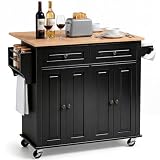
The VEVOR cart packs cabinet storage, two drawers and a drop leaf into a footprint just over 43 inches wide, so it suits apartments and small dining nooks where a 51 inch island would crowd the walkway.
- 43.58 in wide, black finish
- Swivel wheels for rolling between prep and dining spots
- 2 drawers plus a storage cabinet
- Drop leaf, spice rack and towel rack
Pros: compact width; spice and towel racks built in; enclosed cabinet hides small appliances.
Cons: no stools or power outlet in the listing title; the drop leaf is a light-duty perch, not a full dining table.
Skip it if you want a built-in outlet or a stool set included in the box.
Rolling Island Feature Comparison
Use this table to narrow the list by the two features that most often decide a purchase: whether seating is included and whether the island has built-in power. Where a listing does not state a feature clearly, we have marked it “See maker page” rather than guessing.
| Model | Listed Width | Stools Included | Built-In Power | Standout Feature |
|---|---|---|---|---|
| Keyluv 51” Storage Island (Black) | 51 in | Yes, 2 | Yes | Side storage rack and two drawers |
| Keyluv 51.2” Storage Island (White) | 51.2 in | Yes, 2 | Yes | Bright white finish, full bundle |
| Shintenchi Folding Drop Leaf (Brown) | 39.8 in wide, 24.8 in deep | No | Not listed | Rustic look, cabinet with 3-tier shelf and 3 drawers |
| Shintenchi Drop Leaf (Black) | 40 in long, 16 in deep | No | Not listed | Black-and-natural finish, adjustable shelves |
| Shintenchi with Storage (White) | 40 in long, 22 in deep | No | Not listed | Microwave-cart layout, about 75 lb |
| HUAHUU 43″ Rolling Island (White) | 43 in | Yes | Yes (outlet and USB) | Hidden wheels, adjustable shelf |
| VASAGLE 47.2″ with Pegboard | 47.2 in | No | Yes, power strip | Pegboard tool wall |
| VASAGLE with Trash Can Storage | See maker page | See maker page | See maker page | Hidden trash can bay |
| Casual Home Breakfast Cart | See maker page | Yes, 2 | No | Compact breakfast-cart format |
| YITAHOME with LED Lights | See maker page | Yes, 2 soft stools | Yes | LED lighting |
Measure Your Kitchen Before You Buy
The most common regret with a rolling island is buying one that fits the room on paper but blocks the path between the sink, stove, and refrigerator in practice. Before ordering, measure the floor space with the drop leaf extended, not folded, because that is the footprint you will live with during meals. A simple trick is to mark the island’s full dimensions on the floor with painter’s tape and walk around it for a day.
Kitchen designers generally recommend at least 36 inches of clear walkway around an island, about 42 inches for a work aisle used by one cook, and closer to 48 inches when two people regularly cook together. In a small apartment you may not hit those numbers on every side, and that is exactly where a rolling cart earns its keep: you can park it against a wall for daily life and pull it out only when you need the extra surface or seating.
Match Counter Height to Your Stools
Most rolling islands are built close to standard counter height, around 36 inches, so they line up with your existing countertops for a continuous prep surface. Counter-height stools with a seat height of roughly 24 to 26 inches pair with that top. Bar-height stools, usually 28 to 30 inches, are meant for 42-inch bar surfaces and will leave knees jammed against the underside of a counter-height drop leaf.
A useful rule is to leave about 10 to 12 inches between the stool seat and the underside of the top. If an island includes stools, the manufacturer has already done this math. If you are buying stools separately for a Shintenchi or VASAGLE model, check the island’s listed height first and choose stools to match.
Top Materials and How They Hold Up
The work surface takes the most abuse, so it deserves a closer look than the cabinet color. Each common material has its own strengths and quirks:
- Rubberwood and other solid wood tops: Warm looking and can be sanded and re-oiled if scratched, but need occasional conditioning and should not sit wet for long periods.
- Laminate over MDF or particleboard: Affordable and easy to wipe down, but edges can swell if water seeps into exposed seams, and hot pans can mark the surface.
- Stainless steel: Handles heat and moisture well and is easy to sanitize, though it shows fingerprints and can feel more commercial than homey.
- Painted or lacquered finishes: Clean and modern, but chips and scratches are more visible than on wood grain.
Whatever the material, use a cutting board for chopping and a trivet for hot cookware. That single habit does more to keep an island looking new than any finish choice.
Frame Construction and Load Ratings
Rolling islands carry their weight on four small casters, so construction quality matters more than it does for stationary furniture. Look for a stated weight capacity for the main top and, where available, a separate rating for the drop leaf, which is almost always lower because it relies on hinges and brackets rather than the cabinet frame. Metal frames and reinforced back panels resist racking when the cart is pushed across the floor, while lightweight particleboard carcasses can loosen at the joints over time.
Keep heavy items like stand mixers, cast iron, and stacked dishes on lower shelves to keep the center of gravity low. Reserve the extended leaf for plates, serving bowls, laptops, and elbows rather than countertop appliances.
Drop Leaf, Fixed Overhang, or Flip-Up Extension?
Not every island marketed for seating uses the same mechanism. A true drop leaf hangs down against the cabinet when not in use and swings up on brackets, which keeps the folded footprint as small as possible. A fixed overhang is always extended, offering a sturdier dining edge but a larger permanent footprint. Flip-up or slide-out extensions fall in between and are common on compact carts. If your kitchen is tight and you only seat people occasionally, a drop leaf is the most space-efficient choice. If the island will serve as your everyday dining spot, a fixed overhang or a very stiff leaf bracket is worth prioritizing.
Smart Ways to Use a Drop Leaf Island in a Small Kitchen
A rolling island earns its place by doing several jobs. These layouts help you get more value from the same piece of furniture:
- Wall-side breakfast bar: Park the island against a wall with the leaf raised toward the room for a two-person dining spot that frees up the dining table.
- Counter extension: Roll it flush to the end of an existing counter to create a peninsula-style prep run for big cooking days.
- Coffee or beverage station: Models with outlets, like the Keyluv, VASAGLE, and YITAHOME picks, can hold a coffee maker or kettle with mugs and supplies stored below.
- Party buffet: Move it into the dining or living room and raise the leaf to serve drinks, appetizers, or a dessert spread.
- Baking center: Store flour, sugar, sheet pans, and mixing bowls below so everything for a baking session lives in one mobile unit.
- Homework or laptop desk: Between meals, the raised leaf gives kids or remote workers a perch close to the kitchen.
When styling the island, match its hardware or finish to one existing element in the kitchen, such as cabinet pulls or the faucet, so it reads as part of the room rather than an add-on. A small tray for oils and salt keeps the top tidy and is easy to lift off when you need the full surface.
Beyond those core picks, the four additional islands fill specific gaps. The YITAHOME model packs stools, power, and lighting into one bundle, while the VASAGLE pegboard island delivers countertop power without seating. Choose the VASAGLE trash can model if hiding the kitchen bin matters most, and the Casual Home breakfast cart if you need a compact two-seat dining spot more than cabinet storage.
Rolling Kitchen Island Cart with Drop Leaf Seating: Best Picks by Space, Seating and Load
If you only read one section, start here. The top three by full name are the Keyluv 51″ Kitchen Storage Island with 2 Stools for an all-in-one bundle, the Hlivelood 55″ Movable Kitchen Island for the largest eating surface, and the Merax 55.7″ Kitchen Cart Island with 2 Drop Leaves for seating on both sides. The lists below group the carts with the clearest published specs by the problem they solve, with one spec line per pick.
Best Rolling Kitchen Island Carts Under 48 Inches Wide
- HUAHUU 43″ Rolling Kitchen Island with Seating: 43 in wide · hidden wheels · stools included · adjustable shelf · spice rack
- VEVOR Kitchen Island Cart 43.58 in: 43.58 in wide · swivel wheels · 2 drawers · drop leaf · spice and towel racks
- VASAGLE 47.2-Inch Island with Power Strip and Pegboard: 47.2 in wide · power strip · pegboard · stools sold separately
- IRONCK Kitchen Island with Charging Station (KC-KD-02): 47.25 x 15.35 in · 280 lb rated load · 4 casters, 2 braked · one drawer
Best Drop Leaf Islands With Stools in the Box
- Keyluv 51″ Kitchen Storage Island with 2 Stools: 2 stools · built-in outlet · 2 drawers · side rack and towel rack
- Yayzy 53″ Rolling Kitchen Island with 2 Bar Stools: stools rated 220 lb each · 3 AC outlets and 2 USB ports · 70 lb leaf rating
- YITAHOME Rolling Island with LED Lights and Stools: 2 soft stools · LED lighting · outlet · 2 drawers
- Casual Home Drop Leaf Breakfast Cart with 2 Stools: stools store with the cart · open shelving · no outlet
Best for Heavy Use and a Bigger Work Surface
- Merax 55.7″ Kitchen Cart Island with 2 Drop Leaves: 400 lb on the center top · two 47 x 7.87 in leaves · 3 AC outlets and 2 USB ports
- Hlivelood 55″ Movable Kitchen Island: rubberwood top slides to a 47.2 x 29.5 in table · 180 lb rated load · 5 casters, 2 lockable
- HOMCOM 53″ Rolling Kitchen Island with Power Outlet: 53 in wide · wood top · built-in outlet · drop leaf · stools not listed
- homestyles Dolly Madison Drop Leaf Kitchen Cart (5980-95): solid hardwood top · 53.5 x 17.25 in · 4 lockable casters · no outlets
Pick by the constraint you cannot change. A kitchen under 10 feet wide points to the sub-48-inch group, a household with no stools points to the bundle group, and anyone who plans to run a mixer or a coffee maker on the cart should start with the heavy-use group and read the rated load on the listing.
Frequently Asked Questions
How much floor space does a rolling kitchen island with a drop leaf actually need?
You need to account for both the folded footprint and the extended footprint once the leaf is open. Measure your available floor space in both states, including clearance for anyone seated at the leaf to pull a stool in and out comfortably, before choosing a cart width.
Can these carts replace a full, built-in kitchen island?
They can replace many of the functional roles of a fixed island — extra prep surface, additional storage, and casual seating — without the renovation cost or permanence. They are generally lighter-duty than a built-in island, so very heavy daily prep work or large stand mixers are better suited to a counter or a dedicated built-in surface.
Do I need to buy bar stools separately?
It depends on the model. The two Keyluv carts, the HUAHUU cart, and the Yayzy, YITAHOME and Casual Home carts in this guide include stools in the purchase. The Shintenchi models generally provide the drop-leaf overhang for seating but do not include stools, so you will need to source compatible seating separately if you do not already own some.
How much weight can the drop leaf support?
Weight capacity for the drop leaf is not always published by the manufacturer. Where it is not listed, treat the leaf as suited to dining place settings and light prep tasks rather than heavy cookware or appliances, and check the listing’s questions-and-answers section or contact the seller directly if you need a specific figure before buying.
Will the wheels scratch my hardwood or tile floors?
This is not consistently specified across listings, so it is worth checking caster material directly in the product details or photos. As a general precaution, test the casters on your actual flooring once assembled and consider felt pads or locking the wheels when the cart is parked in one spot for extended periods.
Can I plug a blender or coffee maker directly into the cart?
Only the models with a built-in outlet or power strip support that directly: the two Keyluv islands, the HUAHUU 43″, the VASAGLE pegboard island, and the YITAHOME, Yayzy, Hlivelood, Merax, IRONCK and HOMCOM carts. The Shintenchi carts and the homestyles Dolly Madison do not list one, so you would need to run a cord from a nearby wall outlet if you want to power an appliance at the island.
How do I keep a white or light-colored cabinet surface looking clean?
Wipe the surface down after each use with a soft cloth and mild dish soap to prevent flour, sauce, or oil residue from setting in. Light finishes show marks more readily than darker ones, which is a general trait of light-colored kitchen furniture, so building a quick wipe-down into your routine helps the finish stay presentable.
What is the real difference between a rolling kitchen cart and a kitchen island?
A traditional kitchen island is a fixed, built-in structure that is part of the room’s permanent layout. A rolling kitchen cart with a drop leaf delivers many of the same functions — prep space, storage, and casual seating — on casters, so it can be repositioned or tucked away and does not require any renovation or permanent commitment to install.
Which of the six main carts is the easiest to move around a small kitchen daily?
The HUAHUU 43″ model is the most compact of the six main picks and uses a hidden-wheel design intended for a cleaner look when parked, which tends to suit smaller kitchens where the cart is being repositioned frequently. Larger carts like the 51-inch Keyluv models are better suited to open-plan spaces where frequent repositioning is less of a priority.
Is it normal for assembly to take more than an hour?
Yes, especially for models that include bundled seating or a dense feature set like an adjustable shelf and multiple drawers. Set aside a clear afternoon rather than squeezing assembly in before a meal, confirm every hardware bag against the parts list before starting, and assemble on a protected surface so you are not rushing through steps that affect how securely the drop-leaf hinge ends up mounted.
How tall should a rolling kitchen island be?
Most rolling islands are built close to standard counter height, around 36 inches, so the top lines up with your existing counters. That height pairs with counter stools that have a seat height of about 24 to 26 inches. Check the listed height before buying stools separately, since bar-height stools are too tall for a counter-height drop leaf.
How much space do I need around a rolling island?
Aim for at least 36 inches of clear walkway on any side people pass, and around 42 inches on the side where you cook. Measure with the drop leaf raised, because that is the largest footprint. The advantage of a rolling cart is that it can sit against a wall day to day and move into the room only when you need it.
How many people can sit at a drop leaf island?
Most rolling islands with a drop leaf seat two people comfortably. Plan on roughly 24 inches of leaf width per person so elbows do not collide. A 51-inch island can sometimes squeeze in a third person along the leaf side, but two seats is the realistic everyday capacity for most models.
Can I put a microwave or air fryer on a rolling island?
Yes, as long as it sits on the main top rather than the drop leaf and stays within the island’s weight rating. Leave space around the appliance for ventilation, lock the casters before use, and route the power cord so it cannot snag when someone walks past. Islands with built-in outlets make this much tidier.
What should not go on the drop leaf?
Avoid placing heavy appliances, stacks of cast iron, or anyone’s full body weight on the extended leaf, since it is supported by hinges and brackets rather than the cabinet frame. Hot pans should go on a trivet, and liquids should be wiped up quickly on laminate or wood tops to prevent swelling and staining.
Can a drop leaf island replace a dining table?
For one or two people in a small apartment, it often can. A drop leaf island with stools handles quick breakfasts and casual dinners well. Families who eat together nightly or host often will usually still want a separate dining table, using the island as a prep station and overflow seating.
What is the best rolling kitchen island cart with drop leaf seating for a small kitchen?
The HUAHUU 43″ Rolling Kitchen Island with Seating is the most compact all-in-one pick here, with stools included. Under 48 inches wide you can also choose the VEVOR 43.58 in cart, the VASAGLE 47.2 in pegboard island or the IRONCK KC-KD-02, whose 15.35 in depth leaves the most walkway.
Which rolling kitchen island in this guide has the highest listed weight capacity?
The Yayzy 53″ and the Merax 55.7″ both list 400 lb on the main top. The IRONCK KC-KD-02 lists 280 lb and the Hlivelood 55″ lists 180 lb. Leaves are rated far lower, with the Yayzy listing 70 lb for its drop leaf, so keep heavy appliances on the main top.
Will a rolling kitchen island tip if someone leans on the drop leaf?
A leaf supported only by hinges or brackets can flex and shift a light cart if you lean on it, so lock the casters first. Park the cart against a wall in dining mode, keep heavy items on the lower shelves, and treat the leaf as a place for plates and elbows, not a seat.
What should I put on a rolling kitchen island cart?
Keep daily-use items on top: a cutting board, a fruit bowl, a small tray for oils and salt, and one countertop appliance if the cart has an outlet. Store heavier gear such as a stand mixer, cast iron or stacked sheet pans on the lower shelves or in the cabinet.
Final Verdict
For most buyers who want a single, complete purchase that covers prep space, storage, seating, and appliance power without any additional shopping, the Keyluv 51″ Kitchen Storage Island with 2 Stools (Black) is the strongest all-around pick in this lineup, backed by its built-in outlet and generous 51-inch surface. Buyers who want the same completeness in a brighter finish should look to the Keyluv 51.2″ White version instead, accepting the slightly higher maintenance that comes with a light surface.
Buyers working with a smaller kitchen, and who already own their own stools, are better served by the Shintenchi line, where the Storage model in White is the lightest build and doubles usefully as a microwave cart. For a compact kitchen that still wants a dense feature set — seating, spice storage, adjustable shelving — the HUAHUU 43″ island is the most feature-rich option relative to its footprint. Whichever model fits your kitchen, confirm floor clearance with the leaf extended and verify stool compatibility before you buy, since those two details decide more about daily satisfaction with a rolling island than color or brand ever will.