Key takeaways
- Audible alarms: Appropriate when the user can hear a buzzer and is usually near the dispenser. Look for adjustable volume and alarm duration.
- Flashing lights: Helpful for people with hearing loss, but not sufficient by themselves if the dispenser is placed in a dim room.
- Voice prompts: Useful for users who benefit from spoken reminders, provided the volume and language settings are suitable.
- Mobile notifications: Better for caregivers who live elsewhere. Confirm whether alerts require a phone app, Wi-Fi, cellular service, or a paid monitoring plan.
- Missed-dose handling: Some units keep the dose inaccessible until the next release; others continue alerting or notify a caregiver. This distinction matters when a late dose could overlap with the next one.
The best automatic pill dispensers depend on how many doses you need, whether someone must be prevented from taking extra medication, and whether the dispenser can stay near a reliable outlet: for most households, a locked, plug-in model with at least 28 dose compartments is the safest all-round choice, while a compact timed carousel suits simpler routines.
Our top picks


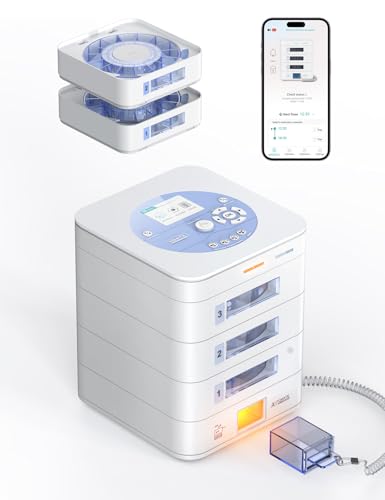
As an Amazon Associate we earn from qualifying purchases at no extra cost to you. Ratings are shown as listed on Amazon.
Quick picks by medication routine
| Situation | Best dispenser type | Useful capacity | Why it fits |
|---|---|---|---|
| One person, one or two daily dosing times | Timed rotating carousel | 28–42 compartments | Simple setup, low countertop footprint, audible reminder |
| Several medicines taken throughout the day | Large locked automatic dispenser | 28–90 doses, depending on dose frequency | More separation between morning, midday, evening, and bedtime doses |
| Caregiver needs missed-dose notifications | Connected dispenser with an app or monitoring service | Usually a multi-day medication supply | Can send alerts when a dose is not collected |
| Frequent travel or no convenient outlet | Battery-operated timed dispenser | 28–42 doses | Portable and less dependent on furniture placement |
| Risk of double-dosing or medication sharing | Locked, caregiver-filled unit | 28–90 doses | Releases only the scheduled portion and limits access to the reservoir |
What separates the best automatic pill dispensers
Dose capacity is not the same as days of medication
A dispenser advertised with 28 compartments may hold 28 individual doses, not 28 days. If a person takes four separate doses each day, 28 compartments provide only seven days of medication. A 42-dose carousel provides roughly 10 days and 12 hours at four doses per day, assuming each compartment is filled for one scheduled event.
Before comparing models, write down the number of scheduled dose events per day and multiply it by the number of days you want between refills. Also check whether a compartment can hold all the tablets in one event. Large tablets, capsules, and irregular shapes may require more space than the nominal compartment count suggests.
Reminder controls should match the user, not just the product label
- Audible alarms: Appropriate when the user can hear a buzzer and is usually near the dispenser. Look for adjustable volume and alarm duration.
- Flashing lights: Helpful for people with hearing loss, but not sufficient by themselves if the dispenser is placed in a dim room.
- Voice prompts: Useful for users who benefit from spoken reminders, provided the volume and language settings are suitable.
- Mobile notifications: Better for caregivers who live elsewhere. Confirm whether alerts require a phone app, Wi-Fi, cellular service, or a paid monitoring plan.
- Missed-dose handling: Some units keep the dose inaccessible until the next release; others continue alerting or notify a caregiver. This distinction matters when a late dose could overlap with the next one.
A reminder is not a medication-management decision. Ask a pharmacist or prescriber how a missed dose should be handled, especially for medicines that affect blood pressure, blood clotting, seizures, insulin, or pain.
Head-to-head: three useful dispenser designs
Timed rotating carousel
This is the familiar round dispenser with separate compartments arranged around a rotating tray. It is generally the most affordable option, usually around $50–$150, and works well for a predictable schedule. Many models hold 28 or 42 dose compartments and use batteries, although some include an AC adapter.
Its advantages are straightforward loading, relatively small size, and no recurring service requirement. Its limitations are equally important: the compartments may be too shallow for bulky doses, and basic versions usually cannot tell a caregiver whether medication was actually taken. A carousel is a good choice when a responsible user needs prompts but does not need strong access control.
Locked automatic dispenser
A locked unit encloses the medication tray and exposes only the dose scheduled for release. Examples of this product category include the Med-E-Lert, Medacube, and MedReady systems, though capacities and features vary by model and configuration. These dispensers commonly cost about $150–$400, with some higher when monitoring or service is included.
The main benefit is control: a person cannot easily remove tomorrow’s doses, spill the entire supply, or accidentally take several scheduled portions at once. The trade-off is refill work. Some units use removable trays, while others require individual compartments or medication cups to be loaded in sequence. Check the instructions before buying if a family member or caregiver has limited hand strength or vision.
Connected medication dispenser
Connected systems, such as Hero’s medication-management device, are designed for routines where a remote caregiver needs status information. Depending on the plan and configuration, they may offer reminders, refill prompts, missed-dose notifications, or a service that organizes medication. Initial hardware and ongoing subscription costs can be higher than those of a standalone carousel.
Connectivity is also the vulnerability. A device may need Wi-Fi, Bluetooth, cellular coverage, or a smartphone. Ask what happens during an internet outage, power interruption, expired subscription, or router change. A connected dispenser should still provide a clear local alarm if remote features stop working.
Refill ease: the detail that determines whether the device gets used
Refilling is usually the first task to become frustrating. Look for a tray or cassette that lifts out without turning the whole machine upside down. Printed dose labels, wide openings, and a clear loading sequence reduce errors. A caregiver filling seven days of four-times-daily medication is handling 28 dose events; a confusing tray can turn a weekly routine into a repeated sorting problem.
Compare these practical details before purchase:
- Can the tray be removed while the dispenser remains plugged in?
- Can compartments accept tablets of different sizes without crushing them?
- Does the unit distinguish morning from evening doses with labels or colors?
- Can you temporarily pause a schedule for a doctor’s appointment or travel?
- Is there a low-medication warning, and does it indicate the tray is nearly empty rather than merely unlocked?
Do not combine different medicines in one compartment unless a pharmacist confirms that the medicines can be stored together. Moisture, light, and tablet coatings can affect some medications.
Locking features, placement, and power requirements
A locked dispenser is not automatically tamper-proof. Examine whether the lid, tray, or power cord can be reached by children or pets. Place the unit on a stable surface roughly 28–32 inches high if the user will load or operate it while standing, or on a reachable table about 24–30 inches high if the user is seated. Leave at least 3 inches of clearance around vents and moving parts, and enough space above the lid for a tray to lift out.
For a bedside table, measure both the footprint and the cord path. A typical carousel may occupy approximately 8–10 inches in diameter, while a larger locked dispenser can require about 10–14 inches of width and 8–12 inches of depth. On a small nightstand, a lamp, water glass, and the dispenser may not fit safely together. A nearby dresser or dedicated medication shelf can be better than forcing everything onto the bedside surface.
Battery-operated models are useful for renters, travel, and rooms where a cord would create a trip hazard. Replaceable batteries also provide some protection during an outage, but check how long the alarm and motor can run on one set. Plug-in models are better for permanent placement and frequent schedules; choose one with battery backup if a missed release would be dangerous. Keep the adapter connected directly or use a properly rated power strip rather than an unsecured extension cord.
Decision checklist before you buy
- Count dose events: Calculate daily doses, not just medications. A person taking five medicines at breakfast may need one compartment, while a person taking one medicine five times daily needs five.
- Measure the largest dose: Include tablets, capsules, split tablets, and any small packets.
- Choose access control: Use an open reminder carousel for independence; choose a lock when double-dosing, confusion, or unauthorized access is a concern.
- Decide who receives alerts: If it is a caregiver, verify app compatibility and whether a subscription is required.
- Plan for outages: Prefer battery backup or a documented manual-release procedure.
- Test the location: Confirm the dispenser is visible, reachable, stable, and away from heat, steam, children, and pets.
Bottom line
The best automatic pill dispensers are not necessarily the ones with the largest reservoirs or the most connected features. Choose a 28–42-dose rotating model for a simple, predictable routine; a locked high-capacity unit when access and double-dosing are the main risks; and a connected dispenser when a remote caregiver needs notifications. The right choice is the one that matches dose frequency, refill ability, power availability, and the user’s actual living space.