Key takeaways
- An 8-inch chef knife is the default size; 6-inch suits small hands and tight boards, 10-inch suits large boards and big produce.
- German-style steel is usually softer and tougher, easier to sharpen and forgiving; Japanese-style steel is usually harder and holds a finer edge but can chip if twisted or used on bones.
- Balance and handle shape matter as much as the blade: a pinch grip prefers a balance point at the bolster, while a handle grip prefers a fuller, rounder handle.
- Hand-wash and dry every knife, and keep a honing steel or fine stone nearby, whatever the steel.
- We did not personally use these knives. This list is built from product listings, maker information and general knife knowledge.
The best chef knife for most home cooks is an 8-inch blade with a stainless steel that holds an edge, a balance point near the heel, and a handle that suits the way you grip it. For a budget workhorse, that points to the Victorinox Fibrox Pro; for a forged German classic, the Wüsthof Classic; for a thinner, harder Japanese-style edge, the Shun Classic or the Tojiro Professional. Which of these is right depends on steel type, balance and handle shape more than on brand, so this guide breaks each of those down before the picks.
Our top picks

As an Amazon Associate we earn from qualifying purchases at no extra cost to you.
Key takeaways
- An 8-inch chef knife is the default size; 6-inch suits small hands and tight boards, 10-inch suits large boards and big produce.
- German-style steel is usually softer and tougher, easier to sharpen and forgiving; Japanese-style steel is usually harder and holds a finer edge but can chip if twisted or used on bones.
- Balance and handle shape matter as much as the blade: a pinch grip prefers a balance point at the bolster, while a handle grip prefers a fuller, rounder handle.
- Hand-wash and dry every knife, and keep a honing steel or fine stone nearby, whatever the steel.
- We did not personally use these knives. This list is built from product listings, maker information and general knife knowledge.
Comparison table
| Pick | Style | Steel / construction (as listed) | Best for | Cost tier |
|---|---|---|---|---|
| Victorinox Fibrox Pro 8 inch | Western | Stainless, TPE non-slip handle, dishwasher safe per listing | Value and everyday cooking | Low to mid |
| Mercer Culinary Renaissance 8 inch | Western | Renaissance line, M23510 | Budget forged-style feel | Low to mid |
| Wüsthof Classic 8 inch | German forged | Forged blade, edge retention per listing | Long-term all-rounder | High |
| ZWILLING Professional S 8 inch | German forged | Company-owned German factory, special formula steel | Rock-chop and pinch-grip users | High |
| Shun Classic 8 inch | Japanese | VG-MAX core, Damascus cladding, pakkawood | Fine slicing and precise cuts | High |
| Tojiro Professional 8.2 inch (21 cm) | Japanese gyuto | VG10, hand made, flagship model | Thin, sharp, lighter feel | Mid to high |
| Shun Kanso 8 inch | Japanese | AUS10A stainless, Tagayasan handle | Simple, plain-wood style | Mid |
How we chose
We did not personally use any of these knives. This is a research-based guide built from the product listings, the maker descriptions available at the time of writing, and widely documented differences between German and Japanese knife design. We looked for real, currently listed 8-inch chef knives, kept at most two per brand, and covered a spread of steel types, handle shapes and cost tiers so that most buyers can find a fit. We left out renewed units, cheap multi-knife bundles, and knives whose listings did not clearly describe the blade steel. Anything we could not confirm is described as “check the maker page” rather than guessed.
We judged each pick on five points: blade steel and construction as listed, balance and handle shape, ease of maintenance, how forgiving it is for everyday tasks, and how well it suits a particular kind of cook.
1. Victorinox Fibrox Pro 8 Inch: Best for everyday value
- Victorinox Fibrox Pro 8 Inch Chef’s Knife
- Listing: dishwasher safe, ergonomic TPE non-slip handle, built for professional chopping
- Western-style blade, light to medium feel
- Textured polymer handle stays grippy when wet
- Cost tier: low to mid
Best for: home cooks who want one dependable knife that does not require much care and does not cost a lot. It is the usual first recommendation for good reason: the handle is comfortable for many hand sizes, the blade is simple to sharpen, and you will not worry about a scratch or a stain.
Skip if: you want a showpiece, a very thin blade or a heavy forged feel. The listing recommends hand-washing for long-term edge care even though dishwasher use is mentioned; check the maker’s care page.
Pros:
- Non-slip handle for wet hands
- Easy to sharpen and maintain
- Strong value for a pro-grade blade
- Replaceable without guilt in a rental kitchen
Cons:
- Plain look
- Lightweight feel may not suit people who like a heavy knife
2. Mercer Culinary Renaissance 8 Inch: Best for a forged feel on a budget
- Mercer Culinary M23510 Renaissance, 8-Inch Chef’s Knife
- Western-style, from Mercer’s Renaissance line
- Full details such as steel grade: check the maker page
- Handle styled for a classic riveted look
- Cost tier: low to mid
Best for: cooks who like the look and heft of a traditional riveted knife without paying forged-German prices. It makes sense as a second knife for a guest kitchen or as a step up from a plain stamped blade.
Skip if: you need documented steel hardness and a long brand track record in the high-end segment, or you prefer a thin, light blade.
Pros:
- Classic styling at an approachable cost tier
- Sturdy handle with a familiar feel
- Straightforward to hone and sharpen
Cons:
- Specs beyond the listing are limited, so check the maker page
- Less refined fit and finish than premium brands
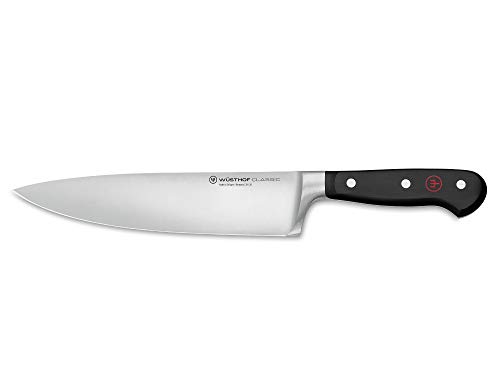
3. Wüsthof Classic 8 Inch: Best forged German all-rounder
- WÜSTHOF Classic 8″ Chef’s Knife, Black
- Listing: forged blade offers excellent edge retention
- Full bolster, triple-riveted style handle
- Western profile with a curved belly for rocking
- Cost tier: high
Best for: cooks who rock the blade on the board, use a pinch grip, and want a knife they can keep for many years. The forged construction gives it a stable, substantial feel, and the full bolster protects the fingers and adds balance at the heel.
Skip if: you want a very light knife or a thin edge that glides through tomatoes with almost no pressure. A full bolster also makes sharpening the heel more awkward unless you learn the technique.
Pros:
- Forged, durable construction
- Balanced feel for rocking cuts
- Widely supported with replacement and sharpening services
- Resists chipping better than very hard steels
Cons:
- Higher cost tier
- Heavier than Japanese-style blades
- Needs regular honing
4. ZWILLING Professional S 8 Inch: Best for a bolstered pinch grip
- ZWILLING Professional S 8-inch Razor-Sharp German Chef’s Knife
- Listing: made in the company-owned German factory, special formula steel
- Full bolster and riveted handle
- Rounded handle intended to feel secure in a big grip
- Cost tier: high
Best for: people who hold the knife with a firm pinch grip and want a dependable German design with a rounded handle. It is a natural alternative to the Wüsthof if you prefer a different handle shape.
Skip if: you have small hands and find full bolsters bulky, or you prefer a lighter blade.
Pros:
- German-made, with a manufacturer-stated special-formula steel
- Comfortable rounded handle for many grips
- Strong all-purpose profile
Cons:
- High cost tier
- Weightier than thin Japanese blades
- Check the maker page for exact hardness and care guidance
5. Shun Classic 8 Inch: Best Japanese-style for precise slicing
- Shun Classic 8″ Chef’s Knife, handcrafted Japanese kitchen knife
- VG-MAX core with Damascus stainless cladding
- Pakkawood handle, D-shaped for a right-hand grip
- Thinner, harder blade than German forged knives
- Cost tier: high
Best for: cooks who slice more than they chop, prefer a light touch, and want a fine, keen edge for vegetables, fish and herbs. Because the steel is harder, it tends to hold sharpness longer, though it is less forgiving of twisting or contact with bones and frozen food.
Skip if: you are left-handed and want a symmetrical handle (the Classic handle is D-shaped, so check the maker’s left-hand option), or you tend to use the knife for hard, heavy tasks.
Pros:
- Fine, sharp edge profile
- Attractive Damascus cladding
- Lighter feel that reduces fatigue in long prep sessions
- Wood handle with a comfortable, secure shape
Cons:
- Harder steel can chip if misused
- Needs a sharpening plan with a stone or a trusted service
- Higher cost tier
6. Tojiro Professional 8.2 Inch: Best for a thin Japanese gyuto edge
- TOJIRO JAPAN Professional Chef Knife, 8.2 inch (21 cm)
- Listing: hand made, flagship model, VG10 steel, easy maintenance
- Gyuto profile, a Japanese take on the chef knife
- Plain, utilitarian handle
- Cost tier: mid to high
Best for: cooks who want a thin, light, sharp blade that cuts cleanly, without paying for decorative cladding. It is a good bridge for someone moving from a German knife to a Japanese gyuto.
Skip if: you rock-chop heavily or use the knife for hard ingredients. Thinner blades prefer a push or slicing motion and a wooden or soft plastic board.
Pros:
- VG10 steel as listed
- Slender, agile blade
- Understated look with practical appeal
- Lower cost than some cladded Japanese options
Cons:
- Not as forgiving of twisting
- Handle styling is plain
- Check the maker page for full care instructions
7. Shun Kanso 8 Inch: Best plain-wood Japanese look
- Shun Kanso 8″ Chef’s Knife
- AUS10A stainless steel blade
- Tagayasan handle, a dense, dark wood
- Handcrafted Japanese kitchen knife per listing
- Cost tier: mid
Best for: cooks who want Japanese-style sharpness with a simpler, matte look, and who like the feel of a natural wood handle. It sits in the middle of the Shun range, which can make it easier to justify than the cladded models.
Skip if: you want the Damascus pattern of the Classic or prefer a rubberized handle that stays grippy when wet.
Pros:
- AUS10A steel as listed
- Clean, minimal look
- Comfortable wood handle
Cons:
- Wood handles need drying and occasional care
- Harder steel needs gentle use
Also consider
- HENCKELS Classic 8-Inch Chef Knife · fully forged construction · German engineered per listing · a lighter-feeling forged alternative to the Wüsthof
- Shun Sora 8-inch Chef’s Knife · VG10 steel edge with 420J stainless body · a lower-cost entry to the Shun lineup
- HOSHANHO 8 inch Japanese high carbon steel chef knife · non-slip handle per listing · a lesser-known brand, so check the maker information before buying
- Mercer Culinary Millennia 8-inch Chef’s Knife · black handle · a stamped, budget-friendly option
Buying guide: how to choose the best chef knife for your hands
Steel type: German vs Japanese
German-style knives typically use softer, tougher stainless steel, often in the mid-to-high 50s on the Rockwell hardness scale. They are forgiving, easy to hone, and shrug off minor abuse. Japanese-style knives typically use harder steel, often in the low 60s, which holds a finer edge longer but can chip if you twist the blade or hit a bone. Maker specifications vary, so check the maker page for each model rather than assuming.
A rough rule of thumb is that softer steel needs more frequent honing but is easier to sharpen, and harder steel needs less frequent sharpening but more careful use. If you cut mostly vegetables, boneless proteins and herbs, either will serve you well.
Blade length
Eight inches is the standard size for a reason: it is long enough to handle a large onion or a cabbage and short enough to control on a normal-sized board. Go to 6 inches if you have small hands or a tiny board, and to 10 inches if you often cut large produce and have a long board and strong grip. Leave at least a few extra inches of board beyond the blade length so your knuckles have room.
Balance and weight
Hold the knife at the bolster or just ahead of the handle and see where it balances. A forged German knife tends to balance near the bolster and feels substantial; a Japanese-style knife tends to feel lighter and more blade-forward. Neither is right or wrong. Heavy knives do some of the work for you in tough cuts, while light knives tire your hand less in long prep sessions.
Handle shape and grip
- Pinch grip (thumb and forefinger pinching the blade base): a full bolster is comfortable and a rounded handle helps.
- Handle grip (all fingers on the handle): choose a full, rounded handle so nothing digs into your palm.
- Left-handed cooks: look for symmetrical handles. D-shaped handles like some Japanese models are shaped for right-handed use, so check the maker’s left-hand versions.
- Wet-hand safety: textured polymer handles such as the Victorinox Fibrox are grippier than polished wood.
Edge angle and sharpening
German-style knives typically have a wider edge angle per side than Japanese-style knives, which makes them tougher but a little less keen. Sharpening is a skill worth learning: a whetstone, a guided system or a mail-in service all work. Honing between sharpenings realigns the edge, but it does not remove metal.
Care and storage
- Hand-wash and dry immediately, even if a listing says dishwasher safe, because dishwashers dull edges and can damage handles.
- Use a wooden or soft plastic board, never glass, stone or ceramic.
- Store in a block, on a magnetic strip or in a sheath, not loose in a drawer.
- Do not cut frozen food or bones with a thin, hard blade.
- Hone before each session, and sharpen when honing no longer restores the edge.
Which cost tier makes sense?
One good 8-inch chef knife does most of the work in a kitchen, so spend your budget there first. For most cooks, the low-to-mid tier (Victorinox, Mercer) provides excellent value. The high tier buys better materials, finish and brand support, but the performance gain over a good mid-tier knife is smaller than the price jump. Spend more only if you will use, sharpen and care for the knife properly.
Fit, finish and what wears first
Look at the spine and heel when you unbox a knife. A smooth, rounded spine is kinder to your index finger during long prep sessions, and a heel that sits a little above the board lets your knuckles clear the surface. On forged knives the bolster and tang are where cheaper construction shows; a seamless transition and tight rivets suggest careful assembly. On wood-handled knives such as the Shun Classic and Shun Kanso, the handle is the first part to show wear if the knife sits wet, so dry it after washing and keep it out of standing water. Polymer handles such as the Victorinox Fibrox hold up to wet kitchens but can feel plain. The edge itself is the part that changes most with use, which is why a honing steel and a sharpening plan deserve a place in the budget alongside the knife.
Common mistakes when buying a chef knife
- Buying a set before finding the one knife you reach for. Most cooks use a single chef knife for the majority of tasks, so choose that first and add a paring and a bread knife later.
- Choosing by steel hardness alone. A very hard blade you are afraid to use is worse than a tougher one you use daily.
- Ignoring handle size. A handle that feels slightly too small or too large becomes tiring within minutes of chopping.
- Skipping a board upgrade. A hard board undoes the benefit of a good edge.
- Leaving the knife in a drawer without protection, where the edge gets knocked against other tools.
Match your cooking style to a knife
| Your habit | Look at | Why |
|---|---|---|
| Rock-chop herbs and onions | Wüsthof Classic, ZWILLING Professional S | Curved belly and full bolster support rocking |
| Thin slicing of vegetables and fish | Shun Classic, Tojiro Professional | Thin, hard edge cuts with little pressure |
| Rental kitchen, light use | Victorinox Fibrox Pro, Mercer Renaissance | Low cost, low worry |
| Wet hands, messy prep | Victorinox Fibrox Pro | Non-slip handle |
| Gift for a serious home cook | Shun Kanso, Wüsthof Classic | Premium feel and brand recognition |
FAQ
What is the best chef knife for a beginner?
The Victorinox Fibrox Pro 8 inch is a safe start because the handle is grippy, the steel is easy to sharpen and the cost tier is low. It lets you learn technique without worrying about damaging an expensive blade.
Is a German or Japanese chef knife better?
Neither is better overall. German knives are tougher and more forgiving, while Japanese knives are thinner and hold a finer edge but need more careful use. Choose by how you cut and how you maintain knives.
Is 8 inches the right size?
For most home cooks, yes. Choose 6 inches for small hands and boards, or 10 inches if you cut large produce regularly and have the board space.
How often should I sharpen a chef knife?
It depends on use and steel. Hone before most uses and sharpen when the edge no longer slices a tomato cleanly. Many home cooks sharpen once or twice a year, though heavy users sharpen more often.
Can I put a chef knife in the dishwasher?
Some listings say a knife is dishwasher safe, but hand-washing protects the edge and handle. Follow the maker’s care instructions.
Are expensive chef knives worth it?
Up to a point. A good mid-tier knife handles almost any job. Premium knives offer better fit, finish and sometimes harder steel, which matters if you cook daily and maintain your tools.
What cutting board should I use?
Wood or soft plastic is gentlest on the edge. Glass, ceramic and stone boards dull a blade quickly.
Which one should you buy?
If you want a single reliable knife without fuss, buy the Victorinox Fibrox Pro 8 inch. If you want a forged German classic that rocks well and will last for years, choose the Wüsthof Classic or the ZWILLING Professional S depending on which handle feels better in your hand. If you slice more than you chop and like a thin edge, go with the Shun Classic or the Tojiro Professional. If the budget is tight and you like a traditional look, the Mercer Renaissance is the economical choice, and the Shun Kanso fits a plain-wood Japanese style.
If you can, hold the knife before you buy it; handle shape and balance matter as much as any spec. Most chef knives are returnable, so use the first few uses to see how the grip feels.
One last tip: if two knives feel equally good, pick the one whose maker publishes clear care and sharpening guidance and whose handle you are happy to hold for twenty minutes of chopping. A knife you enjoy using gets used and maintained, which in the end matters more than a small difference in steel.
Sources
- Victorinox, Wüsthof, ZWILLING, Shun (Kai) and Tojiro maker product pages
- Retail product listing text for each knife
- Maker knife-care and sharpening guides
- General steel hardness and edge-angle references from knife makers
Last updated: November 2026
More from Amazon
Programs that pair well with the guide above. Offers and eligibility are set by Amazon and may change.
Collect the home and kitchen items you want in one registry that guests can shop from.
Create a wedding registrySet up recurring deliveries of everyday items on eligible products. Terms and savings are set by Amazon.
Explore Subscribe & SaveFree shipping on eligible items, Prime Video and more. Eligible new members can start with a free trial.
Start a Prime free trialAudiobooks and podcasts to listen to on the go. Eligible new members can start with a free trial.
Try Audible freeAs an Amazon Associate we earn from qualifying purchases.