Key takeaways
- Compare the best manual knife sharpeners for home kitchens, from guided clamp and rolling systems to compact pull-through models, with specs and FAQs.
The best manual knife sharpener for most home kitchens is the Work Sharp Precision Adjust, because its clamp and angle dial remove the guesswork that makes freehand sharpening frustrating. Pick a guided system if your knives are genuinely dull, a rolling sharpener if you value a polished edge and tidy storage, and a compact pull-through if you only need quick maintenance between bigger sessions.
Manual sharpeners cover a wide range, from clamp-and-rod systems that hold the blade at a set angle while you work the abrasive along the edge, to palm-sized pull-through tools with preset slots that trade precision for speed. The five models below span that range and differ in angle control, abrasives, and serrated support.
As an Amazon Associate, we earn from qualifying purchases.
Quick Answer
The Work Sharp Precision Adjust is the best manual knife sharpener for most home kitchens because its clamp and dial hold any angle from 15 to 30 degrees. The HORL 2 is the premium rolling pick, the Chef’sChoice ProntoPro 4643 handles 15 and 20-degree knives plus serrated blades, and the KitchenIQ Edge Grip is the compact budget choice.
Table of Contents
- Work Sharp Precision Adjust Knife Sharpener
- HORL 2 Walnut Rolling Knife Sharpener
- Chef’sChoice ProntoPro 4643 Manual Knife Sharpener
- Zwilling V-Edge Knife Sharpener
- KitchenIQ 50009 Edge Grip 2-Stage Knife Sharpener
- How to Choose
- Who Should Skip
- FAQ
- Conclusion
Work Sharp Precision Adjust Knife Sharpener
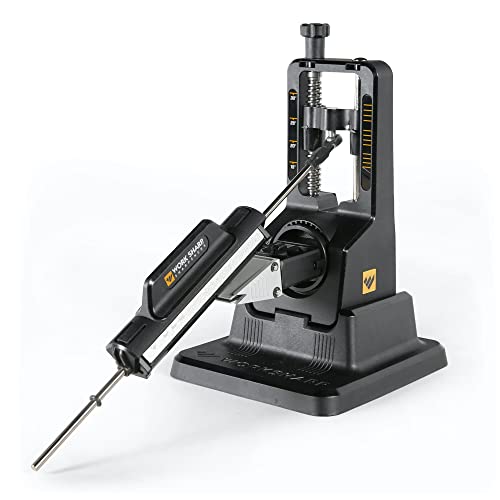
The Precision Adjust is a guided clamp system: the knife locks into a V-Block Clamp, a dial sets the angle anywhere from 15 to 30 degrees in 1-degree steps, and a sliding rod carries the abrasive along the edge. Because the clamp holds the blade and the dial holds the angle, the two variables that ruin freehand results are taken out of your hands. It is the pick for knives that have gone properly dull and need a repeatable edge, not just a touch-up.
The Tri-Brasive rod carries three abrasive faces on one handle: a 320-grit diamond plate to restore a worn edge, a 600-grit diamond plate to refine it, and a fine ceramic stone to hone it. Faces rotate into place and are individually replaceable. The trade-off is pace: clamping and working both sides takes a few minutes per knife, so this is a session tool rather than a quick fix before dinner.
Specs
- Type: Guided clamp system with sliding abrasive rod
- Sharpening angle: Adjustable from 15 to 30 degrees in 1-degree increments
- Abrasives: 320-grit coarse diamond plate, 600-grit fine diamond plate, fine ceramic hone
- Clamp: V-Block Clamp on a benchtop base
- Serrated blades: Not stated
- Dimensions: 6.5 x 9.6 x 5.61 inches
- Weight: Not stated
- Model: WSBCHPAJ
- Warranty: 3 years
HORL 2 Walnut Rolling Knife Sharpener

The HORL 2 takes a different route. The knife sits against a magnetic angle support, and the sharpener is a cylinder that rolls along the blade, spinning its grinding disc through planetary gearing as it travels. One side carries a diamond grinding disc; flip it over and the other side carries a ceramic honing disc. The support offers two fixed angles: 15 degrees for finer Japanese-style edges and 20 degrees for sturdier Western edges.
Because the blade stays still and the disc does the moving, the angle stays consistent from heel to tip without clamping. The walnut body lives in a drawer, and the discs are interchangeable, so worn abrasives can be swapped instead of replacing the whole tool. The limits are real, though: it is made for straight-edge knives, so serrated blades are out, and the fixed two-angle support gives less flexibility than a dial system.
Specs
- Type: Rolling sharpener with magnetic angle support
- Sharpening angles: 15 degrees and 20 degrees
- Abrasives: Diamond grinding disc and ceramic honing disc, interchangeable
- Material: Walnut
- Serrated blades: No
- Dimensions: 5.31 x 4.72 x 2.56 inches
- Weight: 1.74 pounds
- Model: HO2N
- Origin: Made in Germany
Chef’sChoice ProntoPro 4643 Manual Knife Sharpener
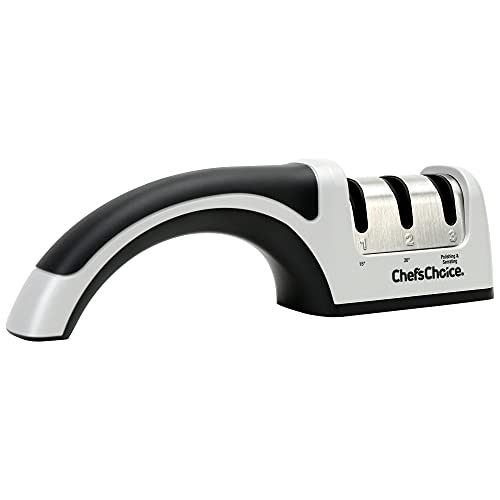
The ProntoPro 4643 is a pull-through sharpener built around diamond abrasives and angle choice. It has dedicated slots for 15-degree Asian-style knives and 20-degree European and American knives, so a mixed drawer does not force one edge geometry onto every blade. A separate slot handles serrated knives, which most manual systems either ignore or damage. You draw the blade through with light pressure; preset guides hold the angle.
Diamond abrasives in every stage mean reshaping a dull edge and refining it happen in the same tool, with no cord and no setup. The long, slim body stores in a utensil drawer. What you give up versus a clamp system is fine control: the angles are fixed at the two presets, and results depend on keeping your draw stroke straight.
Specs
- Type: Manual pull-through sharpener
- Sharpening angles: 15-degree slot for Asian-style knives, 20-degree slot for European and American knives
- Abrasives: Diamond abrasives
- Serrated blades: Yes, dedicated serrated slot
- Dimensions: 9.25 x 2 x 2 inches
- Weight: Not stated
- Model: 4643009
Zwilling V-Edge Knife Sharpener

The V-Edge is a tall pull-through unit built around two ceramic rods arranged in a V profile. You pull the blade down and through the V, and the rods contact both sides of the edge at once, which helps keep the stroke centered from heel to tip. The rods are double-sided, coarse for sharpening and fine for honing, and rotate inside the housing to switch grits.
Its distinguishing feature is the set of interchangeable angle adapters. One suits Western blades and another suits Japanese blades, so the same unit covers both edge styles in a typical home collection. The maker’s manual limits it to double-edged straight knives made of stainless steel, so serrated blades and single-bevel knives should go elsewhere. It suits cooks who want guided pull-through convenience with more deliberate, two-sided contact than basic slot sharpeners give.
Specs
- Type: Pull-through sharpener with V-shaped ceramic rods
- Sharpening angles: Interchangeable adapters for Western and Japanese blades
- Abrasives: Ceramic rods with coarse and fine sides
- Serrated blades: No
- Dimensions: Not stated
- Weight: Not stated
- Model: 32605-000
KitchenIQ 50009 Edge Grip 2-Stage Knife Sharpener

The Edge Grip is the smallest tool here, a palm-sized two-stage pull-through that lives in a drawer and comes out for quick work. The coarse slot uses carbide blades at preset angles to bring a dull knife back, and the fine slot uses ceramic rods to finish the edge and handle everyday touch-ups. A few pulls per slot is the whole routine, making it the easiest sharpener here to use weekly.
Its patented V-shaped base is the clever part: the bottom is shaped to sit on the edge of a counter or table as well as flat on top of it, so the tip of a long chef’s knife clears the surface instead of dragging across it. The base is non-slip and the handle has a soft grip. The fine ceramic slot also handles serrated blades, per the maker. Preset slots mean no angle adjustment, and the carbide slot removes metal quickly, so this is a maintenance tool for everyday knives rather than a precision instrument for premium blades.
Specs
- Type: Compact pull-through sharpener, 2-stage
- Stages: Coarse carbide slot, fine ceramic slot
- Sharpening angle: Preset by the slots
- Base: Patented V Edge Grip bottom for countertop or counter-edge use, non-slip
- Serrated blades: Yes, fine slot
- Dimensions: 3.74 x 2.05 x 1.77 inches
- Weight: Not stated
- Model: 50009
How to Choose
Start with how dull your knives are. A blade that slides across a tomato skin needs abrasive work to rebuild the edge, which points to the Precision Adjust or the ProntoPro 4643. A blade that is mostly sharp but feels tired needs only honing, where the Edge Grip or the fine side of the V-Edge is enough.
Match the sharpener to your edge angles. Western knives are usually ground near 20 degrees per side and Japanese knives nearer 15. A sharpener with the wrong fixed angle will slowly regrind your edge to its own geometry. Adjustable systems like the Precision Adjust cover everything; two-angle tools like the HORL 2 and the ProntoPro cover the two common standards; single-preset tools suit drawers where every knife shares one style.
Decide how much process you will tolerate. Clamp systems give the most repeatable results and ask the most time. Rolling sharpeners sit in the middle, with a short learning curve and quick sessions. Pull-through tools are fastest and simplest, and their preset slots keep results consistent between users. Finally, check serrated support before you buy if bread knives matter to you: only the ProntoPro 4643 and the Edge Grip on this list are made for them.
Who Should Skip
Skip manual sharpeners if you want to restore a full set of neglected knives in one sitting and would rather let a motor do the work; an electric model is faster across many blades. Skip them, too, if your knives have chips, bent tips, or broken points. Sharpeners maintain and restore edges, but real damage needs coarse stone work or a professional repair first.
Owners of single-bevel Japanese knives should look elsewhere: none of these five is designed for single-bevel geometry, and running one through a double-bevel slot will round the flat side. If your knives are ceramic, none of these applies either; ceramic blades need maker-approved diamond systems only.
FAQ
Are manual knife sharpeners better than electric ones?
Neither is better for everyone. Manual sharpeners remove less metal per pass, cost nothing to run, store in a drawer, and give you control over the angle, which suits cooks who sharpen a few knives at a time. Electric models are faster across a whole set and need almost no technique. For most home kitchens, a manual sharpener covers routine maintenance well.
What is the difference between 15-degree and 20-degree edges?
The angle describes how thin the edge is ground on each side. A 15-degree edge is thinner and slices with less resistance, which is why Japanese knives use it, but it is more delicate. A 20-degree edge is thicker and tougher, suiting heavier Western knives and harder use. Sharpen each knife at its factory angle unless you deliberately want to change it.
Can a manual sharpener fix a very dull knife?
Yes, as long as the edge is dull rather than damaged. Start with the coarsest abrasive the sharpener offers, the 320-grit diamond plate on the Precision Adjust or the carbide slot on the Edge Grip, and work until the edge feels even along its length, then move to the finer abrasives. Chips and bent tips need repair before sharpening.
Can manual sharpeners sharpen serrated knives?
Some can. A serrated edge is sharpened by working the beveled side of the teeth, and only sharpeners with a dedicated serrated slot or a suitable ceramic rod are built for it. On this list, the ProntoPro 4643 and the Edge Grip cover serrated blades. Never pull a serrated knife through a standard straight-edge slot, which can flatten the teeth.
Conclusion
For most home kitchens, the Work Sharp Precision Adjust is the safest buy: its clamp and dial make a consistent edge repeatable, and its three abrasives handle everything from dull to nearly sharp. The HORL 2 is the pick if you prefer a compact rolling system and your knives are straight-edged. The ProntoPro 4643 suits mixed drawers with serrated blades, the Zwilling V-Edge offers two-sided ceramic contact with adapters for both knife traditions, and the Edge Grip is the small tool you will reach for every week. Choose by your knives’ angles and their dullness, and any of the five will keep a home kitchen cutting properly.
Product and ASIN Reference
| Product | ASIN |
|---|---|
| Work Sharp Precision Adjust Knife Sharpener | B08L72P245 |
| HORL 2 Walnut Rolling Knife Sharpener | B08JYKN185 |
| Chef’sChoice ProntoPro 4643 Manual Knife Sharpener | B007IVBET0 |
| Zwilling V-Edge Knife Sharpener | B07WZPNLB2 |
| KitchenIQ 50009 Edge Grip 2-Stage Knife Sharpener | B001CQTLJM |
More from Amazon
Programs that pair well with the guide above. Offers and eligibility are set by Amazon and may change.
Collect the home and kitchen items you want in one registry that guests can shop from.
Create a wedding registrySet up recurring deliveries of everyday items on eligible products. Terms and savings are set by Amazon.
Explore Subscribe & SaveFree shipping on eligible items, Prime Video and more. Eligible new members can start with a free trial.
Start a Prime free trialAudiobooks and podcasts to listen to on the go. Eligible new members can start with a free trial.
Try Audible freeAs an Amazon Associate we earn from qualifying purchases.