Key takeaways
- Find the best Vortex long range scope for precision shooting, hunting, and competition. Compare magnification, reticles, turrets, and glass before you choose.
The best Vortex long range scope is the one that matches your rifle, your cartridge, and the distances you actually shoot. Vortex makes long range optics at several levels, from an entry-level first focal plane scope to a flagship competition optic, and the differences are real: tube diameter, elevation travel, reticle design, and illumination all change how far you can dial and how clearly you can see a small target at distance.


The quick answer: for most shooters building a first serious long range rifle, the Viper PST Gen II 5-25×50 is the balanced pick, with a proven first focal plane reticle, a zero stop, and enough magnification for steel well past 800 yards. Shooters on a tighter budget should look at the Venom 5-25×56, while the Diamondback Tactical 6-24×50 is the simplest way into long range shooting. At the top end, the Razor HD Gen III 6-36×56 is the choice for dedicated precision rifle competition.
Quick Picks
Our Short List of 3

All 4 Picks at a Glance
| Product | Specs | Action |
|---|---|---|
| 1. Vortex Optics Razor HD Gen III 6-36×56 FFP Riflescope – EBR-7D Reticle (B09PNRVGZM) | Check price on Amazon | |
| 2. Vortex Optics Viper PST Gen II 5-25×50 FFP Riflescope (B07VFNV3NT) | Check price on Amazon | |
| 3. Vortex Optics Venom 5-25×56 FFP Riflescope – EBR-7C (MOA) Reticle (B095PQ4L45) | Check price on Amazon | |
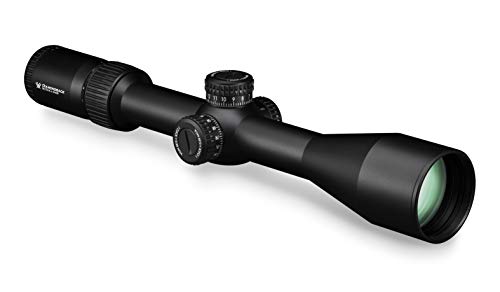 4. Vortex Optics Diamondback Tactical 6-24×50 FFP Riflescope – EBR-2C (MOA) Reticle (B07G8MF1L3) | Check price on Amazon |
How to Choose
Magnification Range and Objective Lens Size
A 5-25x scope covers a wide range: 5x is low enough to find a target and shoot at moderate distance, while 25x is enough to aim precisely at steel and paper at long range. A 6-24x scope follows the same logic. A 6-36x scope adds a very high top end for small targets and extreme distance, but it also adds weight, a tighter eye box at full power, and more mirage on a hot day.
A 50 mm objective balances light gathering and size, while a 56 mm objective gathers more light and usually pairs with a larger tube and more adjustment travel. The trade is bulk: a 56 mm scope needs taller rings. For a rifle carried in the field, a 50 mm scope is often more practical; for a bench or prone rifle, a 56 mm scope makes more sense.
First Focal Plane Versus Second Focal Plane
For long range shooting, first focal plane is the standard choice, and every scope in this guide uses one. In a first focal plane scope, the reticle grows and shrinks with the image as you change magnification, so the holdover marks stay accurate at every power setting. That matters when you hold for wind or elevation instead of dialing, because the marks mean the same thing at 10x as they do at 25x.
In a second focal plane scope, the reticle stays the same size while the image changes, so the holdover marks are only accurate at one magnification, usually the highest setting. That works for hunting at a fixed power, but it adds a step to long range shooting.
Reticle Design: MOA or MRAD, and the Holdover Tree
The reticle is the aiming tool inside the scope, and at long range it does more than mark the center of the target. A Christmas tree reticle, such as the EBR-7C found on three of the scopes in this guide, adds fine hold points below the center and to the sides, so you can hold elevation and wind without turning the turrets. That is useful for fast follow-up shots and for wind that changes between shots.
MOA versus MRAD is a choice of measurement system, not quality. MOA moves the point of impact in fractions of an inch at 100 yards, a system many American shooters already know. MRAD moves it in tenths of a milliradian, a decimal system that pairs neatly with metric rangefinders and ballistic apps. Match the reticle to the turrets: MOA reticle with MOA turrets, MRAD reticle with MRAD turrets. Mixing the two forces a conversion on every shot, which is slow and invites mistakes.
Turret Travel, Zero Stop, and Tracking
Elevation travel decides how far you can dial before the turret runs out. A scope with 70 MOA of travel, such as the Viper PST Gen II, can reach long range with most flat-shooting cartridges, especially on a canted base that tilts the scope forward and leaves more upward travel. A scope with 110 MOA of travel, built on a 34 mm tube, gives far more room, which matters for cartridges with more drop, for rimfire trainers, and for shooting well past 1,000 yards.
A zero stop is a mechanical limit that stops the elevation turret from turning below your zero. After you dial up for a distant target, you can return to zero by turning the turret down until it stops, without counting clicks. The Viper PST Gen II uses the RZR zero stop, the Venom uses the RevStop zero system, and the Razor HD Gen III has a locking zero system. The Diamondback Tactical has exposed turrets but no zero stop, so you must count clicks to return to zero.
Tube Diameter and Mounting
Tube diameter does affect adjustment range and mounting. A 30 mm tube is the long-running standard for precision scopes, and it supports the elevation travel of the Viper PST Gen II and the Diamondback Tactical. A 34 mm tube is larger and stiffer, and it allows more internal adjustment travel, which is why the Venom and the Razor HD Gen III use it. The trade is weight and ring choice: a 34 mm scope needs 34 mm rings or a 34 mm mount.
Before you buy, check the mounting length against your rifle. A long scope on a short action can leave too little room for the rings, and a large objective bell can touch the barrel if the rings are too low. Confirm the ring height clears the objective bell and the bolt handle, and that the eye relief puts your eye in the right place when the rifle is shouldered naturally.
Eye Relief and Weight
Eye relief is the distance between the ocular lens and your eye when the image is full and clear. All four scopes here give roughly 3.4 to 3.9 inches, enough for most centerfire rifles. What changes with magnification is the eye box, the range of head positions that still give a full image. At low power it is forgiving, and at full power it tightens, so small head movements can cut off the edge of the image.
Weight matters too. At around 24 ounces, the Diamondback Tactical is easy to carry and balances well on a hunting-weight rifle. At around 31 ounces, the Viper PST Gen II suits a heavier precision rifle shot from a bipod or rest. At around 35 ounces, the Venom, and at around 45 ounces, the Razor HD Gen III, belong on rifles built to carry that weight.
The Best Vortex Long Range Scope Reviewed
1. Vortex Optics Razor HD Gen III 6-36×56 FFP Riflescope – EBR-7D Reticle (B09PNRVGZM)
The Razor HD Gen III 6-36×56 is the flagship long range scope in the Vortex line, built for shooters who need the most magnification, the most adjustment travel, and the finest glass Vortex makes for a riflescope. The 6-36x range covers finding a target at low power and aiming at a small plate at extreme distance, and the 56 mm objective gathers light for a bright image in poor conditions. The first focal plane EBR-7D reticle is a detailed Christmas tree design for precise holds at any magnification.
Built on a 34 mm tube, it gives extensive elevation travel for dialing at very long range, with exposed, locking turrets for repeatable adjustments and a clear zero system. At around 45 ounces and just over 15 inches long, it needs a solid 34 mm mount and a rifle built to carry it.
Who it suits: dedicated precision rifle competitors and shooters who regularly engage small targets at extreme distance, where optical performance and adjustment range matter more than weight. Who should skip it: shooters who carry their rifle a long way, and anyone who wants a light, compact optic for a hunting rifle.
2. Vortex Optics Viper PST Gen II 5-25×50 FFP Riflescope (B07VFNV3NT)
The Viper PST Gen II 5-25×50 is the balanced pick in this guide, covering the core long range features without the weight and bulk of a flagship scope. The 5-25x range suits steel and paper from moderate distance to well past 800 yards, and the 50 mm objective keeps the scope compact enough for a rifle that is carried as well as shot from a rest. The first focal plane reticle comes in EBR-7C and EBR-2C versions, in MOA and MRAD, with illumination and ten brightness levels for low light use.
The 30 mm tube gives 70 MOA of elevation travel in the MOA version, and a canted base adds usable upward travel for longer shots. The RZR zero stop returns the elevation turret to zero with a positive stop, the tactical turrets are exposed and easy to read, and the side parallax focuses from 25 yards to infinity, so the same scope works on a rimfire trainer and a centerfire precision rifle. At 31.2 ounces and just under 16 inches long, it balances well on a heavy-barrel precision rifle in 6.5 Creedmoor, 308 Winchester, or a similar cartridge.
Who it suits: shooters building a first serious long range rifle, competitors who want a proven first focal plane scope with a zero stop, and hunters who shoot at long range from a fixed position. Who should skip it: shooters who need the elevation travel of a 34 mm tube for extreme distance, and shooters who want the lightest scope for a rifle carried far.
3. Vortex Optics Venom 5-25×56 FFP Riflescope – EBR-7C (MOA) Reticle (B095PQ4L45)
The Venom 5-25×56 is the entry point into a full-size first focal plane long range scope from Vortex, for shooters who want the 5-25x range and a 34 mm tube without stepping up to the Viper PST Gen II or the Razor HD Gen III. The 56 mm objective gathers more light than a 50 mm scope, and the 34 mm tube gives generous elevation and windage travel for dialing at long range. The first focal plane EBR-7C reticle gives accurate holds at any magnification, and the included throw lever makes magnification changes fast.
The Venom includes the RevStop zero system for a reliable return to zero, exposed tactical turrets, and a single-piece aircraft-grade aluminum tube that is waterproof, fogproof, and shockproof. It has no illuminated reticle, the clearest difference from the Viper PST Gen II and the Razor HD Gen III, so low light shooting relies on the glass and reticle alone. At 35 ounces and just over 15 inches long, it suits a rifle shot from a bipod or rest more than a rifle carried all day.
Who it suits: new long range shooters who want a 5-25x first focal plane scope with a lot of elevation travel, shooters building a budget precision rifle who still want a 34 mm tube, and rimfire precision shooters. Who should skip it: shooters who need an illuminated reticle for low light work, and shooters who want the lightest scope in this guide.
4. Vortex Optics Diamondback Tactical 6-24×50 FFP Riflescope – EBR-2C (MOA) Reticle (B07G8MF1L3)
The Diamondback Tactical 6-24×50 is the simplest and lightest long range scope in this guide, and a good place to learn the fundamentals of dialing, holding, and reading wind. The 6-24x range covers long range shooting on steel and paper, and the 50 mm objective keeps the scope compact. The first focal plane EBR-2C reticle is a Christmas tree design with hold points for elevation and wind, so you can practice holds at any magnification.
Built on a 30 mm tube, it has exposed tactical turrets, side parallax from 10 yards to infinity, and a fast-focus eyepiece. It has no illuminated reticle and no zero stop, which keeps the design simple and the weight down to 24.6 ounces, but you must count clicks or watch the turret to return to zero. The field of view runs from 18 feet at 6x to 4.5 feet at 24x at 100 yards, enough to find a target at low power and aim precisely at high power.
Who it suits: shooters learning long range fundamentals, shooters building a light precision rifle or a rimfire trainer, and anyone who wants a first focal plane scope with a holdover reticle at the lowest weight in this guide. Who should skip it: shooters who need a zero stop or an illuminated reticle, and shooters who plan to dial at extreme distance.
What to Check Before You Buy
Start with the rifle and the cartridge. A flat-shooting cartridge in 6.5 Creedmoor or a similar chambering needs less elevation travel than a cartridge with more drop, and a rimfire trainer needs far more than either at the same distance. Confirm the scope has enough travel for the distances you plan to shoot, and remember that a canted base adds usable upward travel.
Check the reticle and turret units together. Choose MOA or MRAD and keep that system across the scope, the ballistic app, and the rangefinder when you can. Confirm the reticle version: the EBR-7C and EBR-2C reticles look similar at a glance, but the hold points and center design differ, and the MOA and MRAD versions are separate listings.
Check the mount before you check out. Confirm the tube diameter, the ring height, and the mounting length. A 34 mm scope needs 34 mm rings, a 56 mm objective needs taller rings than a 50 mm objective, and a long scope needs enough rail space for both rings. Torque the rings to the value in the scope manual, level the reticle, and confirm the bolt handle clears the ocular housing.
Check the warranty. Vortex backs these scopes with an unlimited, unconditional lifetime warranty that covers repair or replacement if the scope becomes damaged or defective, and that warranty is transferable.
FAQ
What magnification do I need for long range shooting?
For most long range shooting, a 5-25x or 6-24x scope is enough. The low end helps you find the target, and the top end gives a precise aim point on steel and paper. A 6-36x scope adds reach for small targets and extreme distance, but it also adds weight and a tighter eye box, so choose it only when the rifle and the shooting justify it.
Is first focal plane better than second focal plane for long range?
For long range shooting, first focal plane is the better choice for most shooters, because the holdover marks stay accurate at every magnification. That matters when you hold for wind or elevation instead of dialing. Second focal plane scopes work well for hunting at a fixed power, but they add a step to long range work.
Should I choose MOA or MRAD?
Choose the system you already know, or the system your spotter and shooting partners use. MOA is familiar to many American shooters, and MRAD pairs neatly with metric rangefinders and ballistic apps. Match the reticle to the turrets and keep the same system across your scope, app, and rangefinder.
How much elevation travel do I need?
It depends on the cartridge and the distance. A flat-shooting centerfire cartridge needs less travel than a rimfire at the same distance, and shooting past 1,000 yards needs more travel than shooting at 600 yards. A scope with 70 MOA of travel covers a wide range of centerfire use, especially on a canted base, while 110 MOA gives far more room for extreme distance and rimfire work.
Can one Vortex scope work for hunting and long range target shooting?
Yes, with a trade. A 5-25×50 scope such as the Viper PST Gen II can serve both roles, but it is heavier and longer than a dedicated hunting scope. A lighter scope such as the Diamondback Tactical is easier to carry, but it gives up illumination and a zero stop. Choose based on which role you do most often.
Bottom Line
The best Vortex long range scope depends on how you shoot. Choose the Razor HD Gen III 6-36×56 for dedicated precision rifle competition and extreme distance. Choose the Viper PST Gen II 5-25×50 for a balanced first serious long range rifle, with a proven first focal plane reticle, a zero stop, and illumination. Choose the Venom 5-25×56 for a 5-25x first focal plane scope with a 34 mm tube and generous elevation travel on a tighter budget. Choose the Diamondback Tactical 6-24×50 for the lightest way into long range shooting.
Disclosure: As an Amazon Associate, we may earn from qualifying purchases.
More from Amazon
Programs that pair well with the guide above. Offers and eligibility are set by Amazon and may change.
Collect the home and kitchen items you want in one registry that guests can shop from.
Create a wedding registrySet up recurring deliveries of everyday items on eligible products. Terms and savings are set by Amazon.
Explore Subscribe & SaveFree shipping on eligible items, Prime Video and more. Eligible new members can start with a free trial.
Start a Prime free trialAudiobooks and podcasts to listen to on the go. Eligible new members can start with a free trial.
Try Audible freeAs an Amazon Associate we earn from qualifying purchases.