Our Short List of 3

- Best for: Most four-speaker upgrades, and anyone who wants CEA-2006 rated output, Hi-Res bandwidth, and bridging flexibility for a later subwoofer.

- Best for: Compact and under-seat installations, factory-system upgrades, and efficient speakers needing moderate, clean RMS power.

- Best for: First-time amplifier owners and factory head unit upgrades who want guided, clipping-free gain setup.
All 4 Picks at a Glance
| Product | Specs | Action |
|---|---|---|
| 1. Pioneer GM-DX874 — Best Overall |
| Check price on Amazon |
| 2. Alpine S2-A36F — Best Compact Hi-Res Pick |
| Check price on Amazon |
| 3. Rockford Fosgate R2-300X4 — Best for Clean Setup |
| Check price on Amazon |
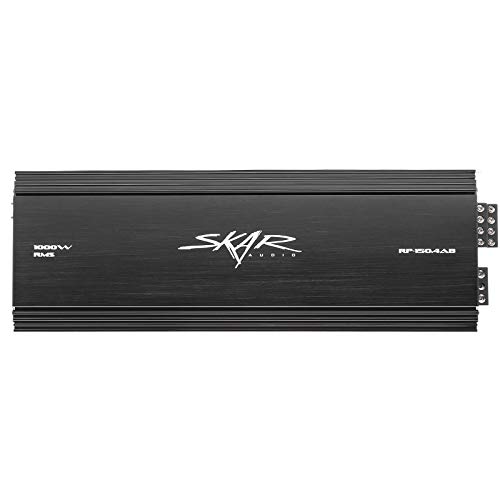 4. Skar Audio RP-150.4AB — Best High-Power Class A/B |
| Check price on Amazon |
Key takeaways
- Compare the best full range car amplifier picks: 4-channel full-range amps from Pioneer, Alpine, Rockford Fosgate and Skar Audio, by RMS power at 2 and 4 ohms, crossovers and CEA-2006 ratings.
Most factory car audio systems fail in the same place. The head unit is asked to power four speakers by itself, and its small built-in amplifier runs out of clean power long before the volume feels satisfying. Voices thin out, drums lose their edge, and turning the knob further adds distortion rather than loudness. The best full range car amplifier fixes that problem: it powers the door, dash, and rear speakers across the whole audible range, so they play louder, cleaner, and with far better control.
That definition decides everything here. Every pick is the same type of product: a multi-channel full-range car amplifier, built to run door speakers, component sets, and rear speakers. There are no monoblock subwoofer amplifiers in this list, because a monoblock is a single-channel amp tuned for bass only and cannot reproduce vocals or treble. No speakers or head units are mixed in either.
The comparison is based on published listing specifications — RMS power per channel at 4 ohms and 2 ohms, bridged output, class, crossovers, and CEA-2006 ratings — with no detailed research claim made. Match RMS output to your speakers, choose the channel count that fits your layout, and set the crossovers correctly, and a full-range amp is the most audible upgrade most cars can receive.
Disclosure: As an Amazon Associate, we earn from qualifying purchases made through links on this page, at no additional cost to you.
Quick Picks
- Best overall: Pioneer GM-DX874 — A bridgeable 4-channel Class D full-range amplifier rated at 100 watts RMS per channel at 4 ohms, Hi-Res Audio compatible, with flexible 4, 3, or 2-channel wiring.
- Best compact Hi-Res pick: Alpine S2-A36F — A small S-Series Class D 4-channel amplifier rated at 60 watts RMS per channel at 4 ohms, Hi-Res Certified, in a chassis made for tight spaces.
- Best for clean setup: Rockford Fosgate R2-300X4 — A Prime Series full-range Class D 4-channel amplifier rated at 50 watts RMS per channel at 4 ohms, with C.L.E.A.N. gain-setting circuitry and variable crossovers.
- Best high-power Class A/B: Skar Audio RP-150.4AB — A full-range Class A/B 4-channel amplifier rated at 150 watts RMS per channel at 4 ohms, for demanding component speakers that can use serious headroom.
How to Choose a Full Range Car Amplifier
Full-Range Versus Monoblock: The Distinction That Decides the Whole Purchase
A full-range amplifier reproduces the entire band your speakers need — roughly 20 Hz to 20,000 Hz, and in some models well beyond that. Every channel can drive a door speaker or a component set and reproduce bass guitar, vocals, and cymbals. A monoblock does the opposite job on purpose: one channel, with circuitry and low-pass filtering optimized for subwoofer frequencies only, so most of the music would be missing from a speaker connected to it.
A system may eventually need both jobs covered, but by different products: the full-range amp powers the speakers you listen to, and a separate monoblock, added later if wanted, powers a subwoofer. A 5-channel amplifier is the one hybrid worth knowing — four full-range channels plus a fifth subwoofer channel in one chassis — acceptable when its main section is a genuine full-range design. This guide prioritizes pure 4-channel full-range amplifiers, which are simpler to wire and right for most speaker-first systems.
Channel Count: 2, 4, or 5 Channels
Channel count is how many speakers the amplifier can drive independently. A 2-channel amp powers one pair, or can usually be bridged for a single subwoofer or a demanding front pair. A 4-channel amp is the natural default: one channel each for front-left, front-right, rear-left, and rear-right, preserving stereo imaging and fading.
Most 4-channel amps here are also bridgeable: two channels combine into one stronger channel. That opens up useful layouts — four speakers in 4-channel mode, a bridged rear pair powering a small subwoofer in 3-channel mode, or both pairs bridged for powerful front component sets. A 5-channel amp adds a dedicated subwoofer channel. Choose 4 channels if speakers are the priority; choose 5 only if you are certain you want speakers and a sub from one box.
RMS Watts: The Only Power Number That Matters
Listings advertise two power figures, and only one should guide a purchase. Peak power is a short-burst number that says almost nothing about everyday listening. RMS power is continuous power: what the amplifier can deliver steadily while music plays. Every comparison here uses RMS watts per channel.
Impedance changes the figure, so note which load a rating refers to. The same amplifier produces more RMS power into a 2-ohm load than a 4-ohm load, because lower resistance lets more current flow. Most car speakers are 4-ohm, so the 4-ohm rating is the one to match against a speaker’s RMS handling; the 2-ohm rating matters for 2-ohm speakers or parallel wiring. Bridged ratings are quoted per bridged channel at 4 ohms, and most amplifiers require a 4-ohm minimum bridged load even if 2-ohm stable in stereo. Aim for 4-ohm RMS output at or slightly above your speakers’ rating: headroom for clean peaks, without excess a careless gain setting could turn into damage.
CEA-2006 and CTA-2006: The Honest-Rating Standard
Because RMS claims are easy to inflate, the industry maintains a voluntary measurement standard — originally CEA-2006, now continued as CTA-2006 — specifying how power should be measured, including test voltage and distortion limits. An amplifier carrying that rating has had its figure produced under a common method, making it comparable across brands. Where a listing here states that rating, the reviews say so; where it does not, treat the figures as the manufacturer’s own specification and match them conservatively. Ignore any listing that leads with maximum wattage and never states RMS per channel at a named impedance.
Crossovers: HPF and LPF Do the System Tuning
A crossover decides which frequencies each channel plays, turning raw power into a coherent system. A high-pass filter, or HPF, blocks low bass from small speakers that cannot reproduce it, protecting door speakers and cleaning up their midrange. A low-pass filter, or LPF, does the reverse, for a bridged subwoofer channel. Full-range mode bypasses the filters for component sets with their own passive crossovers. Look for variable crossovers rather than a fixed switch point, because the right HPF setting depends on speaker size. A common starting point is around 80 Hz for door speakers when a subwoofer handles deep bass, or lower for larger speakers playing without a sub.
Class D Versus Class A/B, and Installation Basics
Class describes how the output circuitry works. Class D amplifiers switch their outputs rapidly, waste little energy as heat, and can be small and powerful at once — why three of the four picks here are Class D designs that fit under a seat. Modern full-range Class D is a mature technology, not the bass-only design some older advice describes. Class A/B, represented by the Skar Audio pick, is the older linear design: larger, warmer-running, and here delivering the highest per-channel RMS figures. Choose by space, power needs, and heat capacity.
Finally, check the signal path. All four picks accept RCA inputs from an aftermarket head unit. Factory head units usually lack RCAs, so speaker-level inputs or included adapters matter if you keep the stock radio, and signal-sensing turn-on removes the need for a separate remote wire. Wiring kits are not included, so budget for correct-gauge power and ground cable, an inline fuse, and speaker wire. Gains are not volume controls: set them to match the head unit’s output, using a clipping indicator where provided.
The Best Full Range Car Amplifiers, Reviewed
1. Pioneer GM-DX874 — Best Overall
- Best for: Most four-speaker upgrades, and anyone who wants CEA-2006 rated output, Hi-Res bandwidth, and bridging flexibility for a later subwoofer.
Most four-speaker upgrades, and anyone who wants CEA-2006 rated output, Hi-Res bandwidth, and bridging flexibility for a later subwoofer.
The Pioneer GM-DX874 is the most complete full-range answer in this guide. The listing describes a bridgeable 4-channel Class D — Pioneer calls the design Class FD — amplifier with CEA-2006 specifications of 100 watts RMS per channel into 4 ohms, 150 watts per channel at 2 ohms, and bridged output of 300 watts RMS per pair at 4 ohms. It can be wired as a 4-channel, 3-channel, or 2-channel amplifier, covering a four-speaker system today and a bridged speaker-plus-subwoofer layout later.
What lifts it above a merely powerful specification is the bandwidth. Pioneer lists it as Hi-Res Audio compatible, with frequency response extending to 50 kHz, gold-plated RCA terminals, and variable high-pass and low-pass filters. Honest CEA-2006 power, wide response, and flexible wiring are why this model leads the list. Confirm the listing’s included contents before ordering, including whether the wired bass boost remote is in the box, since bundles vary between sellers.
2. Alpine S2-A36F — Best Compact Hi-Res Pick
- Best for: Compact and under-seat installations, factory-system upgrades, and efficient speakers needing moderate, clean RMS power.
Compact and under-seat installations, factory-system upgrades, and efficient speakers needing moderate, clean RMS power.
The Alpine S2-A36F answers the other common problem in this category: where to put the amplifier. The Amazon listing describes an S-Series Class D 4-channel amplifier, Hi-Res Certified with response up to 40 kHz, rated at 60 watts RMS per channel at 4 ohms and 90 watts per channel at 2 ohms, in a compact footprint of 8.7 by 2.25 by 8.25 inches, with a two-sided terminal layout for confined installs.
Sixty honest watts per channel is well judged for this role: several times the clean output of a factory head unit, matching a wide range of replacement speakers, without demanding heavy-gauge cable runs or a large mounting surface. The listing also notes selectable, adjustable crossovers, a variable mid-bass EQ circuit, and an optional remote bass knob sold separately. Check the rating notes carefully, because the same family includes mono and 5-channel models whose figures should not be confused with this version.
3. Rockford Fosgate R2-300X4 — Best for Clean Setup
- Best for: First-time amplifier owners and factory head unit upgrades who want guided, clipping-free gain setup.
First-time amplifier owners and factory head unit upgrades who want guided, clipping-free gain setup.
The Rockford Fosgate R2-300X4 is the measured, installer-friendly pick. Listings describe a Prime Series full-range Class D amplifier, CEA-2006 rated at 50 watts RMS per channel at 4 ohms and 75 watts per channel at 2 ohms, with 150 watts RMS per bridged pair at 4 ohms — covering the standard four-speaker layout and the usual bridging options.
Its distinguishing feature is C.L.E.A.N. circuitry — a gain-setting system with clip indicators showing exactly where clean output ends and distortion begins. Incorrect gain setting is the most common reason a new amplifier disappoints or damages speakers, so a built-in visual reference addresses a real problem. Listings also describe variable crossovers, so channels can be high-passed for door speakers or configured for a bridged subwoofer channel. Fifty watts per channel will not win a specification contest against the Pioneer or Skar Audio picks, and it does not need to: matched to sensibly rated speakers, it is ample, honest power with the best setup assistance here.
4. Skar Audio RP-150.4AB — Best High-Power Class A/B
- Best for: High-output builds and power-hungry component speakers, and listeners who specifically want Class A/B amplification.
High-output builds and power-hungry component speakers, and listeners who specifically want Class A/B amplification.
The Skar Audio RP-150.4AB is the traditionalist powerhouse of this guide. Its published specifications describe a full-range Class A/B 4-channel amplifier rated at 150 watts RMS per channel at 4 ohms and 250 watts per channel at 2 ohms, with 500 watts RMS per bridged pair, frequency response from 20 Hz to 20,000 Hz, and 2-ohm stereo stability. Those are the largest per-channel figures here by a clear margin, suiting demanding component speakers that would leave a 50 or 60-watt amplifier short of headroom.
The trade-offs are the classic Class A/B ones, and should be planned rather than discovered. A linear amplifier of this output is larger and hotter-running than the Class D picks, so it needs open mounting space with airflow rather than a sealed under-seat cavity, and properly sized wiring. In return, the published manual lists adjustable gain, variable filtering, and bass EQ switching. Read the listing’s specification table before ordering: with this much RMS output, low-rated factory speakers would be a mismatch in the wrong direction.
Comparison Table
| Model | Class | Channels | RMS at 4 Ohms | RMS at 2 Ohms | Best Role |
|---|---|---|---|---|---|
| Pioneer GM-DX874 | Class D (Class FD) | 4 / 3 / 2 bridgeable | 100 W x 4 | 150 W x 4 | Best overall |
| Alpine S2-A36F | Class D | 4 | 60 W x 4 | 90 W x 4 | Best compact Hi-Res pick |
| Rockford Fosgate R2-300X4 | Class D | 4 | 50 W x 4 | 75 W x 4 | Best for clean setup |
| Skar Audio RP-150.4AB | Class A/B | 4 | 150 W x 4 | 250 W x 4 | Best high-power Class A/B |
Frequently Asked Questions
What makes an amplifier full-range, and why does it matter?
A full-range amplifier reproduces the whole audible band, roughly 20 Hz to 20,000 Hz, on every channel, so it can power speakers that must play vocals and instruments as well as bass. A monoblock cannot do that job: it has one channel filtered for low frequencies only. If the goal is better sound from the speakers you listen to, full-range is the requirement.
How many RMS watts per channel do my speakers actually need?
Start with your speakers’ RMS rating and choose an amplifier whose RMS output per channel at the same impedance is close to or modestly above it. Most replacement door speakers work well with the 50 to 100 watts RMS per channel offered by the Alpine, Rockford Fosgate, and Pioneer picks. High-output component sets can use the Skar Audio amplifier’s larger figure. Ignore peak wattage numbers for this matching exercise.
Can a 4-channel full-range amplifier also power a subwoofer?
Yes, bridged. Most 4-channel amplifiers let you bridge the rear pair into one stronger channel — 300 watts RMS at 4 ohms on the Pioneer pick — to drive a modest subwoofer while the front channels run the front speakers, using the low-pass filter for the subwoofer channel. That 3-channel layout is a good single-amp system. A large subwoofer deserves a dedicated monoblock, and a 5-channel amplifier is the one-box alternative if you plan the subwoofer from the start.
What does CEA-2006 or CTA-2006 compliance actually tell me?
It tells you RMS power was measured under a common industry method — CEA-2006, now continued as CTA-2006 — with defined voltage and distortion limits, rather than the manufacturer’s own looser method. Such ratings can be compared across brands with confidence. The Pioneer and Rockford Fosgate picks carry that rating; where an amplifier lacks it, compare its figures cautiously and never against a rival’s peak wattage.
Should I choose Class D or Class A/B for full-range speakers?
For most cars, full-range Class D is the practical default: efficient, cooler-running, and small, with modern designs reproducing the full band — including Hi-Res bandwidths up to 40 or 50 kHz on the Alpine and Pioneer models. Class A/B, like the Skar Audio pick, remains valid for high-output systems with room for a larger, warmer-running amplifier and wiring to support its current draw. Decide by space, heat, and power needs.
Conclusion
The best full range car amplifier is the one whose channels, RMS output, and crossovers match your speakers — not the one with the largest number on the box. The Pioneer GM-DX874 is the balanced default: CEA-2006 rated at 100 watts RMS per channel, Hi-Res bandwidth, and bridging flexibility. The Alpine S2-A36F delivers clean, Hi-Res Certified power from the smallest chassis here. The Rockford Fosgate R2-300X4 trades raw output for the most honest setup experience, with clip indicators that protect speakers from a bad gain setting. And the Skar Audio RP-150.4AB serves the high-output end with Class A/B power the others do not attempt. Decide your channel layout first, match RMS at 4 ohms second, set the high-pass filter and gains carefully third — and every speaker in the car, not just a subwoofer in the trunk, will finally be doing its job properly.
More from Amazon
Programs that pair well with the guide above. Offers and eligibility are set by Amazon and may change.
Collect the home and kitchen items you want in one registry that guests can shop from.
Create a wedding registrySet up recurring deliveries of everyday items on eligible products. Terms and savings are set by Amazon.
Explore Subscribe & SaveFree shipping on eligible items, Prime Video and more. Eligible new members can start with a free trial.
Start a Prime free trialAudiobooks and podcasts to listen to on the go. Eligible new members can start with a free trial.
Try Audible freeAs an Amazon Associate we earn from qualifying purchases.