Key takeaways
- Footprint and clearance: Measure the diagonal path to the room, not just the floor space. Single-person cabins run roughly 35 to 40 inches square with an interior height near six feet, and most need a few inches of breathing room behind the rear vent panel, so treat the listed dimensions as a minimum rather than the finished envelope.
- Heater layout over raw wattage: Total watts tell you how fast it heats; panel placement tells you how it feels. Look for heaters at the back, calves, and side walls rather than a single rear bank, since low-mounted panels are what make a seated session comfortable instead of a warm back and cold shins.
- Wood species and joinery: Canadian hemlock is the sensible default for indoor use, stable and close-grained without the resin bleed of softer pine. Check for tongue-and-groove panels and a clear, unfinished interior, and skip anything with visible filler or a sealed inner surface.
- Light, and what kind: Red light therapy panels and chromotherapy color lighting are not interchangeable. Targeted red light panels serve a specific purpose; seven-color LED strips are ambient mood lighting. Decide which one you actually want before paying for either.
- Power and placement: Nearly every one-person unit runs on a standard 110V outlet, but a 1200W to 1350W cabin should have that circuit largely to itself. Confirm the cord length, and site the cabin near an outlet you can reach without an extension lead.
What's inside
Infrared saunas have quietly migrated out of gym locker rooms and into spare bedrooms, home offices, and the odd corner of a finished basement. That shift creates a design problem the listings rarely address: you are not just buying a heat source, you are installing a piece of cabinetry that will occupy roughly the same square footage as an armchair and a half, permanently. Meanwhile the product pages blur together into an identical wash of hemlock panels, carbon heater counts, and Bluetooth logos, which makes it genuinely hard to tell a well-joined cabin from a flat-pack box with a good photographer.
This guide looks at single-person indoor infrared saunas through the lens of how they actually live in a home: footprint and ceiling clearance, wood species and grain quality, heater placement, light temperature, and whether the thing can run on a normal outlet without tripping your kitchen circuit. Below are the models worth shortlisting in 2026, followed by the specs that separate a ten-year fixture from a two-year novelty.
As an Amazon Associate we earn from qualifying purchases.


How to Choose an Indoor Infrared Sauna (2026)
- Footprint and clearance: Measure the diagonal path to the room, not just the floor space. Single-person cabins run roughly 35 to 40 inches square with an interior height near six feet, and most need a few inches of breathing room behind the rear vent panel, so treat the listed dimensions as a minimum rather than the finished envelope.
- Heater layout over raw wattage: Total watts tell you how fast it heats; panel placement tells you how it feels. Look for heaters at the back, calves, and side walls rather than a single rear bank, since low-mounted panels are what make a seated session comfortable instead of a warm back and cold shins.
- Wood species and joinery: Canadian hemlock is the sensible default for indoor use, stable and close-grained without the resin bleed of softer pine. Check for tongue-and-groove panels and a clear, unfinished interior, and skip anything with visible filler or a sealed inner surface.
- Light, and what kind: Red light therapy panels and chromotherapy color lighting are not interchangeable. Targeted red light panels serve a specific purpose; seven-color LED strips are ambient mood lighting. Decide which one you actually want before paying for either.
- Power and placement: Nearly every one-person unit runs on a standard 110V outlet, but a 1200W to 1350W cabin should have that circuit largely to itself. Confirm the cord length, and site the cabin near an outlet you can reach without an extension lead.
The Best Indoor Infrared Saunas (2026) Reviewed
1 Person Far Infrared Home Sauna with 7 Low EMF Carbon Heaters
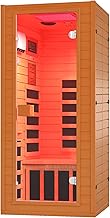
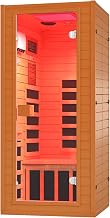
Seven distributed carbon panels give this compact cabin the most even heat envelope in the group, which matters more than peak temperature during a twenty-minute session. The seven-color therapy lighting and Bluetooth speakers are pleasant extras, but the heater spread is the real reason to shortlist it.
35.2″ Single Person Hemlock Sauna Room, 1200W
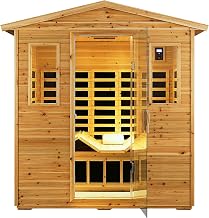
At 35.2 inches wide, this is the model for rooms where every inch is contested, and the 1200W panel array still climbs quickly through its adjustable 25–60°C range. The hemlock construction and glass front keep it from reading as a bulky appliance in a bedroom corner.
Canadian Hemlock 800W Sauna Spa Room
The tempered glass door and circulation vents make this the most open-feeling cabin here, a meaningful difference if enclosed spaces make you restless. At 800W it heats more gradually, which suits longer, lower-temperature sessions rather than a quick pre-shower warm-up.
1 Person Sauna with Red Light Beauty Glow, 1350W
The 308x220mm red light panel and 1350W five-plate layout make this the strongest post-workout option, reaching temperature fast enough for a session that fits between training and dinner. The oxygen ionizer and digital controller round out a genuinely well-equipped cabin.
Far Infrared Sauna Box with Red Light Therapy
A full-size 5.9ft footprint with carbon crystal heating and nine intensity levels, but collapsible, which makes it the honest answer for renters and shared spaces. You trade the presence of a wood cabin for the ability to reclaim the floor entirely.
Frequently Asked Questions
How long does an infrared sauna take to heat up?
Most one-person cabins reach a usable temperature in 10 to 20 minutes, with higher-wattage models like the 1350W and 1200W units at the faster end. Infrared warms your body directly, so you can step in before the air hits its setpoint.
Does low EMF actually matter?
Emissions from quality carbon heaters are low regardless, but shielded low-EMF panels cost little extra and remove a variable you would otherwise have to research per model. It is a reasonable box to tick rather than a headline feature.
Do I need special wiring or ventilation?
A standard grounded 110V outlet is sufficient, ideally not shared with other high-draw appliances. Built-in circulation vents handle airflow, though the room itself should not be fully sealed.
Can I put one in a bedroom or home office?
Yes, and that is where most single-person cabins end up. Compact plug-in models such as the hemlock cabin with digital temperature control are built specifically for apartments, small bedrooms, and office wellness corners.
Final Thoughts
For most homes, the 1 Person Far Infrared Home Sauna with seven low-EMF carbon heaters offers the best balance of even heat, footprint, and finish. Choose the 1350W Red Light Beauty Glow model if recovery is the priority and you want serious red light output, or the collapsible Far Infrared Sauna Box if you need the floor space back between sessions.