Key takeaways
- Footprint and clearance: Measure the unit, then add breathing room. Wood cabins want a few inches off the wall for airflow and a swing radius for a glass door, while tents need a flat spot plus somewhere to store the folded frame.
- Cabin or collapsible: Hemlock cabins read as furniture and hold heat better; fabric tents cost far less, move easily, and suit renters or anyone testing the habit before committing square footage.
- Heat type: Dry infrared warms the body directly and leaves no moisture behind, which matters over hardwood or near drywall. Steamer-equipped tents heat faster and feel more intense but introduce humidity you will need to vent.
- Power draw and EMF: Most home units run on a standard 110V outlet, but a 1200W heater on a shared circuit with a space heater will trip a breaker. Look for published low-EMF testing rather than the phrase alone.
- Extras worth paying for: Chromotherapy lighting, Bluetooth audio, and targeted red light in the 660nm and 850nm range are genuine upgrades. Skip anything that adds cost without changing how often you will use it.
What's inside
Home wellness has moved out of the spare-room afterthought category and into real floor-plan conversations. The trouble is that “infrared sauna” now covers everything from a zip-up fabric pod that folds behind a door to a hemlock cabin that becomes a permanent piece of architecture. Shoppers end up comparing a $300 tent against a $3,000 cabin as if they solve the same problem, then get buried in spec-sheet language: near versus far infrared, low EMF, ceramic versus carbon heaters, 660nm and 850nm wavelengths. Very little of it explains how the thing will actually live in your house.
This guide sorts the current crop by what matters to a real interior: footprint and clearance, material quality you can see and touch, electrical demands, and whether the heat delivery is genuinely dry infrared or steam-assisted. Below you will find our picks across both categories, plus a short buying framework and answers to the questions that come up most often once a sauna is actually in the room.
As an Amazon Associate we earn from qualifying purchases.


How to Choose a/an Infrared Sauna For Home Use (2026)
- Footprint and clearance: Measure the unit, then add breathing room. Wood cabins want a few inches off the wall for airflow and a swing radius for a glass door, while tents need a flat spot plus somewhere to store the folded frame.
- Cabin or collapsible: Hemlock cabins read as furniture and hold heat better; fabric tents cost far less, move easily, and suit renters or anyone testing the habit before committing square footage.
- Heat type: Dry infrared warms the body directly and leaves no moisture behind, which matters over hardwood or near drywall. Steamer-equipped tents heat faster and feel more intense but introduce humidity you will need to vent.
- Power draw and EMF: Most home units run on a standard 110V outlet, but a 1200W heater on a shared circuit with a space heater will trip a breaker. Look for published low-EMF testing rather than the phrase alone.
- Extras worth paying for: Chromotherapy lighting, Bluetooth audio, and targeted red light in the 660nm and 850nm range are genuine upgrades. Skip anything that adds cost without changing how often you will use it.
The Best Infrared Sauna For Home Use (2026), Reviewed
Infrared Sauna Tent with 3L Steamer
The most sensible entry point: nine heat levels, a 99-minute timer, and five-layer insulated fabric that holds temperature better than thinner competitors. The included folding chair and remote make it genuinely usable solo, and the whole thing disappears into a closet between sessions.
1-2 Person Infrared Sauna with Red Light Therapy
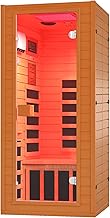
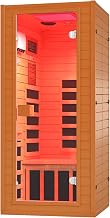
At 40 by 36 by 73 inches, this dry-heat cabin fits a bedroom corner or a garage gym without dominating either. The combination of red light therapy, seven-color chromotherapy, and Bluetooth plus radio makes it the most complete package at its size, and the brown finish stays neutral against most palettes.
OUTEXER Far Infrared Canadian Hemlock Sauna
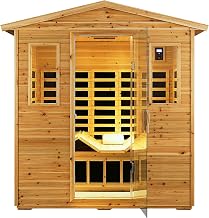
Our pick when material quality leads the decision. Canadian hemlock has a pale, tight grain that ages beautifully, and the tempered glass door keeps a compact 35-inch footprint from feeling like a box. Low-EMF far infrared on standard 110V power, with 1200W of output behind it.
3 Person Ceramic Infrared Sauna with Granite Backdrop
The one to specify if the sauna is meant to be a design feature. Ceramic emitters deliver both far and near infrared, the granite backdrop gives the interior real visual weight, and three-person capacity turns it into a shared space rather than a solo appliance. Plan the electrical and the clearance before it arrives.
Infrared Sauna Box with 660nm & 850nm Red Light
A step up from a standard tent thanks to a dedicated dual-wavelength red light lamp alongside the 3L, 1200W steamer. Choose this over the simpler tents if red light therapy is a primary goal instead of a bonus feature.
Frequently Asked Questions
How long should a session last?
Most people settle into 20 to 40 minutes, starting shorter while acclimating. Hydrate before and after, and step out if you feel lightheaded rather than pushing to the timer.
Do I need special wiring?
Nearly all of these units run on a standard 110V household outlet. Give a 1200W sauna its own circuit where possible, and avoid extension cords.
Is a tent really comparable to a wood cabin?
For sweat and recovery, a good insulated tent performs surprisingly well. Cabins win on heat retention, seating comfort, longevity, and the fact that they look like furniture instead of gear.
Where should it go in the house?
Anywhere with a level floor, an accessible outlet, and some ventilation. Basements and garages work well; steamer-based tents belong on tile or a protective mat rather than directly on hardwood.
Final Thoughts
For most homes, the 1-2 Person Infrared Sauna with red light therapy hits the best balance of footprint, features, and finish. If you want a real wood presence in the room, the OUTEXER Canadian Hemlock cabin is the smarter long-term buy, while the Infrared Sauna Tent with 3L Steamer remains the low-risk way to find out whether the habit sticks.