Key takeaways
- Genuine enzyme content: Look for live bacterial cultures or named enzymes on the label, not just “odor eliminator.” Oxidizers and fragrance blends brighten the stain but leave the uric acid crystals intact, which means the smell resurfaces.
- Fiber and dye safety: Check for CRI Seal of Approval certification and wool compatibility if you own natural-fiber or hand-knotted rugs. Always spot-test on a closet edge or an offcut before treating an open floor.
- Volume versus mess pattern: A 32 oz trigger bottle handles isolated accidents. Repeat marking, a senior cat, or a whole-room saturation event calls for a gallon so you can flood the area properly instead of rationing.
- Residue and finish: Low-surfactant formulas rinse cleaner and resist the sticky, soil-attracting halo that makes a treated patch darken faster than the surrounding carpet. This matters most on ivory, bone, and pale greige piles.
- Scent restraint: Skip anything heavily perfumed. Cats avoid strong citrus and floral notes, and in an open-plan room a loud fragrance reads worse than the original problem. Neutral or barely-there is the goal.
What's inside
Cat urine is the one household stain that refuses to play by normal rules. It soaks past the carpet face into the backing and pad, where uric acid crystals sit dormant until humidity or a steam cleaner reactivates them — which is why a rug can smell fine in February and announce itself in July. Surface cleaners lift the visible mark and leave the chemistry behind, so the odor returns and, worse, becomes a scent marker that invites your cat back to the same square foot.
The fix is enzymatic: proteins and beneficial bacteria that digest the uric acid rather than mask it. This guide covers the enzyme cleaners worth keeping in the utility closet, how to read a label that actually earns the word “enzymatic,” and the application details that separate a permanent repair from a temporary one. Selections below weigh dwell-time performance, safety on wool and natural fibers, residue behavior on light carpet, and whether the scent profile suits a room you actually live in.
As an Amazon Associate we earn from qualifying purchases.



How to Choose a Cat Pee Carpet Cleaner (2026)
- Genuine enzyme content: Look for live bacterial cultures or named enzymes on the label, not just “odor eliminator.” Oxidizers and fragrance blends brighten the stain but leave the uric acid crystals intact, which means the smell resurfaces.
- Fiber and dye safety: Check for CRI Seal of Approval certification and wool compatibility if you own natural-fiber or hand-knotted rugs. Always spot-test on a closet edge or an offcut before treating an open floor.
- Volume versus mess pattern: A 32 oz trigger bottle handles isolated accidents. Repeat marking, a senior cat, or a whole-room saturation event calls for a gallon so you can flood the area properly instead of rationing.
- Residue and finish: Low-surfactant formulas rinse cleaner and resist the sticky, soil-attracting halo that makes a treated patch darken faster than the surrounding carpet. This matters most on ivory, bone, and pale greige piles.
- Scent restraint: Skip anything heavily perfumed. Cats avoid strong citrus and floral notes, and in an open-plan room a loud fragrance reads worse than the original problem. Neutral or barely-there is the goal.
The Best Cat Pee Carpet Cleaner (2026)s Reviewed
Rocco & Roxie Enzyme Stain & Odor Eliminator
The most reliable all-rounder here: a bio-enzymatic formula that’s CRI Certified Safe, chlorine-free, and gentle enough for bedding, crates, and car upholstery alongside carpet. It’s the bottle I’d hand someone with light-colored wool or a rug they care about, because it breaks down odor without leaving a bleached or tacky patch behind.
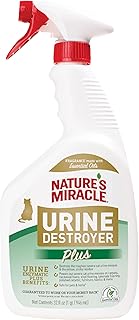
Nature’s Miracle Cat Urine Destroyer Plus
Purpose-built for urine specifically rather than general pet messes, which shows in how it handles older, set-in spots that other cleaners only partially clear. The fresh scent is more assertive than some, so ventilate the room and use a lighter hand on small areas.
Nature’s Miracle Advanced Cat Stain & Odor Eliminator, Severe Mess
The heavier-duty sibling, formulated for saturation events — a repeatedly marked corner, a litter box overflow, a closet discovered late. Use it when you need a single treatment to reach the pad, and expect to let it dwell longer than the label’s minimum.
Biokleen Bac Out Enzyme Cleaner
A plant-based, non-toxic option built on live enzyme cultures, which makes it the pick for households minimizing synthetic chemistry around kids and pets. The lime scent is bright and honest rather than perfumed, and it dilutes well for broader area work.
Urine B-Gone Enzyme Cleaner, 1 Gallon
Buy this when the problem is chronic rather than occasional — a gallon lets you fully flood a spot, which is the single biggest predictor of success with enzymes. It handles human and dog urine too, so it earns its shelf space in mattress and laundry duty as well.
Frequently Asked Questions
How long should the cleaner sit on the carpet?
Longer than most people allow. Enzymes need moisture and time to digest uric acid, so keep the area visibly damp for at least 10 to 15 minutes, and cover a deep stain with a damp towel to slow evaporation. Blot rather than scrub, then air dry.
Why does the smell come back weeks later?
Almost always underdosing. The urine spread wider and deeper than the visible mark, so if you treated a coin-sized spot you likely missed the ring around it. Reapply generously, treating an area two to three times wider than what you can see.
Can I use a steam cleaner first?
No. Heat sets the proteins and can lock the odor into the fibers permanently. Treat with enzymes first, let the area dry fully, and reserve any hot-water extraction for after the odor is resolved.
Do enzyme cleaners stop repeat marking?
They remove the scent cue that draws a cat back, which solves a good share of cases. If marking continues after the odor is genuinely gone, the cause is usually medical or behavioral and worth a vet visit.
Final Thoughts
For most homes, Rocco & Roxie is the safest first purchase — broadly fiber-friendly, certified, and effective without a heavy fragrance footprint. Step up to Nature’s Miracle Advanced Severe Mess when a spot has soaked through to the pad, and keep the Urine B-Gone gallon on hand if accidents are a recurring fact of life rather than a one-off.