Key takeaways
- Zero gravity — a slight head-and-knee lift that distributes weight off the lower back. Standard on the Tami Tami T600 and the Twin XL base-and-mattress bundle.
- Anti-snore — a modest head incline, usually 7 to 12 degrees, that keeps airways open without waking you.
- Flat memory — a one-button return so you’re not thumbing arrows every morning.
What's inside
The adjustable base has quietly become the most consequential piece of furniture in a modern bedroom. It’s no longer a medical-supply afterthought upholstered in gray vinyl — it’s the layer that determines whether your bed reads as a considered piece of design or a mattress dropped on a platform. Raise the head eight degrees and a bedroom becomes a reading room. Lift the legs and it becomes recovery. The frame is doing the work that a stack of pillows used to do badly.
This guide walks through what actually separates a base worth living with from one you’ll resent by month three: motor behavior, preset positions that earn their keep, the profile question nobody asks until the frame arrives, and how to match a base to the mattress you already own. Below are the picks we keep returning to, followed by the reasoning that got them there.
As an Amazon Associate we earn from qualifying purchases.


Start With Size, Split, and Profile — In That Order
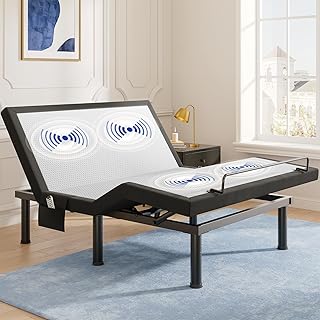
Size is obvious; the other two aren’t. A split configuration lets two sleepers move independently, which matters enormously if one of you reads late and the other doesn’t. Many king bases ship as split by default, and options like the Heavy Duty King Adjustable Bed Frame with independent head and foot tilt handle that separation without turning the mattress into two visible islands. Profile height is the quiet dealbreaker: an adjustable base plus a thick mattress can easily crest 30 inches, which looks wrong under a low headboard and feels wrong on entry. Bases with height-adjustable legs — the Tami Tami T450 offers three settings, the Amada Queen offers four — let you tune the deck to your headboard rather than the other way around.
Judge the Motor, Not the Feature List
Two bases can share an identical spec sheet and feel entirely different in a quiet house at midnight. What you’re listening for is a low, even hum that stops cleanly rather than a whine that shudders at the end of travel. Both Tami Tami models market a quiet motor, and that emphasis is worth taking seriously — motor noise is the complaint that surfaces most often in long-term reviews, well after the massage novelty has faded. Also check lift capacity against your real load: mattress weight plus occupants plus bedding. A hybrid mattress can weigh 100 pounds on its own.
Which Positions You’ll Actually Use
Most remotes offer more presets than anyone needs. In practice, three matter:
- Zero gravity — a slight head-and-knee lift that distributes weight off the lower back. Standard on the Tami Tami T600 and the Twin XL base-and-mattress bundle.
- Anti-snore — a modest head incline, usually 7 to 12 degrees, that keeps airways open without waking you.
- Flat memory — a one-button return so you’re not thumbing arrows every morning.
Independent head and foot articulation is the baseline. Anything beyond that is preference, not necessity.
Treat Massage and Lighting as Character, Not Core
Dual-motor massage is genuinely pleasant and genuinely not why you buy a base. Judge it as a bonus: does it offer intensity levels, does it auto-shut-off, does it sound like a phone buzzing on a nightstand? The Best Choice Products Ergonomic Full base bundles a massager alongside USB ports and a nightlight at an approachable price, which is the right way to encounter these features — included, not paid a premium for. Under-bed lighting is the sleeper hit here. A warm glow at ankle height makes a 3 a.m. walk safe and, incidentally, makes the bed appear to float.
Confirm Your Mattress Will Cooperate
Foam, latex, and most modern hybrids flex fine. Traditional innerspring mattresses with rigid perimeter coils generally don’t, and forcing them will damage both pieces. Check your manufacturer’s guidance before ordering. If your mattress is aging anyway, a matched set removes the guesswork — the Twin XL adjustable frame with 12-inch gel memory foam mattress pairs a fiberglass-free foam build with a base engineered for it, which is a clean answer for guest rooms and dorms.
Tips
- Measure your headboard’s lowest interior point before ordering, then set leg height to sit just beneath it.
- Add a retainer bar or non-slip mattress pad if your mattress creeps forward during head elevation.
- Leave four to six inches of clearance behind the base — the deck travels backward slightly as it lifts.
- Route the power cord along a leg with a cable clip on day one; unmanaged cords are the fastest way to make a good frame look cheap.
Frequently Asked Questions
How difficult is assembly, really?
Most contemporary bases arrive pre-assembled and fold flat. You attach legs, plug in, and pair the remote. Both Tami Tami models advertise tools-free setup in roughly five minutes, and that’s broadly accurate — the harder part is carrying the box upstairs.
Can I keep my existing bed frame or headboard?
Usually yes. An adjustable base can sit inside most platform frames or slat frames with the slats removed, provided the interior dimensions match your mattress size. Headboards typically stay put; the base simply nests in front of them.
Do adjustable bases use much electricity?
Negligibly. The motors draw power only while moving, which totals seconds per day. Standby draw for lighting, USB, and remote sync is comparable to a phone charger.
Are USB ports worth prioritizing?
They’re worth noticing. Dual-side USB on the T600 or four ports on the Amada eliminates a nightstand cable run, which is a small daily convenience with an outsized effect on how tidy the room feels.
Conclusion
The best adjustable bed frame for 2026 is the one that disappears into your bedroom: quiet enough that you forget the motor, low enough to sit right under your headboard, and equipped with two or three positions you’ll actually use every night. Get size, split, and profile correct first, verify your mattress will flex, and treat massage and lighting as the pleasant extras they are. Do that, and the frame stops being a gadget and starts being furniture.