Key takeaways
- Ceramic emitters run hot and localized. They warm the cabin quickly and deliver an intense, directional heat — good if you like a sharp, focused sensation.
- Carbon panels spread lower-intensity warmth across a much larger surface, so the heat feels even and enveloping rather than pointed at your shins.
- Full spectrum combines near, mid, and far infrared in one system. The 2-Person Full Spectrum Infrared Sauna at 1990W is the more capable option here, drawing more power to cover the wider wavelength range.
What's inside
The home sauna has quietly moved from spa-brochure fantasy to a legitimate design decision — something you plan around, like a soaking tub or a reading nook. Infrared cabins are the reason. They run at 110°F to 150°F instead of the 180°F-plus of traditional Finnish rooms, plug into ordinary household circuits, and arrive as flat-packed panels that clip together in an afternoon. That combination means a spare bedroom corner, a finished basement, or a wide upstairs landing can now hold a wellness space that would have required a plumber and a permit ten years ago.
What follows is a practical read on choosing one in 2026: how to match the format to your actual square footage, what heater technology genuinely changes the experience, how to read wood and glass specs like a furniture buyer rather than a spec-sheet skimmer, and where the electrical fine print will trip you up. Below are our recommended picks, spanning full hemlock cabins down to fold-away tents.
As an Amazon Associate we earn from qualifying purchases.




Start With Footprint, Not Features
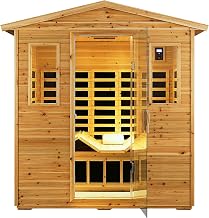
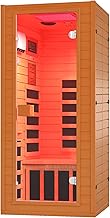
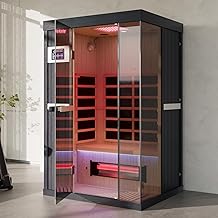
Measure before you browse. A one-person cabin like the OUTEXER Far Infrared Sauna occupies roughly 35 by 28 inches — genuinely closet-sized, and light enough that two people can reposition it. Step up to a two-person unit and you’re at about 40 by 36 inches, which is the sweet spot for most homes: enough bench to stretch a leg or sit sideways, still narrow enough to tuck against a wall. Three-person models such as the hemlock Ceramic Infrared Sauna with granite backdrop read more like built-in cabinetry and want a dedicated wall. Add 4 to 6 inches of breathing room behind and beside any cabin for the power connections, and confirm the door swing clears whatever furniture sits opposite. If none of that works, the collapsible Infrared Sauna Tent with 3L Steamer folds down to a stowable bundle and asks nothing permanent of the room.
Understand the Heater Behind the Panel
Heater type shapes how a session actually feels, and the marketing rarely explains it well.
- Ceramic emitters run hot and localized. They warm the cabin quickly and deliver an intense, directional heat — good if you like a sharp, focused sensation.
- Carbon panels spread lower-intensity warmth across a much larger surface, so the heat feels even and enveloping rather than pointed at your shins.
- Full spectrum combines near, mid, and far infrared in one system. The 2-Person Full Spectrum Infrared Sauna at 1990W is the more capable option here, drawing more power to cover the wider wavelength range.
Wattage is your rough proxy for heat-up time. Around 1200W suits a compact single cabin; a two- or three-person room wants meaningfully more, or you’ll be waiting 20 minutes before every session.
Read the Materials Like Furniture
Most cabins are Canadian hemlock, and there’s good reason for it: pale, tight-grained, close to odorless, and dimensionally stable under repeated heating and cooling. Cedar smells wonderful but costs more and can be assertive for anyone sensitive to aromatics. Check panel thickness and whether the interior is left unfinished — bare wood is correct here, since sealants and stains can off-gas at temperature. Tempered glass doors, standard on units like the OUTEXER and the hemlock deluxe glass three-person cabin, transform the piece visually. A solid-panel box reads as an appliance; a glass front reads as architecture, keeps the room feeling open, and cuts the claustrophobia considerably.
Check the Electrical Fine Print
Nearly every infrared sauna sold for home use runs on 110V/120V, which is the whole appeal. But a 1990W unit pulls close to 17 amps, and that needs a dedicated 20-amp circuit with nothing else sharing it. Smaller 1200W cabins are comfortable on a standard 15-amp line. Never run a sauna through an extension cord or power strip. On EMF: low-EMF construction has become the baseline expectation, and reputable makers publish measured field readings at bench level rather than vague reassurances. Look for the number, not the claim.
Decide Which Extras You’ll Actually Use
Red light therapy panels have become the headline add-on. The specification worth checking is wavelength — 660nm for skin-surface exposure and 850nm for deeper penetration, both included on the Infrared Sauna Box. Seven-color chromotherapy lighting, found on models like the 1-2 Person Infrared Sauna with Bluetooth, is ambience rather than therapy, and that’s a perfectly good reason to want it. Bluetooth speakers earn their keep for anyone doing 30-minute sessions. Steam generators, as on the tent and box formats, shift the experience toward humid heat — a different feel entirely, and a preference worth knowing about yourself before you buy.
Tips
- Preheat 10 to 15 minutes before stepping in, and hydrate beforehand rather than only after.
- Sit on a folded towel and lay a second one underfoot — it protects the bench and drastically reduces cleaning.
- Leave the door propped open for 20 minutes post-session so residual moisture escapes the wood.
- Position the cabin on a hard, level floor. Thick carpet traps heat under the base and complicates leveling.
Frequently Asked Questions
How long does assembly take?
Most panel-based cabins go together in 45 to 90 minutes with two people, using buckle clasps rather than tools. Tents and boxes set up in under 10 minutes.
Is infrared heat as effective as a traditional sauna?
It’s a different mechanism — radiant energy warming your body directly instead of heating the surrounding air. Many people find the lower ambient temperature far easier to tolerate for longer sessions.
How much does it cost to run?
A 1200W cabin used for 30 minutes consumes roughly 0.6 kWh, typically pennies per session. Larger full-spectrum units run proportionally higher.
Can a sauna go in a bathroom or garage?
Bathrooms work if ventilation is solid. Unconditioned garages are harder — cold ambient air extends heat-up time significantly and can encourage condensation in the wood.
Conclusion
The right infrared sauna is the one that fits your room honestly, matches your electrical capacity, and delivers the kind of heat you’ll actually look forward to. Start with a tape measure and your breaker panel, decide between focused ceramic warmth and even carbon or full-spectrum coverage, then treat glass, wood, and lighting as the design choices they are. Get those four things right and the piece stops feeling like equipment and starts feeling like part of the house.