Key takeaways
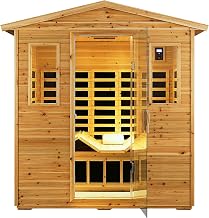
- Footprint and format: Measure the room before the sauna. A cabin around 40″ x 36″ x 73″ needs a permanent home with clearance behind it, while a folding tent collapses into closet depth. Be honest about whether you want an object on display or one that disappears.
- Heat delivery: Dry infrared cabins warm you through radiant panels and feel closer to a traditional sauna. Steamer-equipped tents add humid heat, which most people find more intense at lower temperatures but which also means water tanks, refills, and drying time.
- EMF and emitter quality: Look for brands that publish low-EMF figures and specify their emitter range. A stated 7–14 micron far-infrared output tells you far more than the word “premium” ever will.
- Red light integration: Genuine red light therapy means named wavelengths, typically 660nm and 850nm, and enough LEDs to cover your torso. Seven-color mood lighting is pleasant, but it isn’t the same feature.
- Controls and build details: Remote controls, 99-minute timers, adjustable heat levels, and multi-layer insulated fabric separate a considered design from a repackaged one. Check zipper quality and chair sturdiness on portables, since those fail first.
What's inside
Home saunas have crossed over from spa amenity to furniture decision, and that shift is exactly where buyers get stuck. A cedar cabin reads as a piece of joinery you’ll live with for a decade; a foldable tent reads as equipment you tuck behind a door. Both can deliver a genuine infrared session, but they ask completely different things of your floor plan, your budget, and your tolerance for visual clutter. Add a spec sheet crowded with micron ranges, EMF claims, LED wavelengths, and steamer capacities, and it’s easy to buy on marketing language instead of on how the unit actually behaves in a spare bedroom.
This guide approaches infrared saunas the way we’d approach any furniture purchase: footprint first, materials second, features third. Below you’ll find the brands and models worth shortlisting in 2026, a short framework for choosing between cabin and portable formats, honest notes on where each pick earns its keep, and answers to the questions that come up most often once a sauna is actually installed and running.
As an Amazon Associate we earn from qualifying purchases.


How to Choose an Infrared Sauna Brand (2026)
- Footprint and format: Measure the room before the sauna. A cabin around 40″ x 36″ x 73″ needs a permanent home with clearance behind it, while a folding tent collapses into closet depth. Be honest about whether you want an object on display or one that disappears.
- Heat delivery: Dry infrared cabins warm you through radiant panels and feel closer to a traditional sauna. Steamer-equipped tents add humid heat, which most people find more intense at lower temperatures but which also means water tanks, refills, and drying time.
- EMF and emitter quality: Look for brands that publish low-EMF figures and specify their emitter range. A stated 7–14 micron far-infrared output tells you far more than the word “premium” ever will.
- Red light integration: Genuine red light therapy means named wavelengths, typically 660nm and 850nm, and enough LEDs to cover your torso. Seven-color mood lighting is pleasant, but it isn’t the same feature.
- Controls and build details: Remote controls, 99-minute timers, adjustable heat levels, and multi-layer insulated fabric separate a considered design from a repackaged one. Check zipper quality and chair sturdiness on portables, since those fail first.
The Best Infrared Sauna Brands of 2026, Reviewed
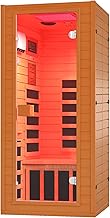
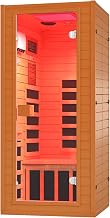
1–2 Person Infrared Sauna with Red Light Therapy
This is the pick for anyone who wants the sauna to read as furniture rather than gear, with a warm brown cabinet, Bluetooth audio, radio, and seven-color therapy lighting built in. At roughly 40″ x 36″ x 73″ it seats one comfortably or two in close quarters, and the dry heat makes it the most traditional-feeling option here.
Relax Sauna Portable Far Infrared Sauna
The purist’s choice, built around a patented FIR generator with a 7–14 micron semiconductor emitter and low EMF, wrapped in a silver reflective folding frame that’s unapologetically utilitarian. You pay for emitter engineering and manufacturing transparency rather than cabinetry, which is the right trade if performance is your only metric.
LifePro Revivify Deluxe Portable Sauna
LifePro has the friendliest learning curve of the group, pairing red light therapy with a 2.6L steamer and a starter set of six essential oils so a first session takes minutes to set up. It’s the model we’d hand to someone who has never used a sauna and wants a home spa ritual without a manual.
Infrared Sauna Box with 660nm & 850nm Red Light
This one leans hardest into light therapy, running a dual 660nm and 850nm lamp alongside a 1200W, 3L steamer with nine heat levels, a timer, and a folding chair. If red light is the reason you’re buying, the wavelength spec here is stated plainly rather than implied.
2-Person Portable Infrared Sauna Box
The most generous portable in the roundup, with 160 dual-wavelength LEDs, two steamers, five-layer waterproof fabric, a 99-minute timer, and remote control. Two people genuinely fit, and it still folds flat, which makes it the best answer for couples in apartments.
Frequently Asked Questions
How often should I use an infrared sauna?
Most owners settle into three or four sessions a week at 20 to 40 minutes each. Start shorter and cooler than you think you need, and hydrate before and after.
Do portable saunas actually work as well as cabins?
For sweat and warmth, yes. Cabins win on comfort, ambience, and the ability to sit upright with your head inside the heat, which changes the experience more than the numbers suggest.
What does a home sauna do to my electricity bill?
Portables typically draw around 1000 to 1500W, similar to a space heater, so a half-hour session costs cents rather than dollars in most regions.
Can I put one on carpet or hardwood?
Use a mat under any steamer-based unit to catch condensation. Dry infrared cabins sit fine on hardwood, though a felt pad protects the finish and makes repositioning easier.
Final Thoughts
If you want the sauna to belong in the room, the 1–2 Person Infrared Sauna in brown is the one to build around. For emitter quality above all else, the Relax Sauna Portable Far Infrared remains the reference point, and couples working with limited square footage should go straight to the 2-Person Portable Infrared Sauna Box.