Key takeaways
- Where the EMF was measured: Ask for readings taken at the seated body position, not at the heater face. Anything at or below roughly 3 mG where you actually sit is a reasonable target, and a manufacturer willing to publish a third-party report is telling you something about the rest of their build.
- Wood species and joinery: Canadian hemlock is the workhorse — dimensionally stable, near-odorless, easy to finish. European aspen is the pick if you’re scent-sensitive or share the room with someone who is. Either way, look for tongue-and-groove panels with tight reveals rather than butt joints hidden behind trim.
- Real-world footprint: Measure the assembled depth plus four to six inches of rear clearance, then measure your narrowest doorway and stair turn. Panels ship flat, but a 61-inch cabin still needs headroom for the roof panel to seat, so check ceiling height before you check price.
- Heater count and placement: Total wattage matters less than distribution. Panels behind the calves, along the back wall, and under the bench give even coverage; a cabin with all its output at torso height leaves your legs cold and pushes you to run longer sessions.
- Circuit and plug type: Most one- and two-person cabins run on a standard 120V outlet, but a 1200W-plus unit really wants a dedicated 15- or 20-amp circuit with nothing else on it. Larger four-person rooms may require hardwiring, which means an electrician in the budget.
What's inside
Shopping for an infrared sauna in 2026 means wading through a lot of unverifiable numbers. Nearly every listing carries a “low EMF” badge, but few explain where the reading was taken, at what distance, or by whom — and a heater panel measured six inches from its surface tells you nothing about what your lower back actually absorbs. Add vague interior dimensions, ambiguous voltage requirements, and freight deliveries that stop at the curb, and a purchase that should feel restorative starts to feel like a gamble.
This guide approaches the category the way we’d spec any other piece of built-in furniture: by footprint, material, joinery, electrical load, and how the thing behaves once it’s living in a real room. Below you’ll find the cabins worth considering this year, from single-seat corner units for apartment bedrooms to a four-person hemlock room that anchors a finished basement, followed by the criteria that actually separate a good cabin from a well-photographed one.
As an Amazon Associate we earn from qualifying purchases.


How to Choose a Low Emf Infrared Sauna (2026)
- Where the EMF was measured: Ask for readings taken at the seated body position, not at the heater face. Anything at or below roughly 3 mG where you actually sit is a reasonable target, and a manufacturer willing to publish a third-party report is telling you something about the rest of their build.
- Wood species and joinery: Canadian hemlock is the workhorse — dimensionally stable, near-odorless, easy to finish. European aspen is the pick if you’re scent-sensitive or share the room with someone who is. Either way, look for tongue-and-groove panels with tight reveals rather than butt joints hidden behind trim.
- Real-world footprint: Measure the assembled depth plus four to six inches of rear clearance, then measure your narrowest doorway and stair turn. Panels ship flat, but a 61-inch cabin still needs headroom for the roof panel to seat, so check ceiling height before you check price.
- Heater count and placement: Total wattage matters less than distribution. Panels behind the calves, along the back wall, and under the bench give even coverage; a cabin with all its output at torso height leaves your legs cold and pushes you to run longer sessions.
- Circuit and plug type: Most one- and two-person cabins run on a standard 120V outlet, but a 1200W-plus unit really wants a dedicated 15- or 20-amp circuit with nothing else on it. Larger four-person rooms may require hardwiring, which means an electrician in the budget.
The Best Low Emf Infrared Sauna (2026)s Reviewed
OUTEXER Far Infrared Sauna, 1200W
A genuinely apartment-friendly cabin at roughly 35 by 28 inches, with a tempered glass door that keeps a small room from feeling like a closet. The 1200W output is generous for a single-seat footprint, so it reaches temperature quickly — just give it its own outlet.
Joyous 2-Person Low EMF Far Infrared Sauna
Seven carbon fiber panels across a Canadian hemlock shell make this the most balanced two-person option here, with heat reaching the calves rather than pooling at shoulder height. The chromotherapy lighting is a soft-touch extra, but the joinery and panel fit are the reason to buy it.
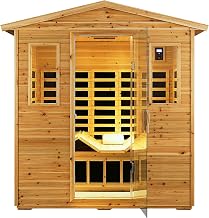
Bergamo 4-Person Low EMF Far Infrared Sauna
This is the one that reads as architecture rather than an appliance — a proper four-person room for a finished basement, home gym, or converted garage. Plan the electrical and delivery path before it arrives; the payoff is a bench long enough to actually lie down on.
Dynamic Saunas Venice 2-Person
Dynamic publishes an under-8 mG figure and has a long enough track record that its assembly instructions and support are dependable, which counts for more than it should in this category. Curbside delivery means you’ll want a second set of hands on arrival day.
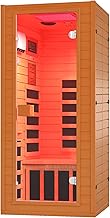
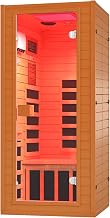
1-Person Hemlock Sauna with Red Light
At 33 inches square and 70 inches tall, this is a tidy vertical footprint that tucks into a corner without dominating it, and the added red light panel is a nice complement to the far infrared heaters. Bluetooth speakers are integrated cleanly rather than bolted on.
Frequently Asked Questions
What actually counts as low EMF?
There’s no binding standard, which is why the number needs context. Treat readings taken at the seated body position as meaningful and readings taken at the heater surface as marketing.
Do I need special wiring?
Most one- and two-person cabins plug into a standard 120V outlet, but they draw heavily and shouldn’t share a circuit with other appliances. Four-person rooms often need a dedicated or hardwired circuit.
Hemlock, aspen, or cedar?
Hemlock is stable and neutral, aspen is the lowest-odor choice and the best option for sensitive users, and cedar brings aroma at a higher price. For a room inside your home, neutral usually wins.
How hard is assembly?
Buckle-clasp panel systems typically take two people 45 to 90 minutes with no specialty tools. The genuine difficulty is moving flat-packed panels through your house, not the build itself.
Final Thoughts
For most homes, the Joyous 2-Person hits the right balance of heater coverage, hemlock build quality, and a footprint that still fits a spare bedroom. Choose the Bergamo 4-Person if you have a basement or garage to give it and want a room rather than a cabinet, and the compact OUTEXER if square footage is the binding constraint and you want quick, low-fuss sessions.