Key takeaways
- Weight capacity per bunk: Look for at least 250 lb on the upper bunk and 350 lb on the lower. Steel frames with cross-bracing and center support legs hold up far better than slatted wood at teen and adult weights, and they don’t develop the creak that wood does after a year of daily use.
- Stairs versus ladder: Angled stairs with treads are safer, easier at 2 a.m., and often hide drawers underneath. They do add 12 to 18 inches of footprint. A vertical ladder saves that space but is genuinely harder to navigate for anyone carrying a laptop or a mug.
- Upper-bunk clearance: Measure ceiling height, then subtract the frame height and your mattress thickness. Teenagers need roughly 30 inches of sit-up room above the top mattress. Thin 6-inch mattresses are the right call up top on almost every metal frame.
- Integrated storage and workspace: Drawers, shelves, pegboards, and L-shaped desks consolidate a dresser and study zone into the bed’s existing footprint. In rooms under 120 square feet, this is the single feature that changes how the room functions.
- Guardrails and mattress fit: Full-length guardrails on both sides of the top bunk are non-negotiable, and the gap between rail and mattress should be tight. Confirm the frame is designed for mattress-only use so you aren’t tempted to add a box spring, which raises the sleeper above the rail line.
What's inside
Shopping for a teenager’s bunk bed is a different exercise than shopping for a child’s. The frame has to carry adult weight without swaying, the top bunk needs headroom for someone who may still be growing, and the whole footprint has to absorb a teenager’s actual life: laptop, chargers, textbooks, clothes that never make it to a closet. Most listings still market to seven-year-olds, which means parents end up filtering past cartoon guardrails and 200-pound weight limits to find frames built for a 5’10” sixteen-year-old.
This guide narrows the 2026 field to six metal bunk systems designed for older kids, shared rooms, and small square footage. I’ve weighed each on frame rigidity, integrated storage, desk and charging provisions, and how honestly the safety features are engineered rather than described. Whether you’re outfitting a shared bedroom, a dorm-style setup, or a guest room that doubles as a study, there’s a configuration here that fits.
As an Amazon Associate we earn from qualifying purchases.




How to Choose a Bunk Bed For Teenager (2026)
- Weight capacity per bunk: Look for at least 250 lb on the upper bunk and 350 lb on the lower. Steel frames with cross-bracing and center support legs hold up far better than slatted wood at teen and adult weights, and they don’t develop the creak that wood does after a year of daily use.
- Stairs versus ladder: Angled stairs with treads are safer, easier at 2 a.m., and often hide drawers underneath. They do add 12 to 18 inches of footprint. A vertical ladder saves that space but is genuinely harder to navigate for anyone carrying a laptop or a mug.
- Upper-bunk clearance: Measure ceiling height, then subtract the frame height and your mattress thickness. Teenagers need roughly 30 inches of sit-up room above the top mattress. Thin 6-inch mattresses are the right call up top on almost every metal frame.
- Integrated storage and workspace: Drawers, shelves, pegboards, and L-shaped desks consolidate a dresser and study zone into the bed’s existing footprint. In rooms under 120 square feet, this is the single feature that changes how the room functions.
- Guardrails and mattress fit: Full-length guardrails on both sides of the top bunk are non-negotiable, and the gap between rail and mattress should be tight. Confirm the frame is designed for mattress-only use so you aren’t tempted to add a box spring, which raises the sleeper above the rail line.
The Best Bunk Bed For Teenager (2026)s Reviewed
Twin Over Twin Bunk Bed with Stairs, 8 Storage Drawers and LED Lights
Eight drawers plus a hanging area makes this the closest thing to a bed-and-wardrobe combination in the category, which is why it works so well in rooms with no closet to speak of. The staircase entry and full-length guardrail are the practical wins here; the LED accent lighting is a pleasant extra rather than the reason to buy.
DICTAC Bunk Bed with L-Shaped Desk and Charging Station
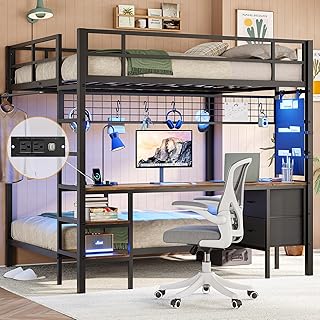
The twin XL upper bunk is the detail that matters most for taller teenagers, adding five inches of length that standard twins don’t offer. Pairing that with an L-shaped desk, five drawers, and a built-in charging station turns a single wall into a complete study-and-sleep zone.
DICTAC Full Over Twin Bunk Bed with Desk and Stairs
A full-size lower bunk gives older teens real sprawling room and makes the bed viable well into the college years or as guest accommodation. The stair access, integrated desk, and charging station round out a frame that reads more like adult furniture than kids’ gear, helped by the matte black finish.
Twin Over Twin Bunk Bed with Hall Tree and L-Shaped Desk
The hall tree is the differentiator, giving a landing spot for jackets, bags, and the daily pile that otherwise ends up on the floor. Combined with the L-shaped desk and five drawers, it’s the most organizationally complete option here for a teen who needs systems, not just square footage.
Jocoevol Industrial Metal Bunk Bed, Vintage Brown
This is the minimalist, heavy-duty pick: no desk, no drawers, no lighting, just a well-braced steel frame in a warm vintage brown that suits a more grown-up room. Choose it when you already own a dresser and desk and simply need a rigid, quiet bunk that won’t feel juvenile.
Frequently Asked Questions
Is a bunk bed still appropriate for a 16- or 17-year-old?
Yes, provided the frame is rated for adult weight and the upper bunk offers adequate clearance. Full-over-twin and twin XL configurations are specifically built for this age group, and metal industrial styling avoids the childlike look that older teens push back on.
What mattress thickness should I use on the top bunk?
Stay between 6 and 8 inches. Anything thicker raises the sleeping surface too close to the top of the guardrail, which undermines the rail’s purpose. A firmer, low-profile foam mattress is the standard choice up top.
Do these frames need a box spring?
No. Metal bunk beds use steel slat systems that support the mattress directly, and adding a box spring compromises both headroom and guardrail safety. Place the mattress straight onto the slats.
How difficult is assembly?
Plan on two people and two to four hours for the storage- and desk-integrated models, which ship with substantially more hardware. Tighten all bolts, then retighten after the first week of use once the frame has settled under load.
Final Thoughts
For most families, the DICTAC Bunk Bed with L-Shaped Desk is the strongest all-around choice, combining twin XL length with a genuine workspace and charging. If you need maximum storage in place of a dresser, the eight-drawer twin over twin with stairs and hanging area is the better value, and for a stripped-back, adult-looking frame that simply holds up, the Jocoevol industrial bunk in vintage brown is hard to beat.