Key takeaways
- Hot sleepers who want softness: a bamboo-derived rayon cover, like the Niagara Sleep Solution topper, moves moisture well and stays cool to the touch without a chemical finish.
- Hot sleepers who run genuinely hot: prioritize a PCM or cooling-fiber face fabric over extra loft.
- Side sleepers with hip or shoulder pressure: more fill height, since pressure relief and cooling are separate problems.
- Anyone with allergies: synthetic down-alternative fills over natural fills, and a pad rated for regular machine washing.
What's inside
Temperature is the quietest variable in a well-designed bedroom, and the one most people get wrong. You can spend months choosing a headboard finish and a lamp with the right warm glow, then lose the whole room to a mattress that traps heat by 2 a.m. A cooling mattress pad is the least glamorous fix in bedding, and often the most effective: a single layer, swapped in an afternoon, that changes how a bed actually performs instead of how it photographs.
This guide covers what “cooling” genuinely means once you get past the marketing, how to read fill and fabric specs, why deep-pocket measurements matter more than thread counts, and when waterproofing is worth the tradeoff in breathability. By the end you should be able to look at any pad and predict how it will feel by the third hour of sleep.
Our Recommended Picks
As an Amazon Associate we earn from qualifying purchases.



Know Which Kind of Cooling You Are Buying
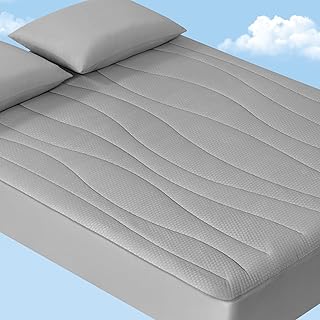
There are two mechanisms, and they behave differently. Passive cooling relies on airflow and moisture movement: an open quilted structure, a breathable fill, and a cover fabric that pulls sweat off skin so evaporation can do its job. It never feels cold, but it stops heat from building. Active cooling uses treated fibers or phase-change material (PCM) that absorbs body heat as it changes state, producing that instant cool-to-the-touch sensation. The Elegear Cooling Mattress Pad with Arc-Chill 3.0 sits in this camp. The catch: PCM has a finite buffer, so once it saturates it behaves like a normal pad until it discharges. Active cooling wins the first hour; passive breathability wins the night. The best pads combine both.
Match Fill and Cover to How You Sleep
The fill determines cushioning and heat retention; the cover determines skin feel. Down-alternative microfiber, used in the OLANLY Quilted Fitted Mattress Pad and the SLEEP ZONE Mattress Topper, gives a soft pillow-top loft that softens a firm mattress and washes easily. It is also the fill most likely to insulate if it is packed too densely, so look for baffled or diamond quilting that keeps air channels open rather than a flat, heavily stuffed panel.
- Hot sleepers who want softness: a bamboo-derived rayon cover, like the Niagara Sleep Solution topper, moves moisture well and stays cool to the touch without a chemical finish.
- Hot sleepers who run genuinely hot: prioritize a PCM or cooling-fiber face fabric over extra loft.
- Side sleepers with hip or shoulder pressure: more fill height, since pressure relief and cooling are separate problems.
- Anyone with allergies: synthetic down-alternative fills over natural fills, and a pad rated for regular machine washing.
Measure Your Mattress Before Anything Else
This is where most returns come from. Measure your mattress from the seam at the top to the seam at the bottom, then add any height a topper already contributes. Modern pads quote generous ranges — 18 inches on the Elegear, 20 on the Niagara, up to 21 inches on the OLANLY and the ELVEN HOME pad — but a skirt that is too deep balloons and slides just as badly as one that is too shallow. A 360-degree elastic skirt grips better than corner straps on a tall mattress, and it is the single feature most correlated with a pad that still lies flat after a month.
Decide Whether You Need Waterproofing
A waterproof membrane is genuinely valuable for kids’ rooms, guest beds, pets, and anyone managing night sweats. It also adds a barrier that airflow has to cross. Newer laminates are far better than the crinkly vinyl of a decade ago — the noiseless quilted waterproof protectors, including the ELVEN HOME model, layer the membrane beneath a quilted face so you feel fabric, not plastic. If you do not need protection, skip it: an unlaminated pad will always breathe better. If you do, buy the version that pairs waterproofing with a quilted cooling top rather than a thin standalone sheet.
Tips
- Wash before first use on cold and tumble dry low. It relaxes the fill, removes finishing residue, and tells you immediately whether the pad holds its shape.
- Layer thin over thick, not the reverse. A cooling pad belongs above a foam topper, never underneath it, or the foam insulates you from the very layer you bought.
- Pair it with breathable sheets. A cotton percale or bamboo sheet lets the pad work; a microfiber sateen sheet cancels most of the benefit.
- Rotate the pad end to end every couple of months to even out compression, the same way you would rotate the mattress itself.
Frequently Asked Questions
Does a cooling mattress pad actually lower the bed’s temperature?
It lowers the temperature at your skin, which is what you feel. Passive pads do it by moving heat and moisture away; PCM pads briefly absorb heat outright. Neither refrigerates the mattress, and none will compensate for a bedroom above roughly 72°F.
Pad or topper — what is the difference?
A pad is thinner and fits like a deep sheet; a topper is thicker and changes the feel of the mattress. Several products marketed as toppers, including the pillow-top styles here, sit in between, adding light loft with a fitted skirt.
How often should I wash it?
Every four to six weeks for most sleepers, more often in summer or if you sweat heavily. Frequent low-heat washing preserves loft better than occasional hot washes.
Will a cooling pad work on a memory foam mattress?
Yes, and it is one of the better upgrades for foam, which traps heat by design. Choose a breathable quilted pad rather than a dense one so you are not stacking two insulating layers.
Conclusion
Buy for the mechanism, not the adjective: confirm how the pad manages heat, choose a fill and cover that suit your sleeping position, measure your mattress depth honestly, and add waterproofing only if you will use it. Get those four right and a modest, well-chosen pad will outperform a far more expensive mattress you were about to replace.