Key takeaways
- Measure the rail first: Note the distance from your slat deck to the top edge of the guard rail, then subtract five inches. That number is your maximum mattress height. Most top bunks land at 6 to 8 inches; bottom bunks are usually free to go thicker.
- Don’t confuse thin with soft: A well-built 8-inch mattress uses a dense support core under a comfort layer, so an adult’s shoulders and hips sink without hitting the base. Medium-firm is the safe default for anyone over roughly 130 pounds sleeping on a low-profile build.
- Plan for heat: Top bunks live in the warmest stratum of the room, and thin foam sits closer to a body’s heat than a tall one. Gel infusions, bamboo charcoal, and green tea additives all help; airflow around the bunk helps more.
- Check the exact size: Bunk frames use full (75″ x 54″), twin XL, and short queen far more often than standard queen. Verify the label dimensions rather than trusting the size name, especially on RV and cabin frames.
- Confirm the slat spacing: All-foam mattresses need slats no more than three inches apart, or a bunkie board. Wider gaps will sag the underside of a thin mattress within a season no matter how good the foam is.
What's inside
Bunk beds have quietly graduated from kids’ rooms into guest lofts, tiny-home mezzanines, cabin bunkrooms, and shared-flat setups where two adults need to sleep well without doubling the footprint. The catch is that the frames were engineered around a hard constraint most shoppers discover too late: a guard rail has to sit at least five inches above the top of the mattress. Load in a standard 12-inch bed and you’ve turned a safety feature into a decorative trim. Go too thin in the other direction and an adult’s hips bottom out on the slats by week two.
This guide is about the narrow, genuinely good band between those two failures. We looked at low-profile foam builds in the 8-to-10-inch range that still carry adult weight, plus a taller hybrid for bottom bunks and standalone frames where rail height isn’t in play. Every pick below is CertiPUR-US certified foam, ships compressed so you can carry it up a ladder solo, and is sized to the odd dimensions bunk frames actually use.
As an Amazon Associate we earn from qualifying purchases.


How to Choose a Bunk Bed Mattress For Adults (2026)
- Measure the rail first: Note the distance from your slat deck to the top edge of the guard rail, then subtract five inches. That number is your maximum mattress height. Most top bunks land at 6 to 8 inches; bottom bunks are usually free to go thicker.
- Don’t confuse thin with soft: A well-built 8-inch mattress uses a dense support core under a comfort layer, so an adult’s shoulders and hips sink without hitting the base. Medium-firm is the safe default for anyone over roughly 130 pounds sleeping on a low-profile build.
- Plan for heat: Top bunks live in the warmest stratum of the room, and thin foam sits closer to a body’s heat than a tall one. Gel infusions, bamboo charcoal, and green tea additives all help; airflow around the bunk helps more.
- Check the exact size: Bunk frames use full (75″ x 54″), twin XL, and short queen far more often than standard queen. Verify the label dimensions rather than trusting the size name, especially on RV and cabin frames.
- Confirm the slat spacing: All-foam mattresses need slats no more than three inches apart, or a bunkie board. Wider gaps will sag the underside of a thin mattress within a season no matter how good the foam is.
The Best Bunk Bed Mattress For Adults (2026)s Reviewed
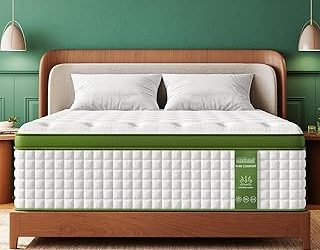
MLILY 8″ Green Tea Memory Foam, Full
The strongest all-around choice for an adult top bunk: 8 inches of medium-firm memory foam with a green tea and gel infusion that keeps the surface from turning swampy overnight. At a true 75″ x 54″, it clears the guard rail on nearly every full-over-full frame we checked.
Lucid 8″ Gel Memory Foam with Bamboo Charcoal
Lucid pairs cooling gel with bamboo charcoal, which handles odor and moisture as well as heat, making it the pick for bunkrooms that get used hard and aired out rarely. Fiberglass-free construction is a meaningful plus on a mattress you’ll be wrestling up a ladder.
14″ Medium Firm Hybrid, Full
For a bottom bunk, loft frame, or daybed with no rail overhead, this is the one adults will notice. Individually pocketed coils give real edge support for sitting up and getting out, and the zoned firmness targets lumbar sag that thin foam simply can’t address.
10″ Full Memory Foam, Medium
A sensible middle path when your rail clearance allows ten inches: more comfort layer than an 8-inch build, with strong motion isolation for shared or stacked sleeping. Ideal for a bunk that doubles as a couch during the day.
Cool Gel 8″ Memory Foam, Short Queen
Short queen is the standard in RVs, camper bunks, and a surprising number of custom cabin builds, and quality options are thin on the ground. This one solves the sizing problem without giving up gel cooling, and it ships with a pillow.
Frequently Asked Questions
What’s the maximum mattress thickness for an adult top bunk?
Six inches is the conservative answer for most commercial frames, and 8 inches works on frames with taller rails. Measure your own rail height and keep five inches of clearance above the sleeping surface.
Will an 8-inch mattress hold an adult long-term?
Yes, if the core is dense and the firmness is medium or medium-firm. Softer 8-inch builds compress under adult weight and start to feel like a mat on a board within months.
Do I need a bunkie board?
Only if your slats are spaced wider than about three inches or the deck is a solid panel with no ventilation. Foam needs continuous support underneath and airflow around it.
How long does it take a compressed mattress to expand?
Most reach full loft in 24 to 48 hours. Unbox it on the bunk itself, since a fully expanded 8-inch full is awkward to maneuver up a ladder.
Final Thoughts
For most adult top bunks, the MLILY 8″ Green Tea is the cleanest fit between rail clearance and real support, with the Lucid 8″ Gel Memory Foam a close second if heat and odor management matter more to you than anything else. Reserve the 14″ Hybrid for the bottom bunk or a standalone loft frame, where its coil support and edge stability come into their own.