Key takeaways
- Weight capacity, stated per bunk: Look for separate upper and lower ratings rather than one combined number. Anything under roughly 300 lb on the top bunk limits you to smaller kids; 400 to 500 lb ranges open the bed up to teens and adults, including a parent reading bedtime stories upstairs.
- Access: stairs versus ladder: Stairs are safer for younger children and far kinder to bare feet, but they consume 18 to 24 inches of floor length. Ladders reclaim that space; padded or wide-tread rungs are worth prioritizing if you go that route.
- Ceiling clearance and sitting height: Measure from your floor to the ceiling, then subtract the frame height. You want at least 30 to 33 inches of headroom above the top mattress so the upper sleeper can sit up without ducking, and remember that thick mattresses eat that budget fast.
- Slat support and noise: Full-width platforms need closely spaced steel or hardwood slats with a center rail. Welded or bolt-through slat systems stay quiet; loose slats resting in channels are the usual source of that 2 a.m. creak.
- Storage that earns its keep: Drawer bases and stair-integrated cubbies can replace a dresser entirely, which matters in small rooms. Just confirm drawer glides are rated for clothing loads and that the unit still fits your wall length with drawers extended.
What's inside
A full over full bunk bed is one of the few pieces of furniture that solves a floor-plan problem and a family problem at the same time. Two standard doubles stacked in the footprint of one means siblings get real mattresses instead of twins they’ll outgrow, guest rooms sleep four without a pull-out, and lake houses stop feeling like tetris. The catch is that scaling up from twin to full changes the engineering: more span, more weight, more leverage on every joint. A frame that felt rock-solid in a showroom twin can develop a wobble at full width if the steel is thin or the slat system is undersized.
This guide looks at the full over full bunks worth considering in 2026, from stair-access wood builds with drawer banks underneath to lean powder-coated metal frames with integrated LED strips. We weighed structural capacity, guardrail height, assembly reality, and how each one actually reads in a room, because a bunk bed is a large visual object whether you want it to be or not.
As an Amazon Associate we earn from qualifying purchases.



How to Choose a Full Over Full Bunk Bed (2026)
- Weight capacity, stated per bunk: Look for separate upper and lower ratings rather than one combined number. Anything under roughly 300 lb on the top bunk limits you to smaller kids; 400 to 500 lb ranges open the bed up to teens and adults, including a parent reading bedtime stories upstairs.
- Access: stairs versus ladder: Stairs are safer for younger children and far kinder to bare feet, but they consume 18 to 24 inches of floor length. Ladders reclaim that space; padded or wide-tread rungs are worth prioritizing if you go that route.
- Ceiling clearance and sitting height: Measure from your floor to the ceiling, then subtract the frame height. You want at least 30 to 33 inches of headroom above the top mattress so the upper sleeper can sit up without ducking, and remember that thick mattresses eat that budget fast.
- Slat support and noise: Full-width platforms need closely spaced steel or hardwood slats with a center rail. Welded or bolt-through slat systems stay quiet; loose slats resting in channels are the usual source of that 2 a.m. creak.
- Storage that earns its keep: Drawer bases and stair-integrated cubbies can replace a dresser entirely, which matters in small rooms. Just confirm drawer glides are rated for clothing loads and that the unit still fits your wall length with drawers extended.
The Best Full Over Full Bunk Bed (2026)s Reviewed
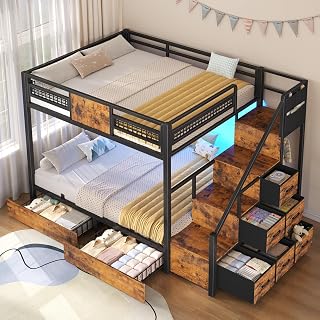
Full Over Full Bunk Bed with Stairs, Storage Drawers and LED Lights
This is the most feature-dense option here: eight drawers, a hanging area, stair access, and full-length guardrails on a metal frame, which effectively turns the bunk into an entire bedroom system. Best suited to a room where this bed is the only major furniture purchase, since the storage footprint replaces both a dresser and a small closet.
Bellemave Full Over Full Bunk Beds with Drawers and Stairs
The wood construction and white finish give this one a softer, more architectural presence than metal frames, and the stairway with storage shelves reads as built-in cabinetry rather than an add-on. It’s the pick for a shared teen room or a guest space you want to look considered rather than utilitarian.
Bellemave Full Over Full Metal Bunk Bed with LED
A heavy-duty black steel frame with storage shelves and integrated lighting, this leans into the industrial look instead of apologizing for it. The LED accent does real work at night, giving each sleeper low-level light without a bedside lamp competing for surface space.
Bellemave Full Over Full Bunk Bed with Storage Shelf and LED Lights
A slightly leaner take on the same design language, with guardrails, a storage shelf, and no box spring required. The space-saving profile makes it a strong fit for rooms with tight side clearance where a drawer base would block a doorway or radiator.
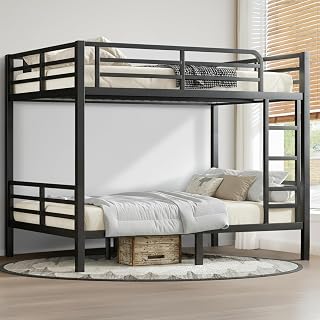
Heavy Duty Metal Full Over Full Bunk Bed with Ladder and Guardrail
With 350 to 500 lb capacity and noise-free steel slats, this is the most straightforwardly structural choice, built for adults and long-term use in bunkrooms or rentals. Skip the frills and you get the thing that matters most: a frame that doesn’t move.
Frequently Asked Questions
Can adults sleep in a full over full bunk bed?
Yes, provided the frame is rated for it. Look for at least 400 lb on the lower bunk and 300 lb or more up top, plus steel construction and a reinforced center support.
Do I need a box spring?
No. Nearly every current full over full bunk uses a slat platform designed to hold the mattress directly, and adding a box spring raises the sleeper dangerously close to the guardrail top.
How thick should the mattresses be?
Six to eight inches on the top bunk keeps at least five inches of guardrail above the mattress surface. The bottom bunk can take a thicker mattress as long as headroom allows.
Can a full over full bunk be separated later?
Some models are designed to convert into two standalone full beds, which meaningfully extends their lifespan. Confirm that in the specs before buying if flexibility matters to you.
Final Thoughts
For maximum storage in a single purchase, the full over full with stairs, eight drawers, and LED lighting does the most work per square foot. If you want the bed to look designed rather than deployed, the Bellemave wood stairway bunk in white is the more refined choice, while the heavy-duty metal frame with 500 lb capacity and noise-free steel slats is the one to buy when durability outranks everything else.