Key takeaways
- Guardrail height and coverage: Look for full-length rails on the top bunk with at least 5 inches of clearance above a compressed mattress. Frames advertising 14-inch rails, like the Max & Lily, give you room to use a thicker mattress without compromising that margin.
- Slat system over box springs: Steel or hardwood slats spaced roughly 3 inches apart carry weight evenly and eliminate the sag that shows up in year two. Heavy-duty metal slats, as used on the Feonase, also cut down on the squeak that keeps a light sleeper awake.
- Access: ladder versus stairs: Angled ladders save floor space; built-in staircases are far easier for younger children and doubles as drawer storage. If your climber is under seven, prioritize stairs even at the cost of a wider footprint.
- Certifications and finish safety: GREENGUARD Gold certification, which Storkcraft carries on the Long Horn, verifies low chemical emissions from the finish. In a small bedroom with limited airflow, that testing is worth more than it sounds.
- Convertibility and load rating: Frames that split into two standalone twins extend the purchase by years. For dorms, camps, or heavier teens, industrial steel builds such as the Jocoevol offer higher weight ratings and simpler hardware.
What's inside
Bunk beds sit at an awkward intersection of furniture buying: they have to satisfy a child’s sense of adventure, a parent’s tolerance for risk, and a room that is almost always smaller than the floor plan promised. Most shoppers end up comparing two dozen listings that all photograph beautifully, then discover after assembly that the ladder rungs bite bare feet, the top bunk creaks with every roll, or the drawers were never going to clear the baseboard. The specifications that actually matter are rarely the ones featured in the first image.
This guide approaches twin-over-twin bunks the way a designer would specify them for a real room: material honesty, slat support, guardrail height, and how gracefully the piece ages as the kids do. Below you will find current standouts across wood and steel builds, storage-heavy configurations, and stripped-back frames that disappear into a shared bedroom. Each pick is assessed on construction, footprint, and long-term flexibility rather than styling alone.
As an Amazon Associate we earn from qualifying purchases.




How to Choose a Twin Bunk Bed (2026)
- Guardrail height and coverage: Look for full-length rails on the top bunk with at least 5 inches of clearance above a compressed mattress. Frames advertising 14-inch rails, like the Max & Lily, give you room to use a thicker mattress without compromising that margin.
- Slat system over box springs: Steel or hardwood slats spaced roughly 3 inches apart carry weight evenly and eliminate the sag that shows up in year two. Heavy-duty metal slats, as used on the Feonase, also cut down on the squeak that keeps a light sleeper awake.
- Access: ladder versus stairs: Angled ladders save floor space; built-in staircases are far easier for younger children and doubles as drawer storage. If your climber is under seven, prioritize stairs even at the cost of a wider footprint.
- Certifications and finish safety: GREENGUARD Gold certification, which Storkcraft carries on the Long Horn, verifies low chemical emissions from the finish. In a small bedroom with limited airflow, that testing is worth more than it sounds.
- Convertibility and load rating: Frames that split into two standalone twins extend the purchase by years. For dorms, camps, or heavier teens, industrial steel builds such as the Jocoevol offer higher weight ratings and simpler hardware.
The Best Twin Bunk Bed (2026)s Reviewed
Twin Over Twin Bunk Bed with Stairs, Storage Drawers & LED Lights
This is the most complete solution here for a genuinely small room: eight drawers, a hanging area, and a staircase absorb the functions of a dresser and a wardrobe in one footprint. The LED accent lighting reads as a gimmick until you see how well it works as a low-glare nightlight for the lower bunk.
Storkcraft Long Horn Twin-Over-Twin Bunk Bed
The design-led choice, with clean vertical posts and a soft white finish that behaves well in transitional and coastal rooms. Its real strength is longevity: GREENGUARD Gold certification, no box spring requirement, and a clean separation into two individual twins when bunking stops being fun.
Feonase Metal Twin Over Twin Bunk Bed
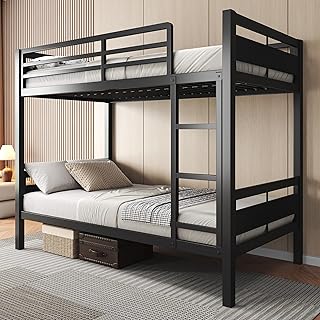
A quiet, rigid steel frame in black that suits older kids and shared guest rooms without pulling attention. The reinforced slat platform and high guardrail address the two most common complaints about budget metal bunks, and assembly is refreshingly logical.
Max & Lily Solid Wood Twin Over Twin Bunk Bed
Solid wood construction and 14-inch guardrails make this the safest-feeling frame in the group, particularly for families using thicker mattresses. The blue finish is bolder than most, so treat it as a color decision rather than a neutral base.
Twin Over Twin Bunk Bed with 6 Drawers, LED Lights & Charging Station
Built for tweens and teens who live in their room: six drawers, three boxes, dual side shelves, and an integrated charging station remove the need for a nightstand entirely. The heavy-duty metal frame keeps all that storage from making the piece feel top-heavy.
Frequently Asked Questions
What mattress thickness works on a top bunk?
Stay at or below 6 to 8 inches for most frames. Measure from the slats to the top of the guardrail and subtract 5 inches of required clearance; that number is your ceiling.
How old should a child be for the top bunk?
Pediatric guidance generally sets six as the minimum for the upper bunk. Stairs, a nightlight, and a rail on the open side all lower the risk for newer climbers.
Do metal or wood bunk beds hold up better?
Steel frames resist joint loosening and carry more weight; solid wood absorbs sound better and looks warmer in a finished room. Both last if the hardware is retightened every few months.
Can bunk beds be separated later?
Only if the manufacturer designed for it. Storkcraft’s Long Horn converts cleanly into two twins, while storage-integrated staircase models are essentially permanent.
Final Thoughts
For most families, the Storkcraft Long Horn is the smartest long-term buy thanks to its certified finish and clean conversion into two twin beds. Choose the Max & Lily solid wood frame if guardrail height and material quality top your list, or the stairs-and-drawers model when the bunk has to double as the room’s entire storage plan.