Key takeaways
- Measure clearance first, then subtract: Put a tape measure from the floor to the underside of the frame, not the mattress, and shop at least half an inch below that number. Casters add height, and a bin that scrapes is a bin you stop using.
- Wheels versus fabric: Rolling rigid bins win for anything you access weekly, like shoes and folded tees. Soft-sided bags win for long-term compression storage, comforters and winter coats, and they collapse flat when empty.
- Clear lids earn their keep: In a dark under-bed cavity, a transparent top means no guessing and no unpacking. Opaque bins need labeling discipline most people don’t maintain.
- Dividers change the math: Adjustable internal partitions turn one deep tub into organized zones, which matters enormously for shoes, socks, and small items that otherwise migrate into one unsortable pile.
- Plan for move-out day: Reinforced handles, stitched seams, and nesting or collapsible designs make the difference between a container you carry twice a year and one you replace annually.
What's inside
Dorm rooms tend to give you one closet the width of a bookshelf, a dresser with three shallow drawers, and a roommate who arrived first. What they also give you, almost always overlooked, is a rectangle of empty air under the bed roughly the size of the mattress itself. On a lofted or riser-lifted frame, that can be eight to fifteen inches of vertical clearance running the full footprint of the room’s largest object. Left alone, it collects dust, chargers, and a single sock. Used well, it absorbs an entire season’s worth of clothing and bedding.
This guide looks at under-bed storage through a design lens rather than a purely utilitarian one: what actually slides cleanly on institutional carpet or vinyl tile, what stays visually quiet in a room where every surface is already busy, and what survives being loaded, dragged, and hauled home in May. Below you’ll find the bins and bags worth buying for 2026, plus the measurements and construction details that separate the ones you keep from the ones that split at the seam by finals week.
As an Amazon Associate we earn from qualifying purchases.


How to Choose Under Bed Storage For Dorms (2026)
- Measure clearance first, then subtract: Put a tape measure from the floor to the underside of the frame, not the mattress, and shop at least half an inch below that number. Casters add height, and a bin that scrapes is a bin you stop using.
- Wheels versus fabric: Rolling rigid bins win for anything you access weekly, like shoes and folded tees. Soft-sided bags win for long-term compression storage, comforters and winter coats, and they collapse flat when empty.
- Clear lids earn their keep: In a dark under-bed cavity, a transparent top means no guessing and no unpacking. Opaque bins need labeling discipline most people don’t maintain.
- Dividers change the math: Adjustable internal partitions turn one deep tub into organized zones, which matters enormously for shoes, socks, and small items that otherwise migrate into one unsortable pile.
- Plan for move-out day: Reinforced handles, stitched seams, and nesting or collapsible designs make the difference between a container you carry twice a year and one you replace annually.
The Best Under Bed Storage For Dorms (2026)s Reviewed
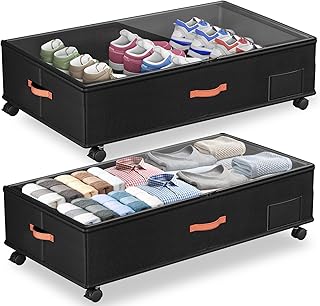
80L 2-Pack Adjustable Under Bed Storage with Wheels
At 80 liters apiece with a clear lid and repositionable dividers, this pair handles the widest range of dorm cargo, from bulky sweatshirts to a semester’s shoe collection, without the contents shifting into chaos. The black shell reads as intentional rather than improvised, which matters when part of the bin remains visible below a bed skirt or lofted frame.
Yecaye Under Bed Storage with Wheels, 2 Pack
The standout here is the 6.7-inch profile, the shallowest of the rigid options reviewed and the safest bet for standard-issue beds with limited clearance. Adjustable dividers plus a clear lid make it the most organized-feeling bin of the group, and the smooth casters glide well on low-pile institutional carpet.
Under Bed Storage Containers with Wheels, 36″ Large 2-Pack
At 36 inches long, these reach deeper under the bed than typical 30-inch bins, which means fewer containers to manage the same volume. Best suited to rooms where you can pull from the long side of the bed rather than the foot.
66L Under Bed Storage with Wheels, 2-Pack Clear Lids
A well-proportioned middle option at 30 by 16.2 by 7.5 inches, sized to slip under most raised frames while still swallowing folded clothing in real quantity. The clear lids and simple rolling action make this the low-friction choice for everyday rotation.
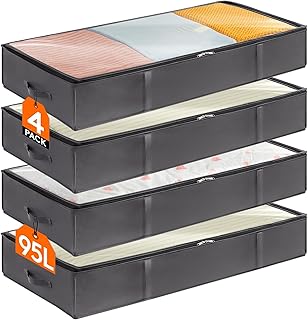
Lifewit 95L 4-Pack Under Bed Storage Containers
Four soft-sided 95-liter bags with reinforced handles are the answer to bedding, not shoes. Comforters, spare sheets, and off-season outerwear compress into them beautifully, and the bags fold to nothing once you unpack in August.
Frequently Asked Questions
How much clearance do I need for rolling under-bed bins?
Plan on at least 8 inches of floor-to-frame clearance for a 7.5-inch bin, and around 7.5 inches for a 6.7-inch model. If your bed sits lower, bed risers are inexpensive and unlock the space instantly.
Are hard bins or fabric bags better for dorms?
Use both. Rigid rolling bins for items you reach for often, fabric bags for compressible bedding and clothing you won’t touch until the weather turns.
Will these fit a lofted dorm bed?
Yes, and lofted beds are the ideal case since clearance is rarely the constraint. Prioritize length and capacity instead, and consider stacking bins if the loft is high.
Do the wheels damage dorm flooring?
The plastic casters on these bins are designed for carpet and hard flooring alike. On vinyl tile, load bins evenly and pull rather than yank to avoid scuffing.
Final Thoughts
For most students, the 80L Adjustable Under Bed Storage with Wheels is the strongest all-around buy, pairing real capacity with dividers that keep the interior usable. Choose the Yecaye 2-Pack if your bed sits low and clearance is tight, and add the Lifewit 95L 4-Pack for bedding and off-season clothes that only need to surface twice a year.