Key takeaways
- Usable freezer volume: Removing the ice assembly typically returns 20 to 30 percent of freezer space. Compare interior shelf depth and basket count rather than trusting the cubic-foot number on the box.
- No plumbing, no compromise: These units need only a standard outlet, which means you can place one in a garage, basement pantry, or island-free galley without calling a plumber or cutting drywall.
- Frost free versus manual defrost: Auto-defrost models keep coils clear on their own and are worth the small energy premium. Manual defrost suits secondary fridges used a few times a week.
- Door swing and clearance: Reversible hinges are the single most useful spec in a tight kitchen. Confirm the handle side before delivery and allow at least an inch of breathing room at the back.
- Finish and hardware: Fingerprint-resistant stainless flatters warm wood cabinetry; matte white disappears against painted shaker fronts. Recessed handles keep a narrow walkway usable.
What's inside
Ice makers are the first thing to fail and the last thing most people miss. They swallow a third of the freezer, demand a water line behind the cabinet, and introduce a slow-drip failure point into an appliance that should be the most boring, most reliable object in the kitchen. Anyone who has mopped up a puddle under a fridge on a Sunday morning, or opened a freezer to find a fused block of cubes welded to a frozen pizza, already understands the appeal of going without.
There is also a design argument. A fridge with no dispenser has an unbroken front — clean stainless, flat white, no plastic paddle interrupting the door. It sits quieter in a small kitchen and reads calmer in an open-plan room. This guide covers the models worth buying in 2026 if you want cold storage and nothing else: what to look for in layout, defrost type, and footprint, followed by honest notes on five refrigerators that skip the ice machine without feeling like a compromise.
As an Amazon Associate we earn from qualifying purchases.


🛒 Best Price Today on Amazon
Prime members get fast, free shipping on everything above, plus member-only deals. New members get a 30-day free trial — cancel anytime.
How to Choose a Refrigerator Without Ice Maker (2026)
- Usable freezer volume: Removing the ice assembly typically returns 20 to 30 percent of freezer space. Compare interior shelf depth and basket count rather than trusting the cubic-foot number on the box.
- No plumbing, no compromise: These units need only a standard outlet, which means you can place one in a garage, basement pantry, or island-free galley without calling a plumber or cutting drywall.
- Frost free versus manual defrost: Auto-defrost models keep coils clear on their own and are worth the small energy premium. Manual defrost suits secondary fridges used a few times a week.
- Door swing and clearance: Reversible hinges are the single most useful spec in a tight kitchen. Confirm the handle side before delivery and allow at least an inch of breathing room at the back.
- Finish and hardware: Fingerprint-resistant stainless flatters warm wood cabinetry; matte white disappears against painted shaker fronts. Recessed handles keep a narrow walkway usable.
The Best Refrigerators Without Ice Makers (2026), Reviewed
KoolMore 28-Inch 14 Cu Ft Top Freezer
The most sensible full-size option here: 28 inches wide, 14 cubic feet, and built with the kind of plain stainless shell that reads intentional next to open shelving. It is rated for garage use, which makes it a strong second fridge as well as a primary one in a rental.
BLACK+DECKER 16.4 Cu. Ft. Top Mount (BR1640KW)
Separate temperature controls for fridge and freezer are unusual at this size and price, and they matter if you store anything more delicate than milk. The white finish is genuinely flat rather than glossy, so it sits quietly in a cottage or apartment kitchen.
Upstreman 14.6 Cu. Ft. Top Freezer (BD146)
Frost free operation, an electronic thermostat, and ENERGY STAR certification put this ahead of most budget top-mounts on running cost. It is also one of the quieter units in this class, which counts in a studio where the kitchen shares a wall with the bed.
Upstreman 7.7 Cu. Ft. Double Door (BD75)
A properly proportioned small fridge with a real freezer compartment, five thermostat settings, and reversible hinges — ideal for a home office, guest suite, or dorm. Manual defrost is the tradeoff, so treat it as a supporting appliance rather than the household workhorse.
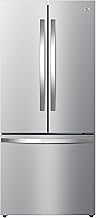
Kenmore 17.5 Cu. Ft. 30-Inch French Door
Proof that French doors do not require a dispenser. At 30 inches wide it slots into older kitchens where standard-depth 36-inch models will not fit, and the full-width fridge compartment handles platters and sheet pans that defeat a top-freezer layout.
Frequently Asked Questions
Can I add an ice maker later?
Not to these models. If you want the option, look at a plumbed unit like the Sharp 28.9 cu. ft. French Door, which includes an ice and water dispenser and a stronger cooling system.
Will a fridge without an ice maker use less energy?
Usually yes, modestly. The ice mechanism cycles a heater to release cubes, so removing it lowers draw. Certification still matters more than the presence of an ice maker.
Are these reliable in a garage?
The KoolMore is explicitly garage-rated. Others may struggle below roughly 55°F or above 90°F, so check the ambient temperature range before installing in an unconditioned space.
Is manual defrost a dealbreaker?
Only for a primary fridge. On a secondary unit, defrosting once or twice a year is a minor chore.
Final Thoughts
For most kitchens, the Upstreman 14.6 cu. ft. is the best balance of frost free convenience, quiet operation, and running cost. The KoolMore 28-inch is the pick for garages and rentals that need durability over refinement, and the Kenmore 30-inch French Door is the one to choose when you want the look of a premium refrigerator in a narrow opening — without a single line of plumbing behind it.