Key takeaways
- Rated capacity with headroom: Add sleeper weights plus your mattress — a queen hybrid runs 90 to 130 pounds — then look for a frame rated well above that total. A 3,500-pound rating isn’t marketing excess; it means the structure never operates near its limit.
- Leg count and center rails: Nine or more legs beats four every time. What matters most is whether load-bearing legs sit under the center rail, since that’s where sag begins on wide frames.
- Slat spacing under three inches: Dense steel slats distribute pressure and protect your mattress warranty. Most foam and hybrid makers void coverage over gaps wider than three inches.
- Steel gauge or genuine hardwood: Lower gauge numbers mean thicker walls. In wood frames, look for solid pine or hardwood slats rather than plywood or particle composite, which delaminates under sustained load.
- Clearance you’ll actually use: Higher decks make sitting down and standing up easier on knees and hips. Fourteen to eighteen inches also opens up real storage — measure your bins before committing to a height.
What's inside
Weight capacity is the one spec most bed frames bury in the fine print, and it’s the one that decides whether your bed feels solid in year three or starts announcing every roll-over. The failure points are predictable: a single center leg carrying load it was never engineered for, slats spaced four inches apart so a mattress sinks between them, and thin-gauge tubing that flexes just enough to work its bolts loose. The result is a dip down the middle, a mattress that wears unevenly, and that low metallic groan at 2 a.m.
This guide looks at frames built for genuine load — 3,000 pounds and up in most cases — and explains what actually earns those numbers: leg count, slat density, steel thickness, and joint design. Below you’ll find six platform frames across queen, full, and full XL, plus a solid pine option for anyone who’d rather not put metal in a bedroom they’ve spent time styling. All of them skip the box spring, which removes a weak layer from the stack entirely.
As an Amazon Associate we earn from qualifying purchases.



How to Choose a Bed Frame For Fat Person (2026)
- Rated capacity with headroom: Add sleeper weights plus your mattress — a queen hybrid runs 90 to 130 pounds — then look for a frame rated well above that total. A 3,500-pound rating isn’t marketing excess; it means the structure never operates near its limit.
- Leg count and center rails: Nine or more legs beats four every time. What matters most is whether load-bearing legs sit under the center rail, since that’s where sag begins on wide frames.
- Slat spacing under three inches: Dense steel slats distribute pressure and protect your mattress warranty. Most foam and hybrid makers void coverage over gaps wider than three inches.
- Steel gauge or genuine hardwood: Lower gauge numbers mean thicker walls. In wood frames, look for solid pine or hardwood slats rather than plywood or particle composite, which delaminates under sustained load.
- Clearance you’ll actually use: Higher decks make sitting down and standing up easier on knees and hips. Fourteen to eighteen inches also opens up real storage — measure your bins before committing to a height.
The Best Bed Frame For Fat Person (2026)s Reviewed
ROIL 18 Inch Queen Bed Frame
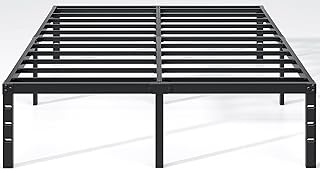
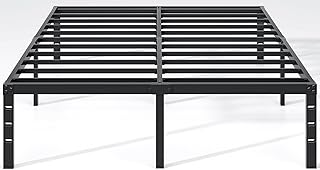
The most thoughtfully engineered frame here: 3,500-pound capacity, 16.4 inches of usable clearance, and four mattress baffles that stop nightly creep without a headboard. Rounded corners are a small detail that pays off in a tight bedroom, and the noise-dampening joints hold up well as the frame settles.
Upcanso 16 Inch Queen Platform Frame
Heavy-duty steel slats and a 3,500-pound rating in a slightly lower profile, with 14 inches of storage underneath. This is the pick if you want serious load capacity but find an 18-inch deck too tall for comfortable entry.
NEW JETO 14 Inch Metal Bed Frame
A clean, low-visual-weight queen platform in matte black that reads as intentional rather than utilitarian. The 14-inch height strikes a practical balance — enough room for flat storage bins, low enough for shorter sleepers — and assembly is genuinely quick.
Maenizi 14 Inch Full Size Bed Frame
Rated to 3,000 pounds, this is a strong full-size option for solo sleepers or smaller rooms where a queen won’t fit. The frame runs quiet, and the black finish disappears under a bedskirt or longer duvet.
Mellow Naturalista Classic Solid Wood Platform
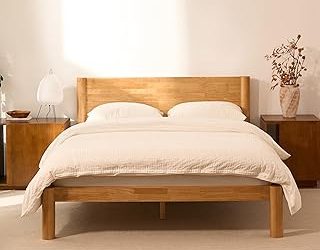
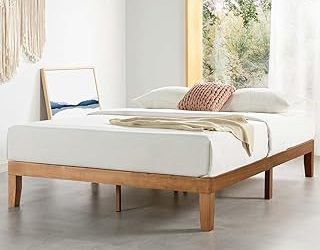
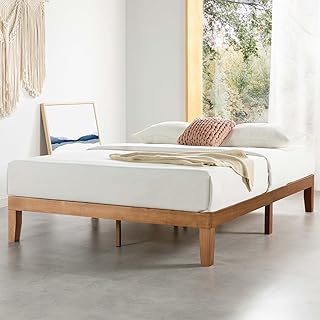
The design-forward choice: solid pine construction with closely spaced wooden slats and no metal in sight. It sits lower at 12 inches and carries less rated load than the steel frames, so it suits moderate weight requirements where warmth and material honesty matter more than maximum specs.
Frequently Asked Questions
How much capacity do I really need?
Total the weight of everyone sleeping in the bed, add the mattress, then double it. That margin accounts for dynamic load — sitting, shifting, and impact all exceed static weight substantially.
Can I skip the box spring?
Yes, and you should. Every frame here is a platform designed for direct mattress contact; box springs add a compressible layer that degrades faster than the frame supporting it.
Why does my current frame creak?
Almost always metal-on-metal contact at loosening bolt joints. Frames advertised as noise-free use rubber or plastic buffers at contact points, which is why the ROIL and Maenizi stay quiet under load.
What about full XL sizing?
If you need extra length without extra width, the Lutown-Teen 14 Inch Full XL adds five inches over standard full — useful for taller sleepers in narrow rooms.
Final Thoughts
The ROIL 18 Inch is the strongest all-around choice, pairing a 3,500-pound rating with baffles and real storage clearance. Choose the Upcanso 16 Inch for the same capacity at a more accessible height, or the Mellow Naturalista Classic if solid pine fits your room better than steel.