Key takeaways
- Joint quality over hardware count: True joinery uses interlocking cuts that seat tighter under weight. Frames that simply hide bolts behind wood caps will develop movement, so look for described tenon, dovetail, or wedge-pin construction and a no-tool or minimal-tool assembly claim.
- Timber species and density: Solid rubberwood and walnut hold fasteners and joints far better than particleboard or thin veneer over MDF. Rubberwood offers excellent stiffness for the money; walnut costs more but reads warmer and ages beautifully.
- Verified load capacity: A 1,500 lb rating backed by SGS or IAS testing tells you the frame was measured, not estimated. This matters most for heavier hybrid and latex mattresses, which can add 100 lb before anyone gets in bed.
- Slat spacing and mattress support: Keep gaps under three inches to avoid foam sag and to satisfy most mattress warranties. Center support legs are non-negotiable on queen and king sizes.
- Storage and clearance: Decide early whether you want low-profile Japandi minimalism or usable space beneath. Headboard shelves, integrated USB ports, and drawer bases each solve a different problem, and retrofitting is rarely graceful.
What's inside
Anyone who has wrestled a flat-pack bed frame into submission at midnight knows the particular disappointment that follows: the wobble, the metal-on-metal squeak, the six leftover bolts. Japanese joinery beds answer that frustration with a different logic entirely. Instead of relying on hardware to hold wood together, they use interlocking cuts, tapered pins, and gravity, which means the structure tightens under load rather than loosening. The trade-off is that the category has filled quickly with frames borrowing the aesthetic without the engineering, and the difference is hard to spot in a product photo.
This guide sorts the genuinely well-built from the merely low-slung. We looked at joint design, species and density of the timber, slat spacing, certified load ratings, and how each frame behaves after a few months of real use, plus the small livability details that matter more than spec sheets suggest: headboard depth, under-bed clearance, whether you can move it without disassembly. Below are the frames worth your floor space in 2026, followed by what to weigh before you commit.
As an Amazon Associate we earn from qualifying purchases.


How to Choose a/an Japanese Joinery Bed Frame (2026)
- Joint quality over hardware count: True joinery uses interlocking cuts that seat tighter under weight. Frames that simply hide bolts behind wood caps will develop movement, so look for described tenon, dovetail, or wedge-pin construction and a no-tool or minimal-tool assembly claim.
- Timber species and density: Solid rubberwood and walnut hold fasteners and joints far better than particleboard or thin veneer over MDF. Rubberwood offers excellent stiffness for the money; walnut costs more but reads warmer and ages beautifully.
- Verified load capacity: A 1,500 lb rating backed by SGS or IAS testing tells you the frame was measured, not estimated. This matters most for heavier hybrid and latex mattresses, which can add 100 lb before anyone gets in bed.
- Slat spacing and mattress support: Keep gaps under three inches to avoid foam sag and to satisfy most mattress warranties. Center support legs are non-negotiable on queen and king sizes.
- Storage and clearance: Decide early whether you want low-profile Japandi minimalism or usable space beneath. Headboard shelves, integrated USB ports, and drawer bases each solve a different problem, and retrofitting is rarely graceful.
The Best Japanese Joinery Bed Frame (2026)s Reviewed
FLEXISPOT Hako G2 Queen
The Hako G2 is the most complete execution of the concept here: solid rubberwood, genuine no-tool assembly that goes together in under half an hour, and dual IAS and SGS certification behind its 1,500 lb rating. The storage headboard is deep enough for books and a lamp without pushing the footprint out, and the ten-year warranty signals real confidence in the joints.
Thor Premium Full (Walnut)
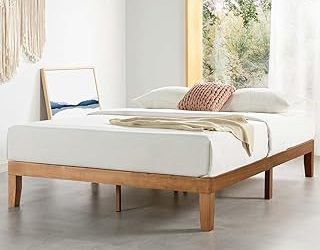
Thor’s walnut finish is the standout aesthetic choice in this group, with a grain and tone that suits older apartments and warmer palettes better than pale rubberwood does. The full-size platform sits low, needs no box spring, and its slat support is dense enough for memory foam, making it a strong pick for guest rooms and smaller primaries.
Softa Mikor Queen
The Mikor is the practical modernist of the lineup, pairing SGS-certified 1,500 lb rubberwood construction with a headboard shelf and built-in USB-A and USB-C ports. If you have been running charging cables up the side of a nightstand, this frame quietly removes the problem while keeping the silhouette clean.
Thor Premium King (Walnut)
Scaling joinery to king size is where weak frames announce themselves, and Thor’s version holds its geometry thanks to reinforced center support and tight slat spacing. Assembly stays genuinely manageable for two people, and the walnut reads as a considered furniture choice rather than a mattress platform.
Rattan Headboard Full with 4 Drawers
This light oak and bamboo cane frame trades pure joinery for a metal platform base with four real storage drawers, which is the right compromise for anyone in a small bedroom without a closet to spare. The woven headboard brings texture that flat wood panels can’t, and the wooden slats still remove any need for a box spring.
Frequently Asked Questions
Do Japanese joinery beds actually need no tools?
The best ones genuinely don’t. Interlocking joints and wedge pins are seated by hand or with a few taps, and models like the Hako G2 and Softa Mikor are designed around that process. Some frames still include a hex key for legs or headboard brackets.
Will a joinery frame squeak over time?
Far less than bolted metal frames, because wood-on-wood joints compress rather than shift. Noise usually comes from slats rubbing their ledges, which a thin felt strip solves permanently.
Can I use a memory foam or hybrid mattress?
Yes. Slat spacing under three inches provides the flat, continuous support foam and hybrid mattresses require, and no box spring is needed on any frame listed here.
Are these frames easy to move?
Easier than most, which is the underrated advantage. Because assembly relies on joints rather than stripped screw holes, joinery beds can be broken down and rebuilt repeatedly without losing rigidity.
Final Thoughts
For most buyers the FLEXISPOT Hako G2 is the safest investment, combining certified load capacity, fast tool-free assembly, and a decade of warranty coverage. Choose the Softa Mikor if integrated charging and a storage shelf earn their keep on your nightstand, or the Thor Premium in walnut if you want the frame to read as a piece of furniture first and a mattress support second.