Key takeaways
- Backing chemistry: Natural rubber grips reliably and stays inert on sealed hardwood. Synthetic adhesives and PVC-based coatings are the usual culprits behind discoloration and sticky residue, especially in rooms that see afternoon sun or radiant heat. If the listing won’t specify, treat that silence as information.
- Thickness against door swing: A quarter inch is the sweet spot for underfoot comfort in living and dining rooms. Anything thicker starts interfering with interior door clearance and creates a lip at thresholds. Under a dining table, thinner is genuinely better since chair legs need to glide rather than sink.
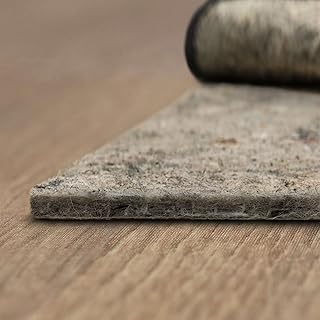
- Density over loft: Felt weight matters more than the number on the packaging. A dense, tightly needled pad supports a hand-knotted wool rug and slows fiber crushing at pivot points. Airy, low-density felt compresses within a season and stops doing its job.
- Coverage strategy: Full pads distribute weight and protect the rug itself. Grippers and tape solve a narrower problem: flat corners and edges. Layered rugs, small kitchen mats, and rugs already sitting on carpet often need the second approach, not the first.
- Trim tolerance: Order roughly an inch smaller than the rug on each side so the pad disappears at the edge. Most felt composites cut cleanly with a utility knife and a straightedge, which means one oversized pad can serve an odd-sized rug better than a close-enough stock size.
What's inside
A rug pad is the one furnishing decision nobody photographs and everybody feels. You notice its absence immediately: the corner that curls toward the entryway, the runner that creeps three inches left every week, the faint shadow of latex bleed on a white oak floor that no amount of buffing will lift. Rugs get chosen for color and weave; pads get chosen in a hurry, usually after something has already gone wrong.
This guide approaches the pad as a material decision rather than an accessory. Below you’ll find the specifications that actually govern how a pad behaves over years of use, plus honest assessments of six options spanning full-coverage felt-and-rubber slabs, silicone-backed cushions, and adhesive corner grippers for spaces where a full pad is overkill.
As an Amazon Associate we earn from qualifying purchases.




How to Choose a/an Area Rug Pads (2026)
- Backing chemistry: Natural rubber grips reliably and stays inert on sealed hardwood. Synthetic adhesives and PVC-based coatings are the usual culprits behind discoloration and sticky residue, especially in rooms that see afternoon sun or radiant heat. If the listing won’t specify, treat that silence as information.
- Thickness against door swing: A quarter inch is the sweet spot for underfoot comfort in living and dining rooms. Anything thicker starts interfering with interior door clearance and creates a lip at thresholds. Under a dining table, thinner is genuinely better since chair legs need to glide rather than sink.
- Density over loft: Felt weight matters more than the number on the packaging. A dense, tightly needled pad supports a hand-knotted wool rug and slows fiber crushing at pivot points. Airy, low-density felt compresses within a season and stops doing its job.
- Coverage strategy: Full pads distribute weight and protect the rug itself. Grippers and tape solve a narrower problem: flat corners and edges. Layered rugs, small kitchen mats, and rugs already sitting on carpet often need the second approach, not the first.
- Trim tolerance: Order roughly an inch smaller than the rug on each side so the pad disappears at the edge. Most felt composites cut cleanly with a utility knife and a straightedge, which means one oversized pad can serve an odd-sized rug better than a close-enough stock size.
The Best Area Rug Pads (2026)s Reviewed
RUGPADUSA Dual Surface Felt + Rubber, 8’x10′
The benchmark for anyone with finished hardwood they care about, pairing dense recycled felt with a genuine rubber underside that holds position without chemical migration. The 1/4-inch profile adds real cushion while staying low enough for door clearance, and it cuts cleanly to fit irregular rug dimensions.
Mohawk Home Non Slip Rug Pad, 8′ x 10′
A felt-and-latex construction made domestically, offering most of the performance of premium pads at a friendlier entry point. The latex grip is assertive on tile and sealed wood, though I’d give newly refinished floors a full cure period before laying it down.
Veken Non Slip Cushioned Rug Pad Gripper, 8 x 10
The silicone-dot backing is the reason to consider this one: it grips through friction rather than tack, which makes it a sensible choice for luxury vinyl plank and other finishes that react poorly to rubber. Nearly a hundred contact strips spread the hold evenly across the footprint.
Jorvila Non-Slip Rug Pad Gripper, 8×10
A thick, comfort-forward cushion that reads plush underfoot and does well in bedrooms and low-traffic sitting areas. It’s the softer end of the density spectrum, so pair it with a rug that has enough body of its own rather than a thin flatweave.
Rabenda Rug Tape Gripper, 12 Pcs
The precision tool of the group. These reusable double-sided corner stickers solve curling edges and shifting runners without committing to a full pad, and they wash and re-adhere several times before losing tack.
Frequently Asked Questions
Will a rug pad damage my hardwood floors?
A natural rubber or felt pad on a fully cured finish will not. Problems arise from PVC coatings, plasticized adhesives, and pads laid on finishes that haven’t off-gassed. Wait at least 30 days after refinishing, and lift the pad occasionally in sun-exposed rooms.
Do I need a pad if the rug sits on carpet?
Yes, and it’s arguably more important. Rug-on-carpet is inherently unstable; a gripper-style pad or corner tape stops the migration that turns a layered look into a tripping hazard.
What size should I order?
Match the rug size, then trim about an inch off each dimension. The pad should be invisible from a standing view, and a slight inset lets the rug edge lie flat against the floor.
How long does a rug pad last?
Quality felt-and-rubber pads hold their density for eight to ten years in residential use. Thin foam and low-density felt often flatten within two, at which point they stop protecting the rug’s foundation.
Final Thoughts
For most homes with hardwood worth protecting, the RUGPADUSA Dual Surface is the pad I’d specify without hesitation, with the Mohawk Home felt-and-latex pad close behind at a lower cost. If your floors are vinyl plank or you only need the corners to behave, the Veken silicone-backed gripper and the Rabenda rug tape handle those cases more gracefully than a full pad would.