Our Short List of 3

- Best for: Campers and van travellers who park for a night or more without hookups and want the longest battery runtime in this class.
- Capacity: 30 quart (28 L), single zone
- Temperature range: -4°F to 68°F
- Battery: 240Wh LiFePO4 (15,000mAh, 16V), detachable, up to 28 hours in ECO mode
- Cooling: 77°F to 32°F in 12 minutes; 35dB listed noise level

- Best for: Drivers whose trips are one long day with several engine-off stops, and who want battery cover for those stops without managing a separate pack.
- Capacity: 31 quart, single zone
- Temperature range: -4°F to 68°F
- Battery: built-in usable battery, up to 6 hours of cooling after a full charge
- Cooling: 77°F to 32°F in 15 minutes; 45W average consumption
- Best for: Solo travellers and couples who want a small fridge they can carry away from the car, and overlanders who like spare batteries they can swap and recharge separately.
- Capacity: 20 L / 21 quart
- Temperature range: -4°F to 68°F
- Battery: 2 x U20 batteries, 74Wh each, up to 12 hours of cooling
- Cooling: 77°F to 32°F in 15 minutes; 35dB listed noise level
All 3 Picks at a Glance
| Product | Specs | Action |
|---|---|---|
| BougeRV CRX3 30 Quart |
| Check price on Amazon |
| EUHOMY 31QT |
| Check price on Amazon |
| LiTHELi 12 Volt Portable Refrigerator with 2 U20 Batteries |
| Check price on Amazon |
Key takeaways
- A car fridge with its own battery keeps food cold after the engine stops. Compare three 12V compressor fridges with included batteries, runtimes and charging options, from their listings.
The real decision with a car fridge is not how cold it gets while you drive. Almost any 12V compressor fridge handles that. The decision is what happens at the stop: engine off, doors closed, sun on the roof, and food that still has to be cold three hours later. A fridge that only runs from the vehicle socket either drains your starter battery or warms up with the cabin. A fridge carrying its own battery keeps cooling on its own power instead.
This guide is for campers who park away from hookups, for road trippers who stop for hikes and lunches, for van travellers who do not want the fridge wired to the starter battery overnight, and for anyone who has lost groceries to a warm cooler on a hot afternoon. Every model below was chosen from its name and specifications on its Amazon product page, and each one runs from a battery that comes with it.
Quick Picks
As an Amazon Associate we earn from qualifying purchases
| Product | Best for | Key spec from title |
|---|---|---|
| BougeRV CRX3 30 Quart | Longest unplugged runtime at camp | 240Wh LiFePO4 battery, 30 quart |
| EUHOMY 31QT | Short stops away from the car | Usable built-in battery, -4°F to 68°F |
| LiTHELi 12 Volt Portable Refrigerator 20L | Carrying the fridge away from the vehicle | Two U20 batteries included, 20L / 21QT |
How to Choose
Start with the battery, not the fridge
Watt-hours decide how long any of these boxes keeps cooling once the engine stops, so read that figure before capacity or colour. A 240Wh pack is a different tool from a small internal cell rated for a few hours: one covers an overnight stop in mild weather, the other covers a long lunch and a hike. Runtime claims also assume a set temperature and a stated ambient temperature, so treat the headline number as a best case. If a listing does not state the battery size in watt-hours at all, that gap is itself useful information about how central battery running really is to the design.
Match the battery style to how you camp
Batteries arrive in three forms here. A detachable pack, like the BougeRV 240Wh unit, slides out so you can charge it indoors or swap in a spare. Swappable tool-style batteries, like the LiTHELi U20 pair, let you carry extra charged packs and extend a weekend without any socket. A sealed built-in battery, like the EUHOMY’s, is the simplest to live with day to day but cannot be swapped when it runs flat, and its eventual replacement is a question to ask before buying. None of these is automatically better. The right one depends on whether your trips are single stops or multi-day stays.
Check how the battery gets charged again
A battery fridge is only useful if refilling the battery fits your routine. Look for charging through the fridge while it runs on vehicle or wall power, because that tops the pack up while you drive and needs no extra steps. Some packs also accept USB-C or a solar input, which suits campers who already carry a folding panel. Tool-style batteries may charge on their own cradle away from the fridge, which is convenient at home but adds a charger to pack. Before ordering, confirm exactly which cables and adapters are in the box, because a missing AC adapter turns home charging into a separate purchase.
Keep the usual fridge checks in view
Battery power does not excuse weak fridge basics. The temperature range should still reach freezing if you carry meat or ice cream, and a range down to -4°F covers that. Capacity between 20 and 31 quarts suits one to four people for a weekend; bigger boxes exist, but in this battery class the mid sizes are where included batteries are realistic. Three-level battery protection still matters for the hours the fridge does run from the vehicle, since it cuts power before the starter battery drops too far. Noise figures around 35dB matter if the fridge sleeps in the same space you do.
The 3 Best Options
BougeRV CRX3 30 Quart
- Best for: Campers and van travellers who park for a night or more without hookups and want the longest battery runtime in this class.
- Capacity: 30 quart (28 L), single zone
- Temperature range: -4°F to 68°F
- Battery: 240Wh LiFePO4 (15,000mAh, 16V), detachable, up to 28 hours in ECO mode
- Cooling: 77°F to 32°F in 12 minutes; 35dB listed noise level
Campers and van travellers who park for a night or more without hookups and want the longest battery runtime in this class.
The same listing sells a Fridge Only package with no battery included, so confirm you have selected the package with the 240Wh battery before checkout. The 28-hour figure is an ECO-mode rating under the maker’s test conditions, not a promise for freezer settings in summer heat.
The CRX3 is the pick for people whose stops are measured in nights rather than hours. Its 240Wh lithium iron phosphate battery is the largest pack in this group, and BougeRV rates it for up to 28 hours of cooling in ECO mode, which is enough to park at a trailhead in the morning and still open a cold fridge the next day. The battery sits in its own compartment, clicks in on spring-loaded pins, and can be charged through the fridge, by USB-C, or from a solar panel. Around it sits a capable single-zone fridge: 30 quarts, a range from -4°F to 68°F, and a 12-minute cool-down to 32°F.
Watch out for: The same listing sells a Fridge Only package with no battery included, so confirm you have selected the package with the 240Wh battery before checkout. The 28-hour figure is an ECO-mode rating under the maker’s test conditions, not a promise for freezer settings in summer heat.
EUHOMY 31QT
- Best for: Drivers whose trips are one long day with several engine-off stops, and who want battery cover for those stops without managing a separate pack.
- Capacity: 31 quart, single zone
- Temperature range: -4°F to 68°F
- Battery: built-in usable battery, up to 6 hours of cooling after a full charge
- Cooling: 77°F to 32°F in 15 minutes; 45W average consumption
Drivers whose trips are one long day with several engine-off stops, and who want battery cover for those stops without managing a separate pack.
Six hours is the maximum after a full charge, and the listing does not state the battery capacity in watt-hours or a recharge time, so check the product page for those figures before relying on it. Because the battery is built in rather than a slide-out pack, ask how it is replaced when it ages.
EUHOMY takes the simplest approach of the three: the battery is built into the fridge and described as usable, running the cooler for up to six hours after a full charge. That is not an overnight solution, and the listing does not pretend otherwise. It is aimed at the gaps inside a driving day, the fuel stop that becomes a two-hour break, the beach car park, the school run detour, where a 12V fridge would sit warming in a switched-off car. The fridge underneath is a conventional 31-quart compressor model with app control, a USB port for a phone, and a compartment that doubles as a charging and storage space.
Watch out for: Six hours is the maximum after a full charge, and the listing does not state the battery capacity in watt-hours or a recharge time, so check the product page for those figures before relying on it. Because the battery is built in rather than a slide-out pack, ask how it is replaced when it ages.
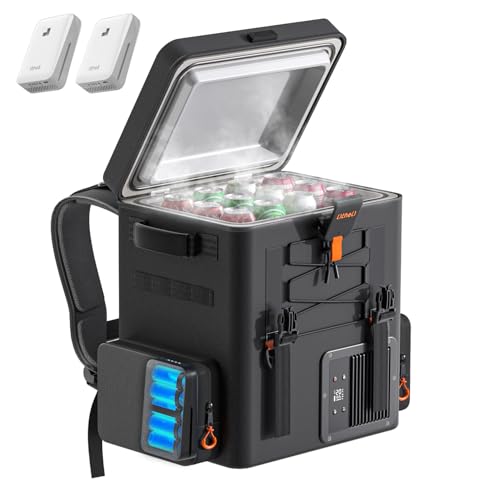
LiTHELi 12 Volt Portable Refrigerator with 2 U20 Batteries
- Best for: Solo travellers and couples who want a small fridge they can carry away from the car, and overlanders who like spare batteries they can swap and recharge separately.
- Capacity: 20 L / 21 quart
- Temperature range: -4°F to 68°F
- Battery: 2 x U20 batteries, 74Wh each, up to 12 hours of cooling
- Cooling: 77°F to 32°F in 15 minutes; 35dB listed noise level
Solo travellers and couples who want a small fridge they can carry away from the car, and overlanders who like spare batteries they can swap and recharge separately.
Check the box contents carefully, because listings for this model note the AC power cord for home use is sold separately. Twenty litres fills quickly for a family, and the two batteries only reach their rated runtime if both start the trip fully charged.
LiTHELi built this fridge around leaving the vehicle behind. The 20-litre box runs from two U20 batteries that slot into the unit, and the same packs double as power banks with a USB-C port for a phone or laptop. Backpack straps and an upright shape that fits behind a car seat make it the one model here you would genuinely carry to a picnic spot, a boat or a fishing bank instead of leaving it in the boot. Cooling is fast for its size, with a listed 15-minute drop to 32°F, and triple-layer insulation holds the cold for about four hours even with no power at all.
Watch out for: Check the box contents carefully, because listings for this model note the AC power cord for home use is sold separately. Twenty litres fills quickly for a family, and the two batteries only reach their rated runtime if both start the trip fully charged.
Which One Fits Your Situation
You camp parked for a night or two
Choose the BougeRV CRX3. Its 240Wh pack is the only battery here sized for overnight stops, and the ECO-mode rating stretches past a full day in mild conditions. The detachable design also means you can carry the battery to a campsite socket or solar panel while the fridge stays in the vehicle, which suits fixed camps with a pitch some distance from the car.
Your stops last two to six hours
Choose the EUHOMY 31QT. A built-in battery that covers a long lunch, a match, or an afternoon at the beach is exactly its brief, and there is no separate pack to remember, charge or store. It behaves like a normal 31-quart car fridge the rest of the time, running from the vehicle socket or a wall outlet, so it asks the least change in routine.
You leave the car and carry the fridge with you
Choose the LiTHELi. The backpack straps, upright footprint and swappable U20 batteries are made for the walk from car park to shoreline or campsite. Carry a second charged pair and the runtime stretches without any vehicle at all, while the USB-C port on the battery keeps a phone alive during the same outing.
You sleep next to the fridge in a van
Any of the three can work, but start with the BougeRV or the LiTHELi, since both publish a 35dB noise figure and both can run overnight on their own batteries instead of cycling against your starter battery. Set the fridge to ECO mode before bed, keep it out of direct contact with the bed frame so vibration has nowhere to travel, and let the battery protection setting guard the vehicle side.
Common Mistakes
- Buying the fridge-only package of a battery model, then discovering the battery was a separate option on the same listing.
- Reading the headline runtime as guaranteed, when it assumes ECO mode, a moderate set temperature and a mild day.
- Choosing capacity by quart count alone and forgetting the battery compartment and insulation eat into the space a tape measure suggests.
- Leaving swappable batteries uncharged in the garage, so the fridge starts its trip already limited to vehicle power.
- Running any 12V fridge from the starter battery for long stops without setting its battery protection level first.
Frequently Asked Questions
How long will a car fridge actually run on its own battery?
It depends on the battery size, the set temperature and the weather. In this group the listed figures run from up to six hours for a small built-in battery to up to 28 hours in ECO mode for a 240Wh pack. Freezer settings, hot cabins and frequent lid opening all shorten those numbers, so plan around roughly half to two thirds of the headline figure for a warm day.
Is a detachable battery better than a built-in one?
Detachable and swappable batteries win on flexibility: you can charge them away from the fridge, carry spares, and replace a worn pack without replacing the fridge. A built-in battery wins on simplicity, with nothing extra to store or lose. For single-day stops the built-in design is usually enough. For multi-day trips away from sockets, swappable packs are the safer pattern.
Can these fridges still drain my car battery?
Yes, while they run from the vehicle socket with the engine off, which is why all three include battery protection that cuts power at a set voltage. The protection has levels, and the highest setting stops earliest and leaves the most charge for starting. Running the fridge from its own battery during stops removes the risk almost entirely, which is the main reason to choose this class.
Can I charge the battery while the fridge is cooling?
On the BougeRV, yes: the pack charges through the fridge while it runs on vehicle or wall power, and it also accepts USB-C and solar input. The LiTHELi batteries are charged as separate packs, so a spare pair can charge while the fitted pair works. For the EUHOMY, the listing does not spell out charging behaviour in detail, so confirm the arrangement on the product page before a long trip.
More from Amazon
Programs that pair well with the guide above. Offers and eligibility are set by Amazon and may change.
Collect the home and kitchen items you want in one registry that guests can shop from.
Create a wedding registrySet up recurring deliveries of everyday items on eligible products. Terms and savings are set by Amazon.
Explore Subscribe & SaveFree shipping on eligible items, Prime Video and more. Eligible new members can start with a free trial.
Start a Prime free trialAudiobooks and podcasts to listen to on the go. Eligible new members can start with a free trial.
Try Audible freeAs an Amazon Associate we earn from qualifying purchases.