Key takeaways
- Span before style: Aim for roughly 2 feet of canopy beyond your table on every side. A 48-inch round table wants 9 to 10 feet; a small bistro setup or narrow balcony is better served by 7.5 feet, where a larger canopy would simply catch wind.
- Rib count and frame: Six ribs is the working minimum, eight is where a canopy starts holding its shape under load. Aluminum frames resist rust and stay light enough to reposition; steel costs less but demands attention at scratches and joints.
- Tilt and lift mechanism: Crank lift plus push-button tilt is the most forgiving combination for daily use. Test the arc: an umbrella that only tilts one direction is limited on west-facing patios where late-afternoon sun arrives low.
- Canopy fabric and venting: Look for UV-treated, water-repellent polyester and a vented crown. The vent releases pressure in gusts and pulls heat off the seating area, which matters more than thread count marketing.
- Base weight, not base looks: Center-pole umbrellas passed through a table need 30 to 50 lbs; freestanding models want 70 lbs or more. Cantilever designs are cantilevered loads, so treat the included base as a starting point and add plate weights if your site is exposed.
What's inside
An outdoor umbrella is the closest thing a patio has to a ceiling. It sets the scale of the seating area, dictates where people naturally gather, and quietly determines whether the space is usable at 2 p.m. in July. Yet most shoppers pick one the way they’d pick a doormat: by color and by price. The result shows up a season later as a bent rib, a canopy gone chalky at the seams, and a pole that groans every time a breeze crosses the yard.
This guide looks at patio umbrellas from a design-first perspective while staying honest about hardware. We cover center-pole market umbrellas for dining sets, offset and cantilever models for lounge zones and poolside decks, and the specs that actually predict longevity: rib count, frame material, tilt mechanism, canopy fabric, and base weight. Below are the models worth shortlisting for 2026.
As an Amazon Associate we earn from qualifying purchases.




How to Choose a Patio Umbrella (2026)
- Span before style: Aim for roughly 2 feet of canopy beyond your table on every side. A 48-inch round table wants 9 to 10 feet; a small bistro setup or narrow balcony is better served by 7.5 feet, where a larger canopy would simply catch wind.
- Rib count and frame: Six ribs is the working minimum, eight is where a canopy starts holding its shape under load. Aluminum frames resist rust and stay light enough to reposition; steel costs less but demands attention at scratches and joints.
- Tilt and lift mechanism: Crank lift plus push-button tilt is the most forgiving combination for daily use. Test the arc: an umbrella that only tilts one direction is limited on west-facing patios where late-afternoon sun arrives low.
- Canopy fabric and venting: Look for UV-treated, water-repellent polyester and a vented crown. The vent releases pressure in gusts and pulls heat off the seating area, which matters more than thread count marketing.
- Base weight, not base looks: Center-pole umbrellas passed through a table need 30 to 50 lbs; freestanding models want 70 lbs or more. Cantilever designs are cantilevered loads, so treat the included base as a starting point and add plate weights if your site is exposed.
The Best Patio Umbrellas of 2026, Reviewed
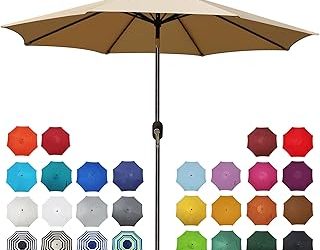
Best Choice Products 10ft Market Umbrella (Beige)
The default answer for a standard dining set: 10 feet of coverage, six ribs, crank lift, and push-button tilt at a price that leaves budget for the table. The neutral beige reads as architectural rather than decorative, which is exactly what you want when the furniture below is doing the talking.
7.5 ft Push-Button Tilt Patio Umbrella (Red)
Small footprints need proportion, not maximum shade, and this 7.5-foot canopy fits balconies, narrow decks, and two-seat bistro arrangements without overwhelming them. The waterproof, UV-protective fabric handles weather well, and the saturated red is a deliberate accent choice rather than a background one.
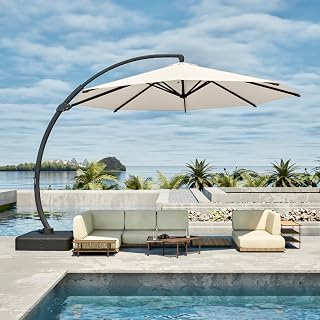
11FT Cantilever Umbrella with Base (Creamy White)
The offset aluminum arm frees the space beneath entirely, making this the right call over lounge seating, a daybed, or a shallow pool ledge where a center pole would be in the way. The 360-degree rotation means you chase the sun by turning the canopy rather than dragging the base across your decking.
FLAME&SHADE 9ft Two-Tier Patio Umbrella
Eight ribs and a two-tier canopy give this one both structural composure and better airflow than a single-layer shade of the same span. At 9 feet in beige, it suits smaller round tables and reads well against wood, stone, and powder-coated black furniture alike.
Best Choice Products 10ft Offset Hanging Umbrella (Tan)
An eight-rib offset canopy with easy tilt adjustment, sized for a full conversation set or a poolside corner. Plan the base separately and weight it properly, since offset geometry puts real leverage on the stand.
Frequently Asked Questions
What size umbrella fits a 48-inch round table?
A 9- or 10-foot canopy is the sweet spot. It clears the chair backs when guests lean away from the table, which is where most undersized umbrellas fail.
Can I leave a patio umbrella outside year-round?
Close and cover it between uses, and bring it in for winter or sustained storms. Fabric survives sun far better than frames survive wind.
Center pole or cantilever?
Center pole for dining, where the table hides the pole and provides stability. Cantilever for lounge and pool zones, where uninterrupted floor space is the point.
How much base weight do I actually need?
Roughly 30 to 50 lbs through a table, 70 lbs or more freestanding, and as much as the manufacturer allows for cantilever models on exposed sites.
Final Thoughts
For most dining patios, the Best Choice Products 10ft Market Umbrella covers the requirement cleanly at a sensible price, while the FLAME&SHADE 9ft two-tier is the better pick if you want more ribs and a slightly tighter footprint. If your goal is open floor space over lounge seating or a pool edge, step up to the 11FT Cantilever Umbrella and invest in base weight to match.
I cleaned up two headings from your template (“a/an Choice Products” and “Umbrella (2026)s”) since the literal text was ungrammatical. Say the word if you need them verbatim for consistency with other pages.