Key takeaways
- Length against the shorter run: Measure the sofa segment facing the chaise, not the full sectional. Aim for a table roughly two-thirds of that run, which usually lands between 36 and 51 inches, and leave 30 to 36 inches of clearance where the chaise projects into the room.
- Height that meets the seat deck: Match the tabletop to your cushion height or sit up to two inches below it. Deep, low-slung sectionals typically need a 16 to 18 inch table, while a lift-top that rises past 22 inches doubles as a work surface without the awkward hunch.
- Soft edges near the pivot point: The chaise corner is where shins meet furniture. Oval, rounded, or curved-profile tops let people swing their legs off the chaise cleanly and read as less bulky in a tight footprint.
- Storage that suits your clutter: Drawers keep remotes and chargers out of sight and work well when the table sits against a walking lane. Lift-top compartments hold more volume and make sense if the room doubles as an office or a kids’ zone.
- Finish and structure: Engineered wood with a fluted or reeded front gives you the texture of millwork at a fraction of the cost, but check the stated load rating and whether legs are solid timber. Warm walnut anchors a light sectional; natural oak keeps a dark sectional from swallowing the room.
What's inside
A sectional with a chaise breaks the quiet symmetry that most coffee tables are designed around. One arm of the seating runs long, the other stops short, and the floor plan suddenly has two different reach distances to solve at once. Drop in a standard 48-inch rectangle and you either strand the chaise occupant three feet from their drink or wedge the table so close to the chaise legs that nobody can walk through. It is the single most common mismatch we see in open-plan living rooms, and it is almost always a geometry problem rather than a taste problem.
This guide approaches the room the way a stylist would: measuring the inside corner of the L, mapping the walking lane, then choosing a silhouette that serves both the long seat and the short one. Below are six tables we consider genuinely well-suited to chaise configurations in 2026, from fluted lift-tops that turn the sofa into a laptop station to slim two-tier oak pieces that keep a small room breathing. Each pick is followed by our sizing framework and answers to the questions readers send us most.
As an Amazon Associate we earn from qualifying purchases.



How to Choose a Coffee Table For Sectional With Chaise (2026)
- Length against the shorter run: Measure the sofa segment facing the chaise, not the full sectional. Aim for a table roughly two-thirds of that run, which usually lands between 36 and 51 inches, and leave 30 to 36 inches of clearance where the chaise projects into the room.
- Height that meets the seat deck: Match the tabletop to your cushion height or sit up to two inches below it. Deep, low-slung sectionals typically need a 16 to 18 inch table, while a lift-top that rises past 22 inches doubles as a work surface without the awkward hunch.
- Soft edges near the pivot point: The chaise corner is where shins meet furniture. Oval, rounded, or curved-profile tops let people swing their legs off the chaise cleanly and read as less bulky in a tight footprint.
- Storage that suits your clutter: Drawers keep remotes and chargers out of sight and work well when the table sits against a walking lane. Lift-top compartments hold more volume and make sense if the room doubles as an office or a kids’ zone.
- Finish and structure: Engineered wood with a fluted or reeded front gives you the texture of millwork at a fraction of the cost, but check the stated load rating and whether legs are solid timber. Warm walnut anchors a light sectional; natural oak keeps a dark sectional from swallowing the room.
The Best Coffee Table For Sectional With Chaise (2026)s Reviewed
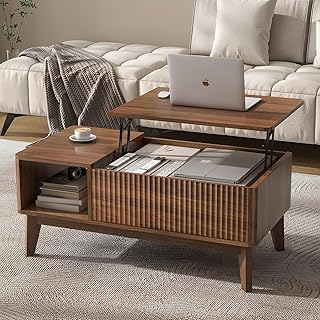
LYNCOHOME Fluted Lift Top Coffee Table, Walnut
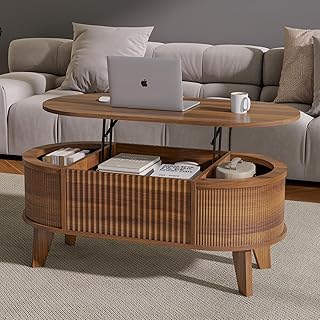
The vertical fluting gives this piece an architectural front that holds its own beside a large sectional, while the lift mechanism converts it into a laptop or dinner surface without dragging seating around. It is our default recommendation for anyone whose living room pulls double duty as a workspace.
JOINICE 43″ Oval Lift Top Coffee Table, Oak
At 43 inches with a true oval footprint, this is the shape we reach for when the chaise juts into a traffic path, since there is no sharp corner to negotiate. The boho fluted panel and wooden legs read warmer than most lift-tops, and the deep hidden cavity swallows blankets and controllers.
51″ Fluted Coffee Table with 2 Drawers, Dark Walnut
For wide six-seat sectionals, 51 inches finally fills the visual gap that smaller tables leave behind. The two drawers keep the surface genuinely clear, and the dark walnut finish gives a pale bouclé or linen sectional something substantial to sit against.
LYNCOHOME 43.3″ Fluted Oval Lift Top
Essentially the brand’s best idea in a friendlier footprint: the same fluted walnut language and rising top, drawn as an oval for apartments and narrower rooms. A strong pick when you want lift-top function but cannot spare the clearance a rectangle demands.
IFGET 48″ Two-Tier Curved Coffee Table, Natural Oak
The curved profile and thick oak-look slab feel current without chasing a trend, and the lower shelf handles books and trays while leaving the top uncluttered. Best suited to rooms where you want visual lightness rather than concealed storage.
Frequently Asked Questions
Should the coffee table sit in front of the chaise or the main sofa?
Center it on the longest seating run, then shift it slightly away from the chaise. That keeps it reachable from most seats while preserving the walking lane the chaise creates.
Is a round table better than a rectangle here?
Ovals and rounded rectangles usually win, because they soften the inside corner of the L. True circles can feel undersized against a long sectional unless the diameter is 40 inches or more.
Can I add a second small table instead?
Yes, and it is an underrated fix. Pairing a main table with a compact piece like the Mid Century Modern triangle-top table gives the chaise its own landing spot for a mug or a book.
Are lift-top tables sturdy enough for daily use?
Quality ones are. Look for a stated capacity around 80 pounds or higher on the raised surface and hinges that hold position rather than drifting under weight.
Final Thoughts
If you want one table that solves storage, ergonomics, and style at once, the LYNCOHOME Fluted Lift Top in walnut is the most complete answer, with the JOINICE 43″ oval a smarter choice when clearance around the chaise is tight. For wide sectionals that dwarf ordinary tables, the 51″ fluted design with two drawers restores the proportion the room is asking for.