Key takeaways
- Footprint and geometry: Measure the finished cabin plus 4 to 6 inches of breathing room on any side that meets a wall, and remember the door swings outward. Corner units reclaim dead space beautifully; rectangular cabins want a long wall and look intentional flanked by low shelving.
- Heater coverage over raw wattage: A 1200W cabin with heaters at the calves, lower back, and side panels will feel more even than a higher-wattage box with everything behind your shoulders. Count heater placements, not just the total number, and look for low-EMF carbon fiber panels rather than exposed rod elements.
- Wood grade and joinery: Solid Canadian hemlock is the sensible default — stable, pale, close-grained, and free of the resin scent cedar can carry. Check that panels are tongue-and-groove and clip-assembled rather than screwed through the face, since visible hardware is what makes a sauna look like equipment instead of cabinetry.
- Glass and sightlines: A tempered glass door lightens the whole volume and keeps a small room from feeling walled off. Full-height glass reads more contemporary; a smaller window with wide hemlock stiles feels warmer and more traditional.
- Electrical and assembly reality: Most 1-2 person units run on a standard 110V circuit, but a dedicated outlet is strongly advised, and larger cabins may not share well with other draws. Plan for two people and 60 to 90 minutes of assembly, plus a clear path wide enough for the largest panel.
What's inside
A sauna is one of the few wellness purchases that has to work as furniture first. It sits in a spare bedroom, a basement corner, a garage gym, or the awkward space behind a stairwell, and unlike a treadmill it cannot be folded away when guests arrive. That is the tension most buyers run into: the specs conversation is all about watts and EMF readings, while the decision that actually matters is whether a 4-by-4-foot hemlock cabinet reads as considered or as clutter in the room you already live in. Add the fact that listings blur together — the same carbon heaters, the same chromotherapy strip, the same stock photography — and it becomes genuinely hard to tell which cabin is well built and which is merely well photographed.
This guide approaches far infrared saunas the way we approach any case good: proportion, materials, joinery, and how the piece behaves in a real floor plan. Below you will find the models worth shortlisting in 2026, a buying framework that cuts through the marketing language, honest notes on each cabin’s strengths and compromises, and answers to the questions that come up once the box is actually in the hallway. Whether you want a slim single-seater for a corner or a two-to-three-person cabin that doubles as a household ritual, the picks here are chosen for build quality and livability rather than headline features.
As an Amazon Associate we earn from qualifying purchases.


How to Choose a Far Infrared Sauna (2026)
- Footprint and geometry: Measure the finished cabin plus 4 to 6 inches of breathing room on any side that meets a wall, and remember the door swings outward. Corner units reclaim dead space beautifully; rectangular cabins want a long wall and look intentional flanked by low shelving.
- Heater coverage over raw wattage: A 1200W cabin with heaters at the calves, lower back, and side panels will feel more even than a higher-wattage box with everything behind your shoulders. Count heater placements, not just the total number, and look for low-EMF carbon fiber panels rather than exposed rod elements.
- Wood grade and joinery: Solid Canadian hemlock is the sensible default — stable, pale, close-grained, and free of the resin scent cedar can carry. Check that panels are tongue-and-groove and clip-assembled rather than screwed through the face, since visible hardware is what makes a sauna look like equipment instead of cabinetry.
- Glass and sightlines: A tempered glass door lightens the whole volume and keeps a small room from feeling walled off. Full-height glass reads more contemporary; a smaller window with wide hemlock stiles feels warmer and more traditional.
- Electrical and assembly reality: Most 1-2 person units run on a standard 110V circuit, but a dedicated outlet is strongly advised, and larger cabins may not share well with other draws. Plan for two people and 60 to 90 minutes of assembly, plus a clear path wide enough for the largest panel.
The Best Far Infrared Saunas (2026) Reviewed
Dynamic Saunas Barcelona 1-2 Person
The Barcelona is the most resolved piece here: 360-degree heating, integrated red light therapy, and a cabin that feels wider than its footprint suggests thanks to generous bench depth. If you want one sauna that satisfies both the wellness spec sheet and a design-led room, this is the one to beat.
Far Infrared Corner Sauna, 2-3 Person Hemlock
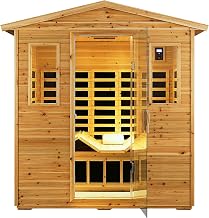
A genuinely smart use of architecture — the angled back tucks into a corner and gives you three-person capacity without eating the middle of the room. Dual Bluetooth speakers, reading lamps, and three chromotherapy lights make it the most sociable cabin on the list.
OUTEXER 1200W Hemlock Sauna
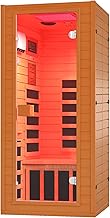
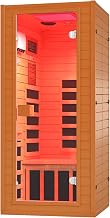
The compact choice, and the one we would put in a city apartment or a narrow basement alcove. A tempered glass door keeps the 35-inch-wide cabin from feeling like a closet, and 1200W is more than enough heat for a single-occupant volume.
Joyous 2-Person Low EMF Infrared Sauna
Seven carbon fiber heaters distributed around the cabin deliver the most even warmth per dollar in this group, and the low-EMF construction is a real reassurance for daily users. Detailing is plain rather than expressive, which is exactly why it disappears into a mixed-use room.
2 Person Far Infrared Sauna with Red Light Therapy
At 48 by 44 inches, this cabin hits the sweet spot between two-person comfort and a footprint you can actually place. Red light therapy plus seven-color chromotherapy and dual speakers make it a strong value pick if the Barcelona sits above budget.
Frequently Asked Questions
How is far infrared different from a traditional sauna?
Far infrared warms your body directly rather than heating the surrounding air, so cabins operate around 120 to 150°F instead of 180°F-plus. Sessions feel gentler, preheat in 10 to 15 minutes, and run on standard household power.
Do I need a dedicated electrical circuit?
Most 1-2 person units plug into a standard 110V outlet, but a dedicated 15 or 20 amp circuit is the safe specification, particularly for 2-3 person cabins. Avoid extension cords and power strips entirely.
Should the sauna sit directly on carpet or hardwood?
Both are workable. Hemlock bases are enclosed and run cool underneath, though a thin rubber or cork mat protects finished floors, evens out minor level variation, and keeps the cabin from creaking.
How much maintenance does hemlock require?
Very little. Wipe benches with a dry or barely damp cloth after use, leave the door ajar to air out, and never seal or varnish the interior — untreated wood is doing the work.
Final Thoughts
For most homes, the Dynamic Saunas Barcelona is the pick we would specify without hesitation: full-surround heat, red light therapy, and proportions that hold up in a real room. If your best available space is a corner, the 2-3 person hemlock corner sauna turns dead square footage into the most generous cabin here, while the OUTEXER 1200W is the honest answer for tight apartments where every inch is already accounted for.