Key takeaways
- Load path and steel gauge: A recessed base concentrates weight at the center, so look for thick-wall tubing, welded rather than bolted junctions at the main spine, and a stated capacity comfortably above the combined weight of your mattress and sleepers. Reinforced cross-supports matter more here than total leg count.
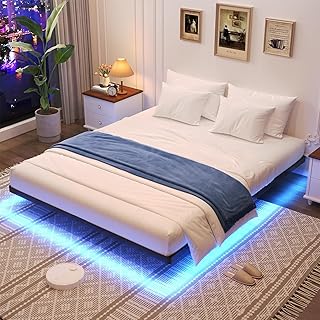
- Clearance you can actually use: Anything under roughly 8 inches is purely visual. Around 9 to 11 inches opens the space to a robot vacuum, flat storage bins, or under-bed lighting that makes the float effect read properly at night.
- Mattress retention: Since the platform sits proud of the base, a mattress with nothing to brace against will drift. Prioritize frames with a slide stopper at the foot or a raised lip, and slats spaced closely enough to support foam without sagging.
- Lighting and power integration: App or remote-controlled LED channels are now standard, but placement varies. Under-perimeter strips create the strongest hover illusion; headboard-only lighting is more of an accent. Check that USB and AC ports sit where your nightstand isn’t.
- Headboard style and assembly reality: Fluted wood and upholstered panels soften a heavily geometric frame; bare metal keeps things graphic. Most of these ship flat-pack with pre-drilled hardware, and the honest time estimate is 45 to 90 minutes with a second person for the headboard lift.
What's inside
The floating bed is one of the few design tricks that reads as luxury and engineering at the same time. Pull the base inward, hide the load-bearing structure under the center of the mattress, and the whole platform appears to hover a few inches off the floor. The illusion is easy to photograph and surprisingly hard to build well. Because the weight of two adults gets funneled through a compact central frame instead of four corner legs, cheap versions telegraph every movement: a slow lean, a metallic tick at 3 a.m., a mattress that creeps toward the footboard because nothing is holding it in place. Buyers also run into vague clearance numbers, LED strips wired to controllers that die before the frame does, and assembly diagrams that assume you own a third hand.
This guide looks at the current crop of queen floating frames through the lens of how they’re actually constructed rather than how they look in a staged render. We cover the specs that determine whether a hovering bed stays quiet and level for years, then review the standouts across the range: powder-coated steel builds with integrated charging, warmer fluted-oak interpretations for softer rooms, upholstered options with real storage clearance, and the value picks worth considering if you mostly want the silhouette.
As an Amazon Associate we earn from qualifying purchases.




How to Choose a Floating Bed Frame (2026)
- Load path and steel gauge: A recessed base concentrates weight at the center, so look for thick-wall tubing, welded rather than bolted junctions at the main spine, and a stated capacity comfortably above the combined weight of your mattress and sleepers. Reinforced cross-supports matter more here than total leg count.
- Clearance you can actually use: Anything under roughly 8 inches is purely visual. Around 9 to 11 inches opens the space to a robot vacuum, flat storage bins, or under-bed lighting that makes the float effect read properly at night.
- Mattress retention: Since the platform sits proud of the base, a mattress with nothing to brace against will drift. Prioritize frames with a slide stopper at the foot or a raised lip, and slats spaced closely enough to support foam without sagging.
- Lighting and power integration: App or remote-controlled LED channels are now standard, but placement varies. Under-perimeter strips create the strongest hover illusion; headboard-only lighting is more of an accent. Check that USB and AC ports sit where your nightstand isn’t.
- Headboard style and assembly reality: Fluted wood and upholstered panels soften a heavily geometric frame; bare metal keeps things graphic. Most of these ship flat-pack with pre-drilled hardware, and the honest time estimate is 45 to 90 minutes with a second person for the headboard lift.
The Best Floating Bed Frames (2026) Reviewed
OLEVS Floating Bed Frame Queen with Smart LED and Charging Station
This is the most complete execution of the modern metal floating bed: a rigid powder-coated steel platform, smart-controlled LED channels, and a built-in charging station that removes the need for a bedside power strip. It suits teen rooms and minimalist primary bedrooms equally well, and the assembly sequence is genuinely straightforward.
Evermagin Oak Queen Floating Bed with Fluted Headboard
The pick for anyone who finds metal frames too cold. The fluted oak-finish headboard brings a boho, tactile quality to the silhouette while the heavy-duty base handles the structural work, and the integrated LEDs plus charging port keep it functionally current.
DICTAC Queen Floating Bed with Storage Headboard
DICTAC solves the nightstand problem by building shelving into the headboard, which is smart in tight rooms where floor space is the real constraint. The metal platform feels stable underfoot and the LED and charging integration is well positioned.
Heavy Duty Modern Metal Floating Platform Bed with Smart LED
A stripped-back option that concentrates its budget on frame rigidity and noise-free joinery instead of extras. If you want the hovering profile without a decorative headboard, this is the cleanest route.
IMMERSTABLE Queen Upholstered Floating Bed with LED
The 11-inch clearance is best in class here, making this the practical choice for under-bed storage, and solid wood slats give foam mattresses proper support. The upholstered black headboard leans hotel-modern rather than showy.
Frequently Asked Questions
Are floating bed frames actually stable?
Well-built ones are. Stability comes from a wide central base and reinforced cross-members, not from corner legs. Check the load rating and confirm the main structure is welded rather than relying solely on bolts.
Do I need a box spring?
No. Every frame here uses a slat system designed to support the mattress directly. Adding a box spring would also ruin the low, floating proportions.
How are the LED lights powered?
They run off a standard outlet through a controller, typically operated by remote or app. No hardwiring or electrician required.
Will my mattress slide off?
Only if the frame lacks retention. Look for a slide stopper or raised footboard edge, and note that heavier hybrid mattresses shift less than lightweight all-foam ones.
Final Thoughts
For most bedrooms, the OLEVS frame delivers the best balance of rigidity, lighting, and built-in charging at a sensible price. Choose the Evermagin oak model if you want warmth and texture in the headboard, or the IMMERSTABLE upholstered version if under-bed clearance and a quieter, hotel-like finish matter more than a graphic metal profile.