Key takeaways
- Material first: Look for recycled felt bonded to natural rubber, or felt on its own. Skip anything described as PVC, vinyl, or “tacky” plastic mesh — those are the pads that discolor laminate finishes over time.
- Grip vs. cushion: A dual-surface felt-and-rubber pad does both, which suits smaller rugs and runners that get pushed around. Under a large rug that’s already anchored by furniture, felt-only is plenty and feels more substantial underfoot.
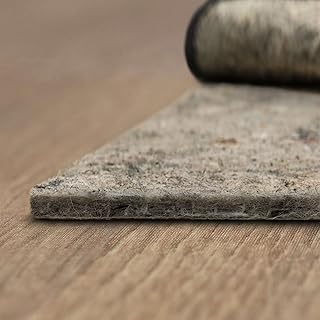
- Thickness with intent: 1/4″ is the sweet spot for laminate — enough loft to soften footfall and mute the hollow click of a floating floor, without lifting the rug edge into a trip hazard or fouling a door swing.
- Size it smaller: Order the pad to match your rug, then trim roughly an inch in from each edge. Felt cuts cleanly with sharp shears, and the slight setback lets the rug taper to the floor instead of ramping.
- Rug backing matters: Coarse jute and latex-backed rugs abrade laminate directly; a pad is non-negotiable there. Low-pile machine-woven rugs mostly need anti-slip, so prioritize the rubber face.
What's inside
Laminate has quietly become the workhorse of the modern interior — warm-looking planks, honest price, almost no fuss. What it does not do well is hold onto a rug. That factory-applied wear layer is engineered to be smooth and stain-resistant, which means a handsome flatweave will slide across it like a coaster on glass. Worse, the wrong pad can leave marks that never come out: soft PVC and vinyl mesh grippers release plasticizers that migrate into the finish and leave a yellowed, tacky ghost of the pad’s own weave.
So the brief for laminate is narrower than most shoppers realize. You want grip without adhesion, cushion without bulk, and materials that stay chemically inert against a urethane-coated surface. Below are the pads worth specifying in 2026 — the ones we keep coming back to on real installs — plus a short framework for matching thickness and construction to the rug you already own.
As an Amazon Associate we earn from qualifying purchases.


How to Choose a Rug Pad For Laminate Floor (2026)
- Material first: Look for recycled felt bonded to natural rubber, or felt on its own. Skip anything described as PVC, vinyl, or “tacky” plastic mesh — those are the pads that discolor laminate finishes over time.
- Grip vs. cushion: A dual-surface felt-and-rubber pad does both, which suits smaller rugs and runners that get pushed around. Under a large rug that’s already anchored by furniture, felt-only is plenty and feels more substantial underfoot.
- Thickness with intent: 1/4″ is the sweet spot for laminate — enough loft to soften footfall and mute the hollow click of a floating floor, without lifting the rug edge into a trip hazard or fouling a door swing.
- Size it smaller: Order the pad to match your rug, then trim roughly an inch in from each edge. Felt cuts cleanly with sharp shears, and the slight setback lets the rug taper to the floor instead of ramping.
- Rug backing matters: Coarse jute and latex-backed rugs abrade laminate directly; a pad is non-negotiable there. Low-pile machine-woven rugs mostly need anti-slip, so prioritize the rubber face.
The Best Rug Pad For Laminate Floor (2026)s Reviewed
RUGPADUSA Dual Surface (8’x10′, 1/4″)
The reference standard for laminate: dense recycled felt for cushion, natural rubber underneath for hold, and no plasticizers to worry about. It’s the pad we recommend when someone has one good rug in a high-traffic room and doesn’t want to think about it again.
RUGPADUSA Basics (9’x12′, 1/4″)
All felt, no rubber, which makes it the right call under large area rugs whose corners are already pinned by a sofa or bed. Excellent sound damping — genuinely useful on floating laminate — and the 9’x12′ cut covers most open-plan living rooms.
Veken Non-Slip Cushioned Rug Pad Gripper
Veken pairs felt with a silicone-dot backing rather than sheet rubber, and the pattern of anti-slip strips does a convincing job on slick laminate. A sensible mid-price option, though silicone grips a touch less aggressively than natural rubber on very smooth wear layers.
Mohawk Home Felt Rug Pad (9’x12′)
Straightforward felt-only cushioning at a friendly price for a big room, with a bit of thermal insulation as a bonus over slab-adjacent laminate. Pair it with furniture placement or corner grippers if your rug tends to creep.
Jorvila Non-Slip Rug Pad Gripper (8×10)
The value pick. It’s thinner and less refined than the RUGPADUSA options, but it holds a lightweight rug in place and adds real padding — a good fit for a guest room, playroom, or rental where you don’t want to overinvest.
Frequently Asked Questions
Can a rug pad damage laminate flooring?
A felt or felt-and-natural-rubber pad won’t. Cheap PVC and vinyl-coated grippers can, leaving yellow staining or a sticky residue that bonds to the finish. Read the material spec, not the marketing.
Is 1/4″ too thick for laminate?
Rarely. It’s the most comfortable option for most rooms. Drop to 1/8″ only where a door needs clearance or the rug meets a threshold you’d rather keep flush.
Do I need grip if the rug sits under furniture?
Usually not for the rug’s sake, but grip still stops the pad itself from shifting and bunching. Felt-only is fine under a fully anchored rug; add rubber for anything in a walkway.
Should the pad be smaller than the rug?
Yes — about an inch inset on each side. This keeps the pad invisible and lets the rug edge lie flat instead of curling upward.
Final Thoughts
If you buy once and forget about it, make it the RUGPADUSA Dual Surface — the felt-and-natural-rubber build is the safest, most secure pairing for a laminate wear layer. For a large anchored rug where cushion and quiet matter more than grip, RUGPADUSA Basics in 9’x12′ is the better value, and the Veken cushioned gripper covers the middle ground nicely if you want both qualities at a gentler price.