Key takeaways
- Target range: Most infrared sessions land between 110°F and 140°F. Beginners do well starting near 110–120°F for 20 minutes; experienced users often settle around 130–140°F. Higher isn’t better — infrared raises core temperature at lower ambient heat than traditional steam.
- Heater technology: Carbon panels spread warmth broadly and evenly, which suits longer, lower-temperature sessions. Ceramic emitters run hotter and more localized, reaching target faster but creating warmer and cooler zones inside the cabin.
- Control resolution: Stepped heat levels (nine on most portable units) give you rough zones. LCD controllers with degree-by-degree presets let you repeat the exact same session, which matters if you’re tracking how your body responds.
- Preheat time: A cabin that needs 40 minutes to reach 130°F will quietly stop getting used. Look for units advertising 10-minute warm-up, or tent-style designs where the enclosed volume heats almost immediately.
- EMF and materials: Low-EMF heater panels are now standard on quality cabins and worth confirming. Kiln-dried hemlock handles repeated heat cycling without warping or off-gassing the way cheaper softwoods can.
What's inside
Ask five sauna owners what temperature they run and you’ll get five confident, contradictory answers. Somewhere between the 200°F folklore of Finnish steam rooms and the gentler reality of infrared panels, buyers get lost — cranking the dial to the maximum, sweating for six minutes, and concluding the unit is broken. Infrared works differently: the heat penetrates rather than surrounds, so the number on the display means something else entirely.
This guide sorts out what temperature range actually suits infrared cabins and tents, then matches that to hardware. We look at heater type, EMF output, control precision, and how each model behaves once it settles into a session — because a sauna that holds 130°F steadily is worth more than one that spikes to 150°F and drifts. Below, five units worth your floor space, plus the specs that determine whether you’ll use it twice a week or twice a year.
As an Amazon Associate we earn from qualifying purchases.


How to Choose a Temp For Infrared Sauna (2026)
- Target range: Most infrared sessions land between 110°F and 140°F. Beginners do well starting near 110–120°F for 20 minutes; experienced users often settle around 130–140°F. Higher isn’t better — infrared raises core temperature at lower ambient heat than traditional steam.
- Heater technology: Carbon panels spread warmth broadly and evenly, which suits longer, lower-temperature sessions. Ceramic emitters run hotter and more localized, reaching target faster but creating warmer and cooler zones inside the cabin.
- Control resolution: Stepped heat levels (nine on most portable units) give you rough zones. LCD controllers with degree-by-degree presets let you repeat the exact same session, which matters if you’re tracking how your body responds.
- Preheat time: A cabin that needs 40 minutes to reach 130°F will quietly stop getting used. Look for units advertising 10-minute warm-up, or tent-style designs where the enclosed volume heats almost immediately.
- EMF and materials: Low-EMF heater panels are now standard on quality cabins and worth confirming. Kiln-dried hemlock handles repeated heat cycling without warping or off-gassing the way cheaper softwoods can.
The Best Temp For Infrared Sauna (2026)s Reviewed
Dry Infrared Sauna Box with 9 Temp Levels & Red Light
Nine discrete heat levels plus crystal heating give this fold-away box unusually fine control for its category, letting you dial in a mild 110°F recovery session or push toward the top end. The integrated red light adds a legitimate second use case, and the whole thing tucks behind a door when guests arrive.
1–2 Person Infrared Sauna with Red Light & Bluetooth
At 40″ x 36″ x 73″, this brown cabinet holds its set temperature well across a genuine two-person footprint, and the seven-color chromotherapy plus Bluetooth make longer low-temperature sessions easy to sit through. A sensible choice if you want a permanent fixture rather than something collapsible.
Homsido 1-Person Hemlock Infrared Sauna
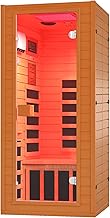
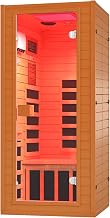
The standout here is the LCD control panel with time and temperature presets, backed by a 10-minute pre-warm cycle — the combination that makes a daily habit realistic. Low-EMF 1200W panels in a hemlock shell put this among the most precise single-person cabins available, and the one-year aftersale coverage is reassuring at this price tier.
2–3 Person Ceramic Corner Infrared Sauna
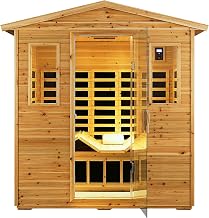
Ceramic emitters climb toward the upper 140s faster than carbon, so this corner unit suits anyone who prefers a hotter, shorter session. The ultra-large hemlock cabin fits two comfortably and three at a squeeze, and the corner geometry recovers awkward room space most cabins can’t use.
Infrared Sauna Tent with 3L Steamer
Five-layer insulated fabric holds heat surprisingly well, and pairing nine dry-heat levels with a 3L steamer means you can run infrared alone or add humidity for a warmer perceived temperature at the same setting. The 99-minute timer and remote handle the practical side; the folding chair is better than expected.
Frequently Asked Questions
What temperature should I set for my first session?
Start at 110–115°F for 15 to 20 minutes. Infrared heats you directly, so the ambient reading feels milder than the effect. Add roughly five degrees per week as your tolerance builds.
Why doesn’t my sauna reach its advertised maximum?
Ambient room temperature, ventilation, and door seal all cap the ceiling. A cabin in a 60°F basement may plateau 10–15°F below the same unit in a heated room. Preheating with the door closed and towels over any gaps usually closes most of the gap.
Is a hotter setting more effective?
Not necessarily. Session duration at a tolerable temperature tends to matter more than peak heat. Most users get better consistency at 130°F for 30 minutes than at 150°F for 10.
Do tents reach the same temperatures as wooden cabins?
Insulated tents often heat faster because the enclosed volume is smaller, and they hold comparable temperatures around your body. Cabins win on even distribution and long-term durability.
Final Thoughts
For temperature precision, the Homsido 1-Person Hemlock Sauna is the clear pick — degree-level presets and a fast pre-warm cycle make repeatable sessions genuinely easy. Households wanting room for two should look at the 1–2 Person Infrared Sauna with Red Light and Bluetooth, while anyone short on space will find the Infrared Sauna Tent with 3L Steamer delivers real heat control without a permanent footprint.