Key takeaways
- Up to 800 lb loaded: 30–40 lb thrust is generally suitable for small boats and calm freshwater.
- 800–1,500 lb loaded: 45–70 lb is a practical range for many jon boats, utility boats, and smaller fishing boats.
- 1,500–2,500 lb loaded: 80–90 lb is more appropriate, particularly for deep-V or fiberglass hulls.
- Over 2,500 lb loaded: Consider a 24- or 36-volt motor producing 100–112 lb of thrust, or use a primary outboard for long-distance travel.
Best Trolling Motors for Quiet Control on Water
The best trolling motors are chosen by matching thrust to your boat’s fully loaded weight, shaft length to the distance from mount to water, and the motor’s construction to freshwater or saltwater use.
A quiet electric motor can do more than move a boat between fishing spots: it can hold position, make small steering corrections, and approach shallow cover without the noise and wake of a gasoline outboard. The right choice depends less on maximum advertised power than on whether the motor has enough reserve thrust, a shaft that stays submerged, and a mount suited to your hull.
Our top picks

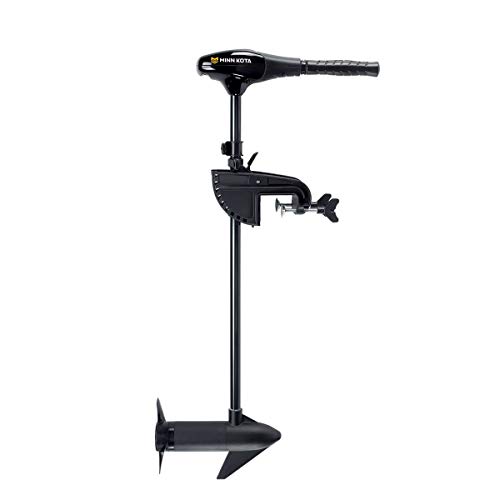
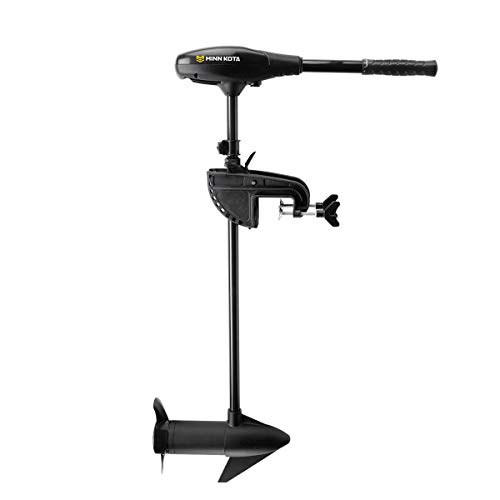

As an Amazon Associate we earn from qualifying purchases at no extra cost to you. Ratings are shown as listed on Amazon.
Quick picks by boating situation
| Situation | Best motor type | Recommended specification | Why it fits |
|---|---|---|---|
| Small aluminum boat or kayak | Transom-mount motor | 30–55 lb thrust, 30–36 in shaft | Light, affordable, and easy to remove for transport |
| 14–17 ft freshwater fishing boat | Bow-mount motor | 55–80 lb thrust, 45–60 in shaft | Better control and steering from the front of the boat |
| Heavy fiberglass bass boat | Electric-steer bow mount | 80–112 lb thrust, 52–60 in shaft | Provides reserve power and precise positioning in wind |
| Saltwater bay boat | Saltwater-rated bow or transom mount | 70–112 lb thrust, 60–72 in shaft | Uses corrosion-resistant components and a longer shaft for higher bows |
| Fishing in current or strong wind | High-thrust 24- or 36-volt motor | 80–112 lb thrust or more | Maintains control without operating continuously at full power |
How much thrust do you need?
Thrust is the pushing force produced by the propeller, measured in pounds. A common starting point is at least 2 lb of thrust for every 100 lb of fully loaded boat weight. That weight includes the hull, batteries, fuel, motor, passengers, tackle, coolers, and safety equipment—not just the manufacturer’s dry hull weight.
For example, a 1,200 lb boat and load suggests a minimum of about 24 lb of thrust by that formula. In practice, a 30 lb motor would be suitable only for calm water and modest maneuvering. A 55 lb motor gives more useful reserve for wind, weeds, current, and frequent starts and stops.
- Up to 800 lb loaded: 30–40 lb thrust is generally suitable for small boats and calm freshwater.
- 800–1,500 lb loaded: 45–70 lb is a practical range for many jon boats, utility boats, and smaller fishing boats.
- 1,500–2,500 lb loaded: 80–90 lb is more appropriate, particularly for deep-V or fiberglass hulls.
- Over 2,500 lb loaded: Consider a 24- or 36-volt motor producing 100–112 lb of thrust, or use a primary outboard for long-distance travel.
Boat shape matters. A wide, deep hull creates more resistance than a narrow flat-bottom boat of the same weight. Wind matters too: a tall console, raised bow, or canopy catches air and can make an undersized motor struggle to hold a position. More thrust does not automatically mean more speed, but it does reduce the time a motor must run at maximum output.
Shaft length: the measurement that prevents lost control
The propeller should remain submerged roughly 12 inches below the waterline during ordinary operation. Too short a shaft allows the propeller to ventilate when the bow rises, causing noise, reduced thrust, and inconsistent steering. Too long a shaft can strike the bottom, complicate stowing, and sit unnecessarily low in shallow water.
| Mounting location | Measure from | Typical shaft length | Common use |
|---|---|---|---|
| Transom | Top of transom to waterline, plus about 12 in | 30–36 in | Small aluminum boats, canoes, and inflatables |
| Bow, low profile | Top of bow to waterline, plus about 12 in | 45–52 in | Low-deck bass boats and shallow jon boats |
| Bow, raised deck | Top of bow to waterline, plus about 12–18 in | 54–60 in | Deep-V fishing boats and higher fiberglass hulls |
| Saltwater bay or offshore bow | Top of bow to waterline, plus about 18 in | 60–72 in | High bows, tidal chop, and open-water conditions |
Measure with the boat loaded as it normally fishes. If your measurement falls between available sizes, the longer shaft is usually safer for a bow mount, provided it can be stowed without interfering with the deck, anchor, or hatch.
Bow mount or transom mount?
Bow-mount motors
A bow mount pulls the boat rather than pushing it, which generally makes it easier to steer into wind and hold a fishing line. Foot pedals leave both hands available for casting, while remote controls and GPS-enabled systems can automate heading or position holding. Models such as the Minn Kota Terrova and Ultrex, Garmin Force Kraken, and Lowrance Ghost represent the premium freshwater end of this category.
The disadvantages are cost, installation space, and battery demand. A bow mount needs a level mounting surface, room for the motor to deploy, and a strong connection to the deck. A quick-release bracket is useful if the boat is stored outside or transported frequently.
Transom-mount motors
A transom motor is simpler and often costs less, usually in the range of about $150–$600 for common recreational models, with higher-output versions costing more. It suits small boats, canoes, inflatable boats, and owners who need to remove the motor after every trip. Tiller steering is immediate and easy to understand.
Because it pushes from the rear, a transom mount is less convenient for precise fishing control. On a boat with a high transom or stern-mounted outboard, verify that the clamp bracket can reach securely and that the motor will clear the propeller of the primary engine.
Freshwater versus saltwater construction
Saltwater is not simply “stronger freshwater.” It accelerates corrosion around fasteners, electrical connections, shafts, steering components, and sacrificial anodes. Choose a motor explicitly rated for saltwater when operating in tidal water, brackish water, or coastal launches. Rinsing the motor with fresh water after every saltwater trip is still necessary.
| Construction feature | Freshwater priority | Saltwater priority | Trade-off |
|---|---|---|---|
| Composite shaft | Lightweight and resistant to bending | Useful where corrosion is a concern | Can flex more than stainless steel under heavy loads |
| Stainless or coated hardware | Helpful for durability | Essential around brackets and electrical fittings | Raises cost and still requires rinsing |
| Sealed electronics | Protects against rain and spray | Reduces damage from salt mist | Repairs may be more expensive |
| Weedless propeller | Important in vegetation | Useful around grass and shallow marshes | May sacrifice some top-end efficiency for clearance |
Do not use a basic freshwater-only model in the ocean just because it has enough thrust. A saltwater-rated motor is a better choice for coastal use, and the battery terminals should be protected with suitable marine-grade connections rather than household extension cords or unsealed connectors.
Battery, voltage, and operating range
Most smaller motors use a 12-volt battery. Higher-thrust motors may require 24 volts, while the strongest systems often use 36 volts. A 24-volt system does not necessarily run twice as fast; its main advantages are higher available power, lower current at a given output, and better endurance under demanding loads.
Battery capacity is measured in amp-hours. A 12-volt, 100-amp-hour battery stores approximately 1,200 watt-hours in ideal conditions, although usable capacity depends on battery chemistry, temperature, age, and discharge limits. Lithium iron phosphate batteries are lighter and maintain voltage well, but typically cost more than lead-acid deep-cycle batteries. Confirm that the charger matches the battery type and voltage.
For quiet control, avoid sizing the system so narrowly that the motor must run at full power all day. A larger motor operated at moderate output is often quieter and more efficient than a small motor constantly fighting wind or current.
Features worth paying for
- Variable-speed control: Provides small speed adjustments and is quieter than a few fixed-speed settings.
- Digital maximizer or pulse-width control: Helps reduce wasted battery power at lower speeds.
- GPS position holding: Useful for repeating a drift, holding over a waypoint, or maintaining a heading, but it depends on satellite reception and a healthy battery.
- Spot-lock-compatible controls: Convenient when wind or current makes manual corrections tiring.
- Depth-adjustable collar: Makes it easier to keep the propeller at the correct depth as the boat loads differently.
- Breakaway mount: Protects the motor if the lower unit contacts an underwater object.
Before buying: installation and durability checks
Measure the deck, hatch openings, and storage compartment before ordering a bow motor. Many complete motor-and-bracket assemblies weigh roughly 35–75 lb, and a long shaft can make the package awkward through a narrow doorway. A transom motor may weigh about 20–45 lb, but its battery can add another 50–70 lb if using lead-acid technology.
Check that the battery compartment is ventilated where required, the cables reach without sharp bends, and the circuit breaker is sized according to the motor manufacturer’s instructions. The first parts commonly affected by neglect are battery terminals, propeller pins, sacrificial anodes, and deploy-and-stow pivots—not usually the motor itself. Rinse saltwater equipment, inspect the propeller for fishing line, and remove the propeller periodically to check the shaft seal area.
For the best balance of quiet operation and control, choose the thrust category above your minimum calculation, select a shaft that keeps the propeller submerged in your normal load condition, and buy a saltwater-rated model whenever coastal use is part of the plan. That approach matters more than choosing the most powerful motor on the shelf.