Key takeaways
- Strip the bed completely first — bedding trapped inside the bag holds humidity against the fabric.
- Tape the zipper pull down with packing tape so it can’t work open mid-carry.
- Wear gloves with grip. Most dropped-mattress incidents are hand slips, not strength failures.
- Carry with the mattress label facing you so you know which side is up when you set it down.
What's inside
A king mattress is the single most awkward object in most homes. It weighs somewhere between 100 and 140 pounds, measures 76 by 80 inches, and has no rigid frame to grab onto — which means it wants to fold in the middle exactly when you need it to stay flat. Add a stairwell, a doorframe, and a rainy loading day, and a piece of furniture you spent real money on can pick up permanent damage in under ten minutes. Compression, torn seams, and moisture in the foam layers are all mostly preventable, and the prevention is cheaper than the repair.
This guide walks through the whole sequence: how to protect the mattress before it leaves the room, how to carry and orient it without stressing the internal coils, what to do about doorways and tight turns, and how to store it if it’s not going straight onto a frame. You’ll also see where a purpose-built mattress bag earns its keep versus improvised plastic sheeting, and what to look for if you’re shopping for one.
As an Amazon Associate we earn from qualifying purchases.


Bag it before you lift it
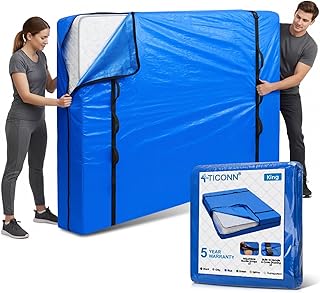
Wrap the mattress while it’s still flat on the bed, not after you’ve wrestled it into the hallway. A proper king mattress bag does three jobs at once: it blocks water and road grit, it stops the fabric cover from snagging on hinges and truck walls, and — critically — it gives you handles where the mattress has none. Options like the Nordic Elk King Size Mattress Bag with eight reinforced handles or the TICONN Heavy Duty King Mattress Cover with full-around handles and adjustable buckles turn a slippery slab into something two people can actually grip. If you’re moving through a doorway with hard edges, look for extra-thick material such as the SGPAC Heavy Duty Mattress Bag, which is built to resist punctures rather than just repel rain. A twelve-handle bag with a strong zipper gives you the most placement options for a long carry.
Keep it vertical — but only briefly
Turning the mattress on its side is the only realistic way to get it through most doors and up most stairs, and short periods on edge are fine. The risk is sustained pressure: leaving a hybrid or innerspring king standing on one edge for hours puts uneven load on the perimeter coils and the foam encasement. Get it upright, move it, and lay it flat again as soon as you reach the truck. Never fold or bend a king mattress. Innerspring and pocket-coil constructions can suffer permanent coil deformation from a single hard crease, and thick foam layers can delaminate at the fold line.
Measure the exit route, not just the mattress
The mattress will fit through a standard 32-inch door on edge — the question is whether the turn at the end of the hallway will. Before lifting anything, walk the route with a tape measure and check three things: the narrowest doorway width, the diagonal clearance at any 90-degree turn, and stairwell headroom on landings. Remove the door from its hinges if you’re within an inch or two; it takes five minutes and buys you real room. If you have a tight switchback stair, plan on a third person at the landing to pivot rather than trying to muscle the turn with two.
Load it flat and load it last
In the truck, a king mattress belongs flat against one wall or laid across the top of the load — never sandwiched under boxes. Weight on a mattress in transit compresses foam unevenly and can crush coil units over a long drive. If flat isn’t possible, stand it on its long edge against a side wall and strap it so it can’t slide or lean. Slide the strap over the bag’s buckles or handles rather than cinching directly across the center of the mattress. A common mistake is loading the mattress early and stacking against it; the resulting dents in memory foam often don’t fully recover.
Storing it between moves
If the mattress is going into storage rather than straight onto a frame, keep it flat, off the concrete, and sealed. Concrete wicks moisture, so put it on a pallet or a couple of 2x4s. Choose a reusable waterproof bag with a real zipper over a thin disposable sleeve — you’ll open and reseal it more than once, and a torn bag protects nothing. Climate-controlled space is worth the premium for anything with memory foam, which degrades in sustained heat.
Tips
- Strip the bed completely first — bedding trapped inside the bag holds humidity against the fabric.
- Tape the zipper pull down with packing tape so it can’t work open mid-carry.
- Wear gloves with grip. Most dropped-mattress incidents are hand slips, not strength failures.
- Carry with the mattress label facing you so you know which side is up when you set it down.
Frequently Asked Questions
Can one person move a king mattress?
It’s possible on flat ground with a handled bag and a furniture dolly, but not advisable on stairs. The mattress is wide enough that a single carrier can’t control both ends, and a mid-carry fold is where damage happens.
Is it safe to fold a king mattress to fit it in a car?
No. Only mattresses sold compressed in a box — like most 14-inch hybrids, including bed-in-a-box models with pocket coils — are engineered for that, and only once, at the factory. Folding at home risks permanent coil and foam damage.
Do I need a mattress bag if the move is only ten minutes?
Yes. Most mattress damage happens during handling, not driving: scraped fabric on doorframes, grit from the truck floor, a sudden rain shower at the curb. Ten minutes is enough for all three.
How long can a mattress stay on its side?
Treat a few hours as the practical ceiling for a hybrid or innerspring king. Foam-only mattresses tolerate it slightly better, but flat is always the correct resting position.
Conclusion
Moving a king mattress well comes down to three decisions made before the lift: seal it in a handled, waterproof bag; measure the route and clear the obstacles; and load it flat with nothing stacked on top. Get those right and the rest is just careful walking — and the mattress arrives in the same condition it left in, which is the entire point.