Key takeaways
- Wood type and honesty of construction: Solid rubberwood and pine are the sweet spot for durability against cost. Rubberwood is denser and takes a walnut or mahogany finish beautifully; pine is lighter, softer, and more forgiving on a budget. If a listing says “wood” without naming the species, expect engineered panels somewhere in the mix.
- Slat spacing, not slat count: Foam and hybrid mattresses need gaps of roughly three inches or less to avoid sagging and to keep warranties intact. A center support rail with legs matters more than a high slat count on a frame without one.
- Deck height and what lives underneath: Twelve to fourteen inches of clearance gives you real storage without stacking your mattress into loft territory. Lower profiles read more contemporary but eliminate under-bed space entirely.
- Headboard proportion: Measure your wall before falling for a 51-inch headboard. Tall fluted panels anchor high-ceilinged rooms and overwhelm compact ones, where a modest slatted or flat headboard keeps sightlines open.
- Noise engineering: Look for felt or rubber padding at slat contact points, bolt-through joinery rather than cam locks, and rounded edges. These are the details that separate a frame that stays silent from one that needs re-tightening every season.
What's inside
Wood is having a moment in the bedroom again, and not the glossy, orange-toned wood of a decade ago. The current wave leans quieter: fluted fronts, softly rounded corners, low profiles that let a mattress read as architecture rather than an afterthought. The catch is that the category has filled up faster than quality has caught up. Two beds can look nearly identical in a listing photo and behave completely differently after six months, one holding tight and silent, the other announcing every shift in weight through a chorus of creaks. The word “wood” is doing a lot of heavy lifting in these product titles, and it rarely tells you whether you’re getting kiln-dried rubberwood, pine, or a veneered engineered panel dressed up to look the part.
This guide sorts through the wooden platform beds worth considering in 2026, with attention to the details that actually determine how a frame lives in a room: slat spacing and support, joinery, headboard proportion, deck height, and whether the finish will still look intentional under warm evening light. Below you’ll find the current standouts across sizes and price tiers, plus a short framework for matching a frame to your mattress and your room.
As an Amazon Associate we earn from qualifying purchases.



How to Choose a Wooden Platform Bed (2026)
- Wood type and honesty of construction: Solid rubberwood and pine are the sweet spot for durability against cost. Rubberwood is denser and takes a walnut or mahogany finish beautifully; pine is lighter, softer, and more forgiving on a budget. If a listing says “wood” without naming the species, expect engineered panels somewhere in the mix.
- Slat spacing, not slat count: Foam and hybrid mattresses need gaps of roughly three inches or less to avoid sagging and to keep warranties intact. A center support rail with legs matters more than a high slat count on a frame without one.
- Deck height and what lives underneath: Twelve to fourteen inches of clearance gives you real storage without stacking your mattress into loft territory. Lower profiles read more contemporary but eliminate under-bed space entirely.
- Headboard proportion: Measure your wall before falling for a 51-inch headboard. Tall fluted panels anchor high-ceilinged rooms and overwhelm compact ones, where a modest slatted or flat headboard keeps sightlines open.
- Noise engineering: Look for felt or rubber padding at slat contact points, bolt-through joinery rather than cam locks, and rounded edges. These are the details that separate a frame that stays silent from one that needs re-tightening every season.
The Best Wooden Platform Beds (2026), Reviewed
AMERLIFE Fluted King Bed Frame, Black
The fluted headboard and matching footboard give this king a tailored, almost cabinetry-like presence, and the black finish does the rare trick of feeling both moody and neutral. Rounded safety edges and full slat support make it a genuinely practical choice for a primary bedroom that needs to look composed without a box spring.
LIFEMENT Signature Wood Platform Bed, Natural Full
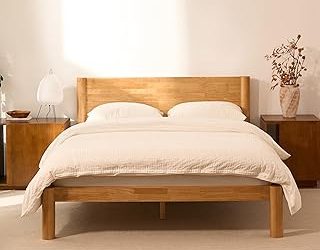
A restrained, honest frame built around the things that matter most: noise-free assembly, usable under-bed clearance, and a headboard that stays out of the way visually. In a full size, it’s one of the smarter picks for guest rooms, smaller primaries, and rentals where you want warmth without commitment.
Apollo Solid Wood Platform Bed, Queen in Mahogany
Solid rubberwood with a reinforced frame puts this squarely in mid-century Scandinavian territory, tapered legs and all. The mahogany finish reads richer in person than in photos, and it pairs unusually well with linen bedding and mixed-metal lighting.
Evermagin Fluted Walnut Queen with Storage Bench
The 63-inch storage bench at the foot is the standout here, functioning as a chest, a seat, and a visual anchor all at once. Combined with the tall fluted walnut headboard, it’s the most design-forward option on this list and the best fit for a boho or warm-modern room with the square footage to carry it.
Mellow Naturalista Classic 12-Inch, Queen Pine
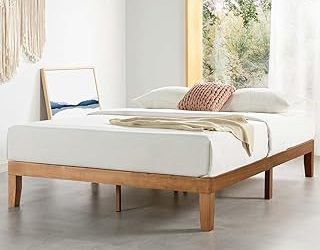
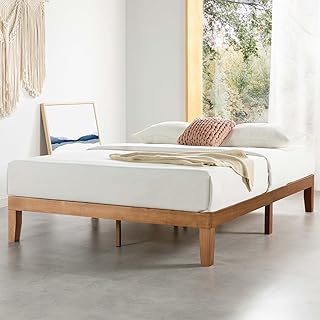
Twelve inches of solid pine with wooden slats, minimal styling, and nothing to distract from the mattress. It’s the frame to buy when you want the wood to feel like a material choice rather than a statement, and it takes a coat of stain or paint readily if you ever want to shift direction.
Frequently Asked Questions
Do wooden platform beds need a box spring?
No. Every frame here uses slat support engineered to hold a mattress directly, which is why deck heights run 12 to 14 inches. Adding a box spring raises the sleep surface awkwardly and provides no structural benefit.
Will a wooden frame stay quiet over time?
Mostly, yes, if the joinery is bolt-through and the slats sit on padded contact points. Retighten the hardware once after the first month of use, then annually. Frames like the KOMFOTT 14-inch rubberwood platform are built with this kind of rigidity in mind.
Is rubberwood better than pine?
Rubberwood is harder and more dimensionally stable, so it resists dents and holds tight joinery longer. Pine is lighter and easier to move and finish, which makes it a strong value pick if the bed won’t see heavy daily disassembly.
How long does assembly usually take?
Plan on 30 to 60 minutes with a second set of hands, longer for kings with footboards or a storage bench. Keep the hardware finger-tight until every piece is in place, then tighten in sequence to avoid a racked frame.
Final Thoughts
If you want the most polished look for a primary bedroom, the AMERLIFE fluted king delivers a designer silhouette at a mainstream price. For a warmer, more collected feel, the Apollo solid rubberwood queen in mahogany is the one I’d live with longest, and the Evermagin fluted walnut with its storage bench makes the strongest case for anyone who needs the bed to solve a storage problem while it anchors the room.