Key takeaways
- Measure the narrowest table-leg opening, bench envelope and tuck-in depth with a practical worksheet and a clearly labeled fit example.
What's inside
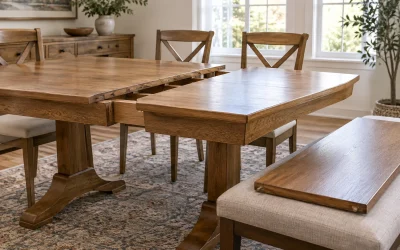
To check whether a dining bench fits between table legs, compare the bench’s widest outer dimension with the narrowest opening along its actual path. Tabletop length is not that opening. Then check height, depth, braces, and the space needed to pull the bench out and sit down.
Define what you mean by fitting
A bench may stand comfortably beside a table yet be unable to tuck underneath it. Another may tuck away neatly but leave too little room for someone’s legs when pulled into its eating position. Decide which outcome you need before choosing a size.
Write down three positions: fully stored, ready for someone to sit, and occupied. If you only need a bench to sit beside the table, full tuck-in may be optional. If the room doubles as a walkway or work area, the stored position may be the deciding requirement.
Measure the opening at several heights
Start with the inside distance between the table legs near the floor. Repeat near the bench seat height and anywhere a bracket, stretcher, or apron projects inward. Splayed legs can make one measurement misleading. A decorative foot can narrow the route even when the space higher up looks generous.
Record the bench’s seat length and its overall width across the outermost legs or frame. Use whichever is larger for the relevant part of the path. The top may overhang its base, or the base may spread beyond the top. Ask for an extra dimension drawing when a product page lists only the seat.
| Measurement | Where to measure | Purpose |
|---|---|---|
| Clear opening | Between legs, feet and brackets at several heights | Find the narrowest entry |
| Bench envelope | Widest seat, frame or leg dimension | Check what must pass through |
| Vertical clearance | Floor to lowest table obstruction | Check bench and cushion passage |
| Stored depth | Table edge to opposing obstruction | Check how far the bench can tuck |
| Pull-out space | Bench position to wall or furniture | Allow an actual sitting trial |
| Occupied fit | Seat, table underside and foot position | Check the intended diners |
Use product dimensions precisely
The IKEA ÅLHULT bench, article 606.030.93, is listed as 40.5 inches long, 14.125 inches wide, and 17.75 inches high. These describe that bench; they do not tell you the clearance under an unrelated table. Even a product described as suitable for tucking under a table needs to be checked against the table you own.
Do not use package dimensions for this step. Packaging answers a transport question, while assembled dimensions describe the furniture in the room. Also note any cushion you plan to add. Its height and ties can change passage under a low apron, even if the bare wooden bench clears.
Worked example: the hidden narrow point
This example uses invented measurements. A table has a 60-inch top, with 45 inches between the inner faces of its legs near the seat. Decorative feet narrow the opening to 42 inches near the floor. A proposed bench is 40.5 inches across its widest points.
The tightest horizontal clearance is 42 minus 40.5, or 1.5 inches total. If centered, that leaves 0.75 inch on each side. That calculation does not establish comfortable handling clearance or account for an angled approach. It simply identifies the tight location you must examine rather than relying on the much larger tabletop.
Now suppose the bench seat clears the apron but a crossbar stops it after ten inches of travel. The bench may enter between the legs yet remain partly exposed. Your worksheet should record “partial tuck only,” instead of reducing the whole assessment to a yes or no based on length.
Test the movement without forcing furniture
Make a paper footprint of the bench and place it beside the table. Slide the paper through the planned path, marking any leg or foot that intrudes. Use a separate note for the seat height because a floor outline cannot represent an apron or brace above it.
If you can try an actual bench in a showroom, ask staff to demonstrate movement with the intended table. Pull it out as you normally would, then sit and stand without climbing over it. Test access for a person seated near the middle; a long bench does not provide independent entry to every seat.
At home, avoid dragging a heavy bench or using your fingers as clearance gauges. The purpose is to verify a comfortable arrangement, not to prove that furniture can squeeze through with force. A tight fit that requires perfect alignment every time may be a poor everyday choice.
Keep seating capacity as a separate check
Passing between the legs does not establish how many people should sit on the bench. Follow its stated use and load instructions, then check comfortable seating with the intended diners. The table’s end seats, braces, and place settings may further limit practical capacity.
Before ordering, save the bench dimensions, your table measurements, and a note describing the accepted stored position. For armchairs on another side of the same table, use the separate armchair and table-apron clearance check. Each seating type needs its own fit assessment.