Key takeaways
- Best Overall: DREO 11L Smart 747S, up to 700 sq ft listed, 100 hours, 21 dB, app and remote
- Best Smart Alternative: Levoit OasisMist 1000S, 10 liters, listed at about 100 hours, smart controls
- Best Value for Big Rooms: Lacidoll 8L, 8 liters, 48 hours and 800 sq ft listed
- Best for Warm and Cool in Large Rooms: iFeiCho 7L Smart, 70 hours, 450 mL per hour maximum, up to 500 sq ft
- Best Classic Warm Mist: Vicks Warm Mist 1 gallon, filter-free, medium to large rooms
- Best for a Desk or Small Office: Levoit 3L Cool Mist, a compact top-fill tank with 360-degree nozzle
- Best With Nightlight: Frida 3-in-1, 60-hour runtime with diffuser and nightlight
For a dry cough that flares up in the rooms where you spend your day, the DREO 11L Smart 747S is the best humidifier in this guide because it is built for spaces up to a listed 700 square feet, runs a listed 100 hours per fill and is rated at 21 dB, while the Levoit OasisMist 1000S is the runner-up if you prefer the Levoit app and a 10-liter tank. Both are designed for living rooms, home offices and open-plan spaces rather than just a nightstand.
Most humidifier advice focuses on the bedroom, but a dry cough often nags during the day, when you are working at a desk or sitting in a heated living room. That changes the best choice. You need larger coverage, quiet operation during calls and a unit that looks acceptable in a shared room. A humidifier will not treat a cough, which can come from infections, allergies, reflux, asthma and many other causes. It may add moisture to dry air that makes your throat feel scratchy. See a doctor if a cough lasts more than two or three weeks, brings up blood, comes with fever, wheezing or shortness of breath, or follows a choking episode.
We did not personally use these products. Specs come from product listings and maker information, and we mark unverified details as not listed. Prices appear only as tiers (Budget, Mid-range, Premium).
Our top picks



As an Amazon Associate we earn from qualifying purchases at no extra cost to you.
Top Picks at a Glance
- Best Overall: DREO 11L Smart 747S, up to 700 sq ft listed, 100 hours, 21 dB, app and remote
- Best Smart Alternative: Levoit OasisMist 1000S, 10 liters, listed at about 100 hours, smart controls
- Best Value for Big Rooms: Lacidoll 8L, 8 liters, 48 hours and 800 sq ft listed
- Best for Warm and Cool in Large Rooms: iFeiCho 7L Smart, 70 hours, 450 mL per hour maximum, up to 500 sq ft
- Best Classic Warm Mist: Vicks Warm Mist 1 gallon, filter-free, medium to large rooms
- Best for a Desk or Small Office: Levoit 3L Cool Mist, a compact top-fill tank with 360-degree nozzle
- Best With Nightlight: Frida 3-in-1, 60-hour runtime with diffuser and nightlight
Room Coverage Comparison Table
| Product | Best space | Key specs (from listings) | Output per hour at listed runtime | Price tier |
|---|---|---|---|---|
| DREO 11L 747S | Open plan, up to 700 sq ft | 11L; 100H; 21 dB; app and remote | About 110 mL | Premium |
| Levoit OasisMist 1000S | Large living room or suite | 10L; about 100H; smart | About 100 mL | Premium |
| Lacidoll 8L | Large room, up to 800 sq ft | 8L; 48H; top fill | About 167 mL | Mid-range |
| iFeiCho 7L Smart | Large room, up to 500 sq ft | 7L; 70H; warm and cool; 450 mL/h max | About 100 mL (low) | Premium |
| Vicks Warm Mist 1 gal | Medium to large room | 1 gallon; filter-free | Runtime not listed | Mid-range |
| Levoit 3L Cool Mist | Desk, small office | 3L; top fill; 25W | Runtime not listed | Mid-range |
| Frida 3-in-1 | Bedroom or den | 60H; diffuser; nightlight | Tank not listed | Mid-range |
1. DREO 11L Smart 747S: Best Overall for Large Living Spaces
- Tank: 11 liters, top fill
- Listed coverage: up to 700 square feet
- Listed runtime: up to 100 hours
- Noise: 21 dB listed
- Controls: app and remote in the listing
Best for: an open-plan living area, a large home office or a master suite where you spend long hours.
Skip if: your space is a small room, where this unit would be larger than needed.
A big tank solves the biggest annoyance of daytime humidifier use, which is refilling. At roughly 110 mL per hour on the listed numbers (11,000 mL over 100 hours), the unit can run for days between fills. If you work from home, that means a quiet machine in the corner and one fill every few days instead of a nightly chore.
The 21 dB listed noise level is helpful on video calls, since a loud hiss is picked up by microphones. Real sound depends on settings and the water level, so expect a bit more at high output.
App and remote control let you set a target and schedule, which prevents the unit from running when you are away. Coverage numbers are best-case; a drafty room with a high ceiling will not hold the same humidity as a sealed room, so watch a hygrometer.
Pros
- Large tank and very long listed runtime
- Low listed noise
- App and remote control
- Large coverage rating
Cons
- Premium price tier
- Big footprint
- Overkill for small rooms
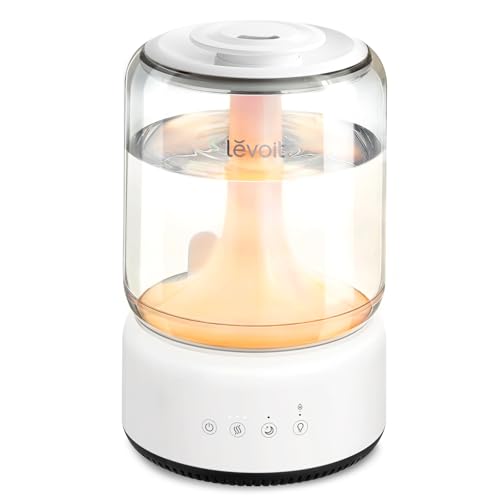
2. Levoit OasisMist 1000S: Best Smart Alternative
- Tank: 10 liters
- Listed runtime: about 100 hours
- Type: smart ultrasonic
- Positioning: large room, bedroom and indoor plants
- Controls: app
Best for: people who prefer the Levoit app ecosystem and want a large, smart humidifier.
Skip if: your tap water is hard and you do not want to use distilled, since ultrasonic output carries minerals.
The 1000S is the closest rival to the DREO 11L. Ten liters over about 100 hours is about 100 mL per hour, a gentle rate that suits a steady daytime humidity target. The smart controls let you set the room to a humidity level and walk away.
The mist is cool. If you want warm mist for your cough, look at the iFeiCho or Vicks instead.
If your family already uses Levoit devices, the app may be familiar. Otherwise the DREO offers similar capacity at a similar tier.
Pros
- Big tank with long runtime
- Smart target setting
- Good for large rooms
Cons
- Premium price tier
- Hard water can leave dust
- No warm mist
3. Lacidoll 8L: Best Value for Big Rooms
- Tank: 8 liters, top fill
- Listed coverage: large room, 800 square feet
- Listed runtime: up to 48 hours
- Type: cool mist
- Positioning: bedroom, nursery and large room per the listing
Best for: a large room where you want volume at a lower tier than the smart models.
Skip if: you want app control or a documented noise level; neither is in the title.
Eight liters over 48 hours is about 167 mL per hour, higher than the premium units. That makes it effective in a big, dry room, and it makes it easy to over-humidify a small one. Use it only where the space justifies it.
Treat the 800-square-foot figure as an upper bound. Insulation, drafts and ceiling height change real results.
Because it is a less established brand, check the return policy and the manual.
Pros
- High output
- Big tank
- Mid-range tier
Cons
- Noise not listed in the title
- Easy to over-humidify
- Less established brand
4. iFeiCho 7L Smart: Best Warm and Cool Option for Large Rooms
- Tank: 7 liters
- Mist type: warm and cool
- Listed runtime: 70 hours
- Output: up to 450 mL per hour
- Coverage: up to 500 square feet; app and remote
Best for: adults who want to choose between warm and cool mist in a large room and like smart control.
Skip if: children or pets could reach the unit, or you want the lowest price.
Having both mist types in a big room is unusual. On a cold day, warm mist may feel more comfortable when you have a scratchy cough. On mild days, cool mist uses less energy. As with all warm units, the medical evidence does not favor warm over cool, so choose by comfort.
The 450 mL per hour maximum is generous, while 7,000 mL over 70 hours is 100 mL per hour at the low setting. That range gives you room to boost output for a dry afternoon and then dial back.
Warm mist requires the usual safety care: stable surface, out of reach of children and pets, and descaling on schedule.
Pros
- Warm and cool mist
- Wide output range
- App and remote
- Large coverage
Cons
- Premium price tier
- Burn risk with warm mist
- Scale cleanup
5. Vicks Warm Mist 1 Gallon: Best Classic Warm Mist
- Tank: 1 gallon (about 3.8 liters)
- Type: warm mist
- Design: filter-free per the listing
- Room size: medium to large
- Controls: basic
Best for: adults who prefer a familiar warm mist machine in a home office or living room.
Skip if: you want a quiet, silent machine or you have children in the home.
A simple warm mist unit with a 1-gallon tank is easy to understand. Fill it, plug it in and let it run. It does not have smart control, so keep a hygrometer nearby to avoid over-humidifying.
The title does not give a runtime, so we do not quote one. Plan to refill daily and descale weekly with vinegar.
Warm mist can feel soothing for a dry cough, but there is no strong evidence that it works better than cool mist. Keep it out of reach.
Pros
- Large tank
- Filter-free
- Familiar design
Cons
- Burn and spill risk
- Scale build-up
- No humidity control
6. Levoit 3L Cool Mist: Best for a Desk or Small Home Office
- Tank: 3 liters, top fill
- Power: 25 watts
- Nozzle: 360-degree
- Diffuser tray in the listing
- Runtime: not listed in the title
Best for: a small office or den where a big unit would be too much.
Skip if: you need to cover a large space.
If your dry cough hits at your desk, a compact unit placed three to four feet from your chair can add comfort without taking over the room. The 360-degree nozzle lets you aim mist away from your computer and papers.
Keep electronics at a safe distance, since mist can settle on surfaces. A coaster or tray under the unit protects the desk.
Skip the essential oil tray if fragrance irritates your cough.
Pros
- Compact
- Easy top fill
- Directional nozzle
Cons
- Runtime not listed
- Small coverage
- No sensor
7. Frida 3-in-1: Best With a Nightlight for Den or Bedroom
- Type: cool mist
- Listed runtime: 60 hours
- Functions: humidifier, diffuser, nightlight
- Positioning: large rooms and bedrooms
- Tank: not listed in the title
Best for: a den or bedroom where you want a soft light and a long runtime.
Skip if: you are sensitive to scents or want complete darkness.
The 60-hour listed runtime is long. Without a tank size, we cannot calculate an output rate.
Treat the diffuser as optional. For a cough, plain water is the safer choice.
Check that the nightlight can be switched off.
Pros
- Long runtime
- Nightlight
- Bedroom-friendly
Cons
- Tank size not listed
- Diffuser may irritate
- Noise not listed
Also Consider
GloryAir 9L: A 9-liter cool and warm mist unit with 60 hours listed, for people who want a large tank and both modes at a premium tier.
Crane Warm Mist: A small warm mist unit with a vapor pad tray for a desk or small room; mind the hot-water caution.
MEGAWISE 3.5L: A 3.5-liter top-fill ultrasonic unit with diffuser function; a decent small-room backup.
How We Chose
We started with real humidifiers in the product store and focused on large-tank units, since daytime rooms are bigger than nurseries. We compared tank size, listed runtime, noise, coverage and controls.
The research uses listing details, manufacturer information and public guidance from sources including Mayo Clinic and the EPA. We did not personally use these products and we do not publish lab numbers. If a spec was not in the listing, we mark it not listed.
We limited each brand to two main picks, avoided medical promises and used price tiers.
Buying Guide
Daytime vs Nighttime Humidifier Needs
At night you want quiet and a small footprint. In the day you want coverage and long runtime, since refilling a unit mid-meeting is annoying. Larger tanks of 7 to 11 liters suit daytime spaces. Noise ratings matter during calls.
Place the unit away from your computer and from wood floors where mist can condense.
Coverage and Output
Divide tank volume by runtime to get output per hour. Large units listed at 100 hours from 10 liters put out about 100 mL per hour at the lowest setting. Smaller rooms need less; large open spaces need more or several smaller units.
Coverage claims are best-case estimates. Open doors, high ceilings and drafts reduce real-world performance.
Warm Mist, Cool Mist and Safety
Cool mist is safer around children and pets. Warm mist is comforting for some adults but carries burn risk and needs descaling. In a shared living room, cool mist is the safer default.
Humidity Target
Aim for about 30 to 50 percent. Dry air can make a cough feel worse in some people, while humidity above 60 percent encourages mold and dust mites, which can trigger coughing. A hygrometer is the best companion purchase.
Water and Cleaning
Empty and rinse the tank daily, and descale weekly with white vinegar. In hard-water areas, use distilled water for ultrasonic units to avoid white dust. A dirty humidifier can add germs and mold to the air, which can make coughing worse.
Mistakes That Keep a Dry Cough Going
A humidifier can only help if it is used well. Avoid these errors.
- Buying a unit that is too small for the room.
- Running it on high until humidity passes 60 percent.
- Placing it near computers or wood furniture where mist condenses.
- Skipping cleaning and breathing in stale mist.
- Using essential oils that irritate the throat.
- Ignoring a cough that lasts more than two or three weeks.
Why Your Cough May Be Worse in Winter
Heating systems warm cold outdoor air, which lowers relative humidity. A home that sits at 60 percent in July may sit at 20 percent in January. Dry air can make the lining of the nose and throat feel dry and scratchy, and some people find that they cough more in those conditions.
A humidifier may reduce that dryness. But coughs have many causes, and a cough that persists despite a comfortable humidity level deserves a medical check. Pay attention to patterns: does it start when you lie down, after meals, after exercise or only at work? Those clues help a doctor figure out the cause.
Also check your environment. Dust, pet dander, new carpets, cleaning products and smoke can trigger coughing. Keep the humidifier clean so it does not add to the problem.
Worked Example: A 20 by 25 Foot Open-Plan Room
Picture an open-plan living and working area of 20 by 25 feet, which is 500 square feet, with nine-foot ceilings. That is 4,500 cubic feet of air. In a heated home in January, humidity might sit at 25 percent. Raising it to 40 percent takes a lot more water than in a bedroom, because the room is bigger, has more furniture and fabric to absorb moisture and shares air with the rest of the house.
A unit that puts out about 100 mL per hour would add 2.4 liters in a day running around the clock, which is modest for a space this size. A unit that outputs 167 mL per hour, like the Lacidoll, would add four liters. The 450 mL per hour maximum on the iFeiCho can add much more when needed. That flexibility is what you pay for in the larger and smarter models.
In practice, start at a medium setting and check a hygrometer after two hours and again in the evening. If the reading is stuck below 35 percent in this size of room, step the output up. If it climbs past 50 percent, step down. The goal is a stable 40 to 45 percent, not a record high.
Because open-plan spaces share air with kitchens and hallways, expect lower real-world results than coverage ratings suggest. If you cannot reach your target with one large unit, consider adding a second smaller unit in the area where you spend the most time rather than a single giant one.
Noise, Placement and Video Calls
Working from home puts new demands on a humidifier. A hissing sound that is invisible at night can be audible in a microphone. Look for listed noise at or below 28 dB, and place the unit at least six feet from your desk and behind you rather than beside the microphone.
Keep mist away from keyboards, monitors and paper. A unit on a low table aimed at the middle of the room spreads moisture better than one jammed against a wall. Keep it off hardwood or laminate unless you use a water-safe tray, because mist can condense and leave marks.
Check the unit when you take a break. Looking at the tank level and the hygrometer takes seconds and prevents the unit from running dry or overshooting.
A Daytime Routine That Works
Set the humidifier to a target of 40 to 45 percent and let it run while you work. Keep the room door closed if you can, since open doors let moisture escape into hallways. In the evening, empty the tank, rinse it and let it air dry. Once a week, descale.
If you use a smart unit, schedule it to start an hour before you sit down and to stop when you leave. That avoids a damp, stale room when no one is there. If you use a manual unit, set a phone reminder to switch it off.
Frequently Asked Questions
Does a humidifier help a dry cough?
It may make dry air more comfortable, but it does not treat the cause of a cough. See a doctor if the cough lasts more than two or three weeks.
What size humidifier do I need for a living room?
For 300 to 500 square feet, look for 7 to 10 liters; for up to 700 square feet, 10 to 11 liters. Coverage ratings are best-case.
Is warm or cool mist better for a dry cough?
Neither has proven medical superiority. Cool mist is safer around children and pets.
What humidity should I aim for?
About 30 to 50 percent. Use a hygrometer.
Should I use distilled water?
It reduces white dust and scale in ultrasonic units, especially with hard water.
How often should I clean it?
Rinse daily and descale weekly, or follow the manual.
When should I see a doctor about a cough?
If it lasts more than two or three weeks, brings up blood, comes with fever, wheezing or shortness of breath, or affects a young child, contact a doctor.
Which One Should You Buy?
For a large living or working space, buy the DREO 11L Smart 747S, or the Levoit OasisMist 1000S if you prefer its app. For a large room on a smaller budget, the Lacidoll 8L works. If you want warm mist, choose the iFeiCho 7L or the Vicks 1-gallon, and keep them out of reach of children. For a desk, the Levoit 3L is enough.
Match the unit to the room, watch the hygrometer and keep it clean. And if the cough persists, see a doctor.
If you are undecided between a single large unit and two smaller ones, consider how your home is laid out. One large unit works best in a single open space. Two smaller units are better when you split your day between a closed home office and a living room, because each room then gets steady moisture without relying on air to travel through doorways. Whichever route you take, buy a hygrometer for each room so you can see what is actually happening.
Sources
- Mayo Clinic guidance on cough and humidifiers
- U.S. Environmental Protection Agency pages on indoor humidity
- Manufacturer pages for DREO, Levoit and Vicks
- Product listing details for Lacidoll, iFeiCho and Frida
Last updated: October 2026