Key takeaways
- Fill with filtered water. It produces clearer, better-tasting nuggets and dramatically slows mineral buildup in the auger.
- Run the machine 20 to 30 minutes before guests arrive rather than the night before. Nugget ice is not designed for long-term storage and will fuse in the bin.
- Empty and dry the reservoir if you will not use the unit for more than a few days. Standing water is the main cause of off smells.
- For overflow, bag finished nuggets and move them to the freezer, then break the bag apart by hand before serving.
What's inside
Nugget ice has quietly become one of those small luxuries that reshapes how a kitchen feels. It is the soft, chewable, slightly cloudy pellet you know from hospital cafeterias and drive-thru soda fountains, and it earned its following honestly: it chills fast because of all that surface area, it soaks up whatever it is sitting in, and it collapses pleasantly between your teeth instead of threatening a molar. In a home where the counter is also a gathering spot, a nugget machine reads less like an appliance and more like a piece of hospitality hardware.
The catch is that countertop nugget makers vary far more than their spec sheets suggest. Two units both claiming 44 lbs per day can behave completely differently in a real kitchen, one running quietly in the background and the other rattling through a dinner party. Below, we cover how output ratings actually translate to daily use, how to size a machine to your counter and your water source, what self-cleaning does and does not handle, and which features are worth paying for. Our current recommended picks appear first, followed by the reasoning that got them there.
As an Amazon Associate we earn from qualifying purchases.


🛒 Best Price Today on Amazon
Prime members get fast, free shipping on everything above, plus member-only deals. New members get a 30-day free trial — cancel anytime.
Understand What Daily Output Really Means
Every listing leads with a 24-hour figure, and every one of those figures assumes ideal conditions: cool ambient air, cold intake water, a bin that gets emptied continuously. Real households see less. The more useful number is time to first ice, because that reflects how the machine performs on demand. Units advertising first ice in six or seven minutes, like the EUHOMY Nugget Ice Maker with Handle at 34 lbs per day, will keep a small gathering supplied even though their headline output sits below the 44 lbs class. If you host regularly or fill tumblers all day, step up to something like the Silonn 44 lbs Nugget Ice Maker and give it a head start before guests arrive.
Match the Footprint to Your Counter and Cabinets
Nugget machines are deep rather than wide, and most stand tall enough to conflict with an upper cabinet. Measure the height under your cabinets before anything else, then check how the unit loads. Some fill from a top reservoir, which needs clearance overhead; the Silonn 44lbs model uses a front pull-out water tank instead, which is the better choice for a tight upper-cabinet run. Also plan for airflow. These machines vent heat, and pressing one against a backsplash or into a corner niche will slow production and shorten compressor life. Leave a few inches of breathing room on the vented side.
Decide Between Scoop-and-Basket and Self-Dispensing
Most countertop nugget makers collect ice in a removable basket you scoop from, which is simple, easy to clean, and easy to carry to a drinks table. Self-dispensing designs like the Silonn Auto Drop Nugget Ice Maker push ice straight into a glass, which feels more polished on a bar cart and cuts down on handling. Consider who uses it. Households with kids or frequent entertaining tend to prefer dispensing; anyone who moves ice in bulk to coolers or pitchers will get more from a basket.
Weigh Noise, Finish, and Cleaning Honestly
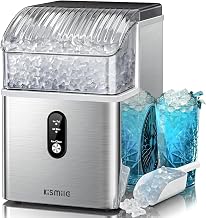
Nugget makers are noisier than cube makers by design, since an auger is shaving and compacting ice continuously. If the machine lives in an open-plan kitchen, look for a stated decibel figure rather than a vague quiet claim. The Kismile 35 lbs Nugget Ice Maker publishes 43 dB, which is roughly library-level and genuinely liveable. On finish, brushed stainless plays well with most contemporary kitchens and hides fingerprints better than gloss black, though a black unit like the handled EUHOMY disappears nicely into a darker coffee station. As for self-cleaning: it flushes the water path, which matters, but it does not descale. Hard-water homes still need periodic vinegar or citric acid cycles.
Tips
- Fill with filtered water. It produces clearer, better-tasting nuggets and dramatically slows mineral buildup in the auger.
- Run the machine 20 to 30 minutes before guests arrive rather than the night before. Nugget ice is not designed for long-term storage and will fuse in the bin.
- Empty and dry the reservoir if you will not use the unit for more than a few days. Standing water is the main cause of off smells.
- For overflow, bag finished nuggets and move them to the freezer, then break the bag apart by hand before serving.
Frequently Asked Questions
Do nugget ice makers keep ice frozen?
No. Countertop models are producers, not freezers. The insulated bin slows melting for a few hours, and most units recycle meltwater back into the reservoir to make fresh ice, so nothing is wasted.
Can I plumb one into a water line?
Most countertop nugget makers are reservoir-fed only, which is part of why they are so portable. If you want a permanent line, look at built-in undercounter machines instead.
How long should one last?
Expect three to five years with routine descaling, longer with filtered water. The auger and pump are the wear items, so cleaning is the single biggest factor in lifespan.
Are they practical for an RV or camping?
Yes, if you have stable AC power and level footing. Models with a carry handle, like the handled EUHOMY, are the easiest to transport since the reservoir drains cleanly.
Conclusion
Choose by how you actually live with ice rather than by peak output: measure your clearance, decide whether you scoop or dispense, check the noise figure if the kitchen is open, and commit to a descaling routine from day one. Get those four right and any of the machines above will earn its place on the counter.