Key takeaways
- Match coverage to the actual room, not the whole floor: Look for AHAM Verifide or a stated square footage per hour. A unit rated for 1,695 to 1,881 sq ft clears a great room properly; a 300 sq ft bedroom does not need that much motor.
- Check the full filter stack: True HEPA handles fine particulates, but activated carbon is what removes cooking odors, smoke, and VOCs. A washable pre-filter is the difference between replacing cartridges twice a year and four times.
- Prioritize sleep-mode decibels: A purifier you switch off at night is decorative. Dedicated quiet modes with dimmable or fully dark displays matter more than peak turbo output for bedroom placement.
- Treat the plant as sculpture, then as air quality: Live plants contribute modestly to filtration but enormously to how a room reads. Choose by light conditions and leaf architecture, and let the machine do the measurable work.
- Buy for the silhouette you can live with: Cylindrical towers in graphite or matte white recede against most walls. Anything with a glossy panel or a bright LED ring will pull focus in a minimal space.
What's inside
Air quality has become the invisible layer of interior design, and most people discover it the hard way: a room that looks finished but smells like last night’s dinner, a windowsill that collects a fine grey film by Thursday, a bedroom that leaves you congested every spring. The instinct is to buy a machine or buy a plant, then wonder why neither quite solved it. Plants soften a room and quietly metabolize a handful of airborne compounds; purifiers do the heavy mechanical lifting on particulate matter, dander, and smoke. Treated as a pair, they cover very different jobs.
This guide approaches the category the way a curator approaches a room: what earns floor space, what disappears into the architecture, and what actually performs once the styling photos are done. Below you will find HEPA units sized from nightstand corners to open-plan living rooms, plus two live plants worth building a vignette around. Everything here is selected for real airflow numbers, filter economics, and a form factor you will not want to hide behind a chair.
As an Amazon Associate we earn from qualifying purchases.



How to Choose a Plants Air Purifier (2026)
- Match coverage to the actual room, not the whole floor: Look for AHAM Verifide or a stated square footage per hour. A unit rated for 1,695 to 1,881 sq ft clears a great room properly; a 300 sq ft bedroom does not need that much motor.
- Check the full filter stack: True HEPA handles fine particulates, but activated carbon is what removes cooking odors, smoke, and VOCs. A washable pre-filter is the difference between replacing cartridges twice a year and four times.
- Prioritize sleep-mode decibels: A purifier you switch off at night is decorative. Dedicated quiet modes with dimmable or fully dark displays matter more than peak turbo output for bedroom placement.
- Treat the plant as sculpture, then as air quality: Live plants contribute modestly to filtration but enormously to how a room reads. Choose by light conditions and leaf architecture, and let the machine do the measurable work.
- Buy for the silhouette you can live with: Cylindrical towers in graphite or matte white recede against most walls. Anything with a glossy panel or a bright LED ring will pull focus in a minimal space.
The Best Plants and Air Purifiers of 2026, Reviewed
DREO HEPA Air Purifier (DR-HAP008 / Dreo 338)
The most complete package for a primary bedroom: AHAM Verifide performance, a live PM2.5 readout, four speeds, and a scent diffuser that lets you skip a separate reed set on the dresser. Auto mode is genuinely responsive, ramping up during cooking and settling back down without you touching it.
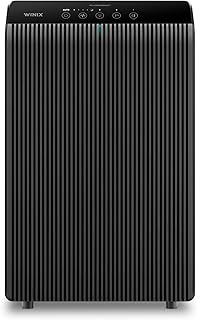
WINIX 5510 Air Purifier
The successor to the much-loved 5500-2, now with app control and coverage up to 1,881 sq ft per hour. The deodorization carbon filter is unusually thick for this price bracket, which makes it the pick for households with pets, smokers nearby, or an open kitchen that vents into the living room.
KNKA APH4000 Air Purifier
Clears up to 1,695 sq ft in an hour with an AQI display and a washable pre-filter that meaningfully lowers running costs. The white cabinet is clean enough to sit beside a sofa arm without looking like equipment, and the pet mode is tuned for dander rather than being a marketing label.
Hunter HP450UV Air Purifier
A compact graphite cylinder built for smaller rooms, nurseries, and home offices where floor space is scarce. True HEPA plus carbon handles allergens and odors capably, and the round tower profile is one of the least visually intrusive shapes in the category.
Costa Farms ZZ Plant
The most forgiving structural plant you can put in a room: glossy upright stems, drought tolerance, and a tolerance for low light that suits hallways and north-facing corners. Pair it with the Rattlesnake Calathea when you want pattern and movement rather than sculptural calm.
Frequently Asked Questions
Do houseplants actually purify indoor air?
Only marginally at residential scale. Research on plant-based filtration used sealed chambers, and you would need an impractical number of specimens to match one HEPA unit. Buy plants for atmosphere and humidity, and buy a purifier for measurable air quality.
How many purifiers does a home need?
One correctly sized unit per frequently used room beats a single oversized machine in a hallway. Air does not travel between closed doors, so bedroom and living room coverage should be handled separately.
How often should filters be replaced?
Plan on six to twelve months for HEPA and carbon, shorter with pets or wildfire seasons. Rinse washable pre-filters monthly; that single habit extends the life of everything behind it.
Which plants suit low-light rooms?
The ZZ plant is the safest choice for dim corners. Rattlesnake Calathea prefers bright indirect light and consistent moisture, so reserve it for a well-lit shelf or bathroom.
Final Thoughts
For most homes the DREO DR-HAP008 is the balanced choice, combining real-time monitoring with a quiet enough sleep mode to live in a bedroom, while the WINIX 5510 is the one to specify for large open-plan spaces with pets or heavy cooking. Add a Costa Farms ZZ Plant for the visual weight a machine cannot provide, and the room finally works on both levels.