Key takeaways
- Battery capacity vs. runtime: Treat mAh as a rough guide, not a promise. A 20,000mAh pack typically covers an evening on low to medium; 40,000mAh gets you through a weekend of intermittent use. Run the light and the motor together and expect roughly half the advertised figure.
- Blade span for the space: A 20-inch fan suits an umbrella table, a two-chair balcony, or a camper awning. Step up to 30 inches or more for a full gazebo, a dining set, or anything over about 100 square feet, where a small blade just stirs air near the ceiling.
- Recharge method: USB-C recharging is fine for a covered patio near an outlet. Bundled solar panels matter for sheds, coops, remote campsites, and anywhere you won’t reliably remember to bring the fan inside.
- Light quality: Dimmable output with adjustable color temperature (roughly 3000K to 6500K) lets one fixture serve dinner lighting and task lighting. Fixed cool-white LEDs read harsh outdoors and flatten the look of warm materials like teak and rattan.
- Mounting hardware: Check for an included hook, an extension rod, or a carabiner-style hanger, and confirm the total weight against whatever you’re hanging it from. Fabric canopies and pop-up frames have real load limits.
What's inside
Cooling a covered porch or a pergola usually runs into the same wall: there’s no junction box overhead, no switch loop in the ceiling, and no appetite for paying an electrician to run conduit through finished soffits. Renters have it worse, since permanent wiring is off the table entirely. So the fan gets skipped, a floor unit takes its place, and the seating area you designed around ends up cluttered with a base, a cord, and a tripping hazard.
Battery powered ceiling fans solve the geometry problem instead of the wiring problem. They hang from a hook, an umbrella pole, a gazebo crossbar, or a tent frame, and they push air down through the seating zone where you actually feel it. Below are the models I’d put on a real project, plus the specs that separate a fan you’ll still be using in year three from one that becomes patio clutter by August.
As an Amazon Associate we earn from qualifying purchases.



How to Choose a Battery Powered Ceiling Fan No Wiring (2026)
- Battery capacity vs. runtime: Treat mAh as a rough guide, not a promise. A 20,000mAh pack typically covers an evening on low to medium; 40,000mAh gets you through a weekend of intermittent use. Run the light and the motor together and expect roughly half the advertised figure.
- Blade span for the space: A 20-inch fan suits an umbrella table, a two-chair balcony, or a camper awning. Step up to 30 inches or more for a full gazebo, a dining set, or anything over about 100 square feet, where a small blade just stirs air near the ceiling.
- Recharge method: USB-C recharging is fine for a covered patio near an outlet. Bundled solar panels matter for sheds, coops, remote campsites, and anywhere you won’t reliably remember to bring the fan inside.
- Light quality: Dimmable output with adjustable color temperature (roughly 3000K to 6500K) lets one fixture serve dinner lighting and task lighting. Fixed cool-white LEDs read harsh outdoors and flatten the look of warm materials like teak and rattan.
- Mounting hardware: Check for an included hook, an extension rod, or a carabiner-style hanger, and confirm the total weight against whatever you’re hanging it from. Fabric canopies and pop-up frames have real load limits.
The Best Battery Powered Ceiling Fan No Wiring (2026)s Reviewed
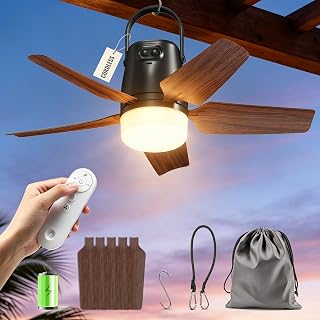
Gazebo Outdoor Ceiling Fan Light, 31.5″
The 31.5-inch blade span and 40,000mAh pack make this the only model here I’d trust over a full outdoor dining table, and the 3000K–6500K dimmable light means it handles both the meal and the cleanup. Four wind speeds give you usable low settings, which most compact fans lack.
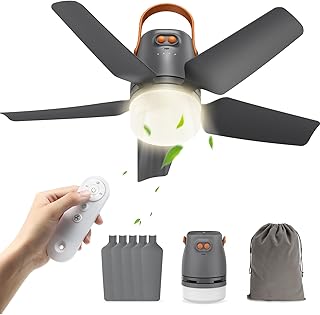
21″ Portable Ceiling Fan with Light & Remote
A sensible middle size at 21 inches with a 20,400mAh battery, and the hangable design moves easily between a canopy, a cruise cabin, and a campsite. This is the one to buy if a single fan needs to serve several different setups through the season.
20″ Outdoor Ceiling Fan for Patios
The farmhouse-leaning finish is the differentiator here, since most portable fans read as camping gear rather than furniture. At 20 inches with 20,000mAh, it’s sized for umbrella tables, porch swings, and RV awnings rather than large open spans.
Gliztech Solar Ceiling Fan Light
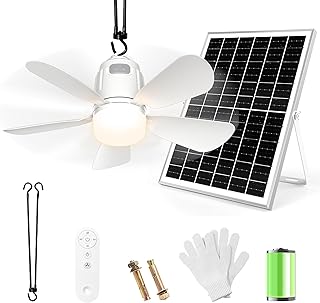
A 30W solar panel paired with a 20,000mAh battery makes this the pick for outbuildings, chicken coops, and sheds where dragging a charging cable out is the reason a fan stops getting used. Expect longer top-ups on overcast weeks, so site the panel thoughtfully.
20″ Canopy Fan with Lights and Dual Solar Panels
Two 10W panels ship in the box, which gives you placement flexibility that a single fixed panel doesn’t, and the dimmable light plays well inside tents and garages. A strong choice for anyone who camps often and charges rarely.
Frequently Asked Questions
How long do these fans actually run per charge?
Roughly 6 to 10 hours on low for a 20,000mAh model, dropping to 3 to 5 hours on the highest speed. Running the LED light simultaneously reduces those numbers noticeably.
Can they be left outside year-round?
No. Most are splash-resistant at best, not weather-rated for sustained exposure. Bring them in during storms and store them indoors over winter to protect the battery.
Will one work under a patio umbrella?
Yes, if the model includes a pole clamp or hook adapter and the umbrella is anchored in a weighted base. Confirm the hanging weight before mounting to a lightweight ribbed canopy.
Is the airflow comparable to a hardwired fan?
Not at the same span. Battery fans prioritize efficiency over raw CFM, so aim for direct overhead placement within about eight feet of seating rather than whole-room circulation.
Final Thoughts
For a covered patio or gazebo where airflow actually needs to reach a table, the 31.5″ Gazebo Outdoor Ceiling Fan and its 40,000mAh battery is the most capable option here. Choose the 21″ Portable Ceiling Fan if you want one fan that travels between patio, campsite, and RV, and go with the Gliztech Solar model when recharging access is the real constraint.