Key takeaways
- Power and coverage: Budget roughly 1,500W per 80 to 100 square feet in a sheltered space, and considerably more where air moves. Anything above 2,000W generally needs a dedicated 240V circuit, which means an electrician and a permit conversation before it means a purchase.
- Emitter type: Carbon fiber elements reach temperature almost instantly and glow softly, which suits dining areas where harsh light would break the mood. Short-wave halogen and tungsten emitters push heat farther and cope better with open perimeters, at the cost of a brighter, more visible glow.
- Mounting format: Ceiling and wall units keep floors clear and read as architecture rather than equipment, but they commit you to a fixed heat footprint. Towers move with the furniture and follow the season, which matters if your layout changes.
- Weather sealing: Look for an IP or IPX rating stated plainly. IPX5 handles driven rain and hose-down cleaning; a heater rated only for damp locations belongs under a solid roof, not a pergola with gaps.
- Safety hardware: Tip-over cutoffs and overheat protection should be standard on any freestanding model, and a child lock is worth having if the heater lives where people gather. On mounted units, check the specified clearance to combustibles and respect it exactly.
What's inside
The terrace looks its best in late October, when the light goes low and gold and the planting has gone slightly wild. That is also, inconveniently, the moment most outdoor rooms become unusable. A propane mushroom heater will buy you an hour, but it hisses, needs refilling, and reads as rental furniture next to a well-considered sofa and a good stone floor. Electric infrared heaters solve the physical problem and the aesthetic one at once: they warm bodies and surfaces directly rather than heating the air, so wind matters far less, and the best of them disappear into a ceiling plane or a slim vertical line.
The trade-off is that electric heat forces real decisions about wiring, mounting, and coverage before anything gets bought. A 1,500W plug-in unit and a 6,000W hardwired panel are not competing products; they serve entirely different rooms. This guide covers six heaters across three formats, freestanding towers, wall-mounted infrared, and flush ceiling units, and explains which specifications actually change your experience on a cold evening.
As an Amazon Associate we earn from qualifying purchases.





How to Choose an Electric Patio Heater (2026)
- Power and coverage: Budget roughly 1,500W per 80 to 100 square feet in a sheltered space, and considerably more where air moves. Anything above 2,000W generally needs a dedicated 240V circuit, which means an electrician and a permit conversation before it means a purchase.
- Emitter type: Carbon fiber elements reach temperature almost instantly and glow softly, which suits dining areas where harsh light would break the mood. Short-wave halogen and tungsten emitters push heat farther and cope better with open perimeters, at the cost of a brighter, more visible glow.
- Mounting format: Ceiling and wall units keep floors clear and read as architecture rather than equipment, but they commit you to a fixed heat footprint. Towers move with the furniture and follow the season, which matters if your layout changes.
- Weather sealing: Look for an IP or IPX rating stated plainly. IPX5 handles driven rain and hose-down cleaning; a heater rated only for damp locations belongs under a solid roof, not a pergola with gaps.
- Safety hardware: Tip-over cutoffs and overheat protection should be standard on any freestanding model, and a child lock is worth having if the heater lives where people gather. On mounted units, check the specified clearance to combustibles and respect it exactly.
The Best Electric Patio Heaters (2026), Reviewed
Bromic Tungsten Smart-Heat 4000W
The specifier’s default, and deservedly so: dual tungsten elements throw usable heat well past the ten-foot mark, and the black-on-black housing sits cleanly under a soffit without asking for attention. It needs 220V–240V hardwiring and ideally a dimmer control, but for a permanent outdoor dining room it is the most convincing option here.
Eurofase EF60240B 6000W
Serious output for large or exposed terraces, with a slim black profile that mounts flush enough to read as a light fixture from below. This is the pick when a single heater has to cover a long table, though the 240V load means it belongs in a project already going through electrical work.
ThermoMate 3000W Carbon Fiber Infrared Heater
Carbon fiber gives near-instant warmth with a gentler glow than halogen, which makes this the better choice over a seating group where glare would be unwelcome. The remote and 24-hour timer are genuinely useful for covered porches and workshops that get used on a schedule.
Haimmy 42-inch Infrared Tower Heater
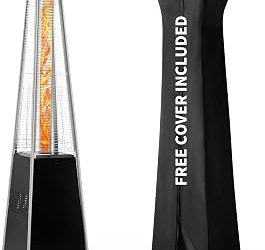
The most flexible option on the list: nine heat levels and nine timer settings give you fine control, and IPX5 sealing plus tip-over and overheat cutoffs mean it can stay outside through a shoulder season. At 1,500W it runs on a standard outlet, so it works in rentals and on balconies where mounting is not permitted.
1500W Hanging Carbon Fiber Infrared Heater
A quiet solution for gazebos and covered patios with limited floor area, suspending the heat source above the seating rather than beside it. Coverage is modest, so treat it as a warm zone over a specific table rather than whole-space heating.
Frequently Asked Questions
How much does an electric patio heater cost to run?
Multiply kilowatts by your utility rate. A 1,500W unit at 17 cents per kWh runs around 26 cents an hour; a 4,000W heater is closer to 68 cents. Timers and dimmers cut that meaningfully.
Can I plug in a 3,000W or 4,000W heater?
No. Anything above roughly 1,800W requires a dedicated 240V circuit and hardwiring by a licensed electrician. Standard household outlets cannot carry that load safely.
Do electric heaters work in wind?
Better than gas, since infrared warms objects rather than air, but wind still steals comfort. On exposed sites, mount lower, aim closer, and consider a windbreak or screen on the prevailing side.
Are these safe to use indoors?
Infrared electric heaters produce no combustion byproducts, so units rated for indoor and outdoor use are fine in garages, workshops, and sunrooms. Maintain the manufacturer’s clearances from fabric, timber, and stored materials.
Final Thoughts
For a permanent outdoor room where the heater should read as part of the architecture, the Bromic Tungsten Smart-Heat is the most refined choice, with the Eurofase EF60240B taking over when the space is large or genuinely exposed. If you need warmth this weekend without an electrician, the Haimmy 42-inch tower delivers real control and weather resistance from an ordinary outlet.