Key takeaways
- Match wattage to the room, not the label: Nearly every plug-in model tops out at 1500W, which realistically heats 400 to 1000 sq. ft. as supplementary warmth. Claims of whole-home heating are optimistic; treat these as zone heaters that make one room genuinely comfortable.
- Decide on form factor first: A freestanding stove sits in a corner and needs no construction. A recessed wall unit reads as intentional architecture but requires a stud-bay cutout or a mantel surround. A mantel console gives you a TV platform and cable storage in the same footprint.
- Look for 3D or layered flame, not a flat projection: The convincing models use a depth effect with a rear reflector and log or crystal media, so the flame appears to move through the firebox rather than across a single plane. Adjustable brightness and flame speed matter more than color options.
- Insist on flame-only mode and a real thermostat: Flame-without-heat lets the unit work in July. A degree-based thermostat that cycles to hold temperature beats a simple high/low switch, which will overheat a small bedroom within twenty minutes.
- Check the safety and control basics: ETL or UL listing, tip-over and overheat cutoff, child lock, and a 12-hour timer. Also confirm the unit runs on a standard 120V outlet and gets a dedicated circuit — 1500W on a shared kitchen line is a tripped breaker waiting to happen.
What's inside
Electric fireplaces occupy an odd space in home design: they promise the visual gravity of a hearth without the chimney, the ash, or the permits, and yet most shoppers end up frustrated. The flame looks like a screensaver. The heater struggles past ten feet. Or the unit is genuinely warm and genuinely capable, but styled like a piece of office equipment that wandered into the living room. The gap between “space heater with a picture of fire on it” and “architectural focal point” is wide, and product listings rarely tell you which side a model falls on.
This guide sorts the current crop of electric fireplace heaters by the thing that actually matters: what job you need it to do in a specific room. We look at freestanding stoves that read as furniture, recessed wall units that disappear into millwork, mantel consoles that double as media storage, and infrared models built for sustained warmth in a drafty space. For each pick, we cover flame realism, heat output in square feet, thermostat behavior, and the installation reality nobody mentions until you’re holding the box.
As an Amazon Associate we earn from qualifying purchases.


How to Choose an Electric Fireplace Heater (2026)
- Match wattage to the room, not the label: Nearly every plug-in model tops out at 1500W, which realistically heats 400 to 1000 sq. ft. as supplementary warmth. Claims of whole-home heating are optimistic; treat these as zone heaters that make one room genuinely comfortable.
- Decide on form factor first: A freestanding stove sits in a corner and needs no construction. A recessed wall unit reads as intentional architecture but requires a stud-bay cutout or a mantel surround. A mantel console gives you a TV platform and cable storage in the same footprint.
- Look for 3D or layered flame, not a flat projection: The convincing models use a depth effect with a rear reflector and log or crystal media, so the flame appears to move through the firebox rather than across a single plane. Adjustable brightness and flame speed matter more than color options.
- Insist on flame-only mode and a real thermostat: Flame-without-heat lets the unit work in July. A degree-based thermostat that cycles to hold temperature beats a simple high/low switch, which will overheat a small bedroom within twenty minutes.
- Check the safety and control basics: ETL or UL listing, tip-over and overheat cutoff, child lock, and a 12-hour timer. Also confirm the unit runs on a standard 120V outlet and gets a dedicated circuit — 1500W on a shared kitchen line is a tripped breaker waiting to happen.
The Best Electric Fireplace Heaters (2026), Reviewed
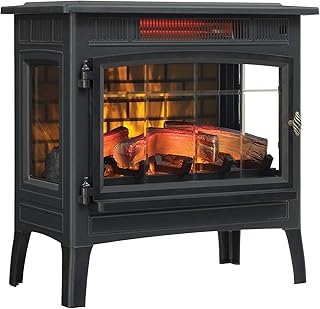
duraflame Freestanding Electric Fireplace Stove Heater
The most convincing cast-iron-look stove in this price range, with a 3D flame effect that holds up in a dim room and enough output to warm roughly 1,000 sq. ft. as supplemental heat. It’s the right pick when you want the fireplace to look like a deliberate piece of furniture rather than an appliance.
Dr. Infrared DR-991 Portable Electric Fireplace Heater
Infrared heat plus a built-in humidifier makes this the standout for dry winter climates and anyone who finds forced-air heat scratchy. The 1500W element runs quiet, the LED display gives you precise control, and it’s the most technically capable unit here even if the styling is more functional than decorative.
R.W.FLAME 43″ Electric Fireplace Mantel with TV Stand
A wooden surround, an open media shelf, and a 750W/1500W firebox in one piece, which solves the classic small-living-room problem of wanting both a hearth and somewhere to put the television. The adjustable LED flame is respectable, and the console depth handles most 50-inch sets comfortably.
Tehanld 60″ Ultra-Thin Recessed Wall-Mounted Electric Fireplace
The designer choice: a slim 60-inch linear firebox with both log and crystal media, a true 60–99°F thermostat, child lock, and a 12-hour timer. Recess it into a stud bay or hang it flush, and it reads as built-in architecture instead of a purchased object.
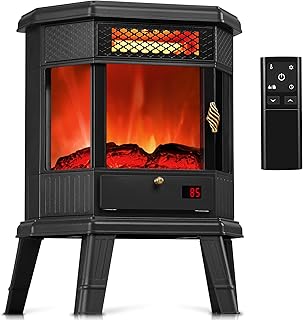
ZAFRO Electric Fireplace Stove with Dual Heat and Flame-Only Mode
At 22 inches and 5,100 BTU, this compact stove is the sensible bedroom or home-office answer, with 1000W/1500W settings and a built-in thermostat that actually cycles. Flame-only mode keeps it useful year-round, and the ETL listing plus overheat protection covers the safety fundamentals.
Frequently Asked Questions
Can an electric fireplace heat a whole room on its own?
In a well-insulated space up to about 400 sq. ft., often yes. Beyond that, treat it as supplemental heat that lets you lower the central thermostat and keep one room warmer than the rest of the house.
Is infrared better than a standard fan-forced element?
Infrared warms objects and people directly, so it feels immediate and doesn’t dry the air as aggressively. Fan-forced convection heats the air itself and distributes more evenly across an open floor plan. Both work; infrared tends to feel better in seated spaces.
What does an electric fireplace cost to run?
At 1500W and average U.S. rates, roughly 15 to 25 cents per hour on high. Thermostatic models cost noticeably less because they cycle off once the room reaches temperature, and flame-only mode draws just a few watts.
Do recessed wall units require an electrician?
Not necessarily. Many, including 22-inch stoves and the RealSmart-style freestanding infrared units, simply plug in. A flush-mounted linear insert usually needs framing work and, ideally, a nearby outlet inside the cavity — that’s where a professional pays for itself.
Final Thoughts
For most homes, the duraflame freestanding stove delivers the best balance of visual credibility and real warmth with zero installation. If you’re renovating or want the fireplace to look architectural, the Tehanld 60″ recessed unit is the design-forward choice, and the Dr. Infrared DR-991 remains the one to buy when comfort and dry-air relief outrank aesthetics.