Key takeaways
- Pint rating vs. real coverage: Pints-per-day is measured in saturated lab conditions, so treat it as ceiling, not average. Match the square-footage claim to your space first, then size up one tier if you have a sump, exposed soil, or standing water history.
- Drainage that fits the room: A bucket means daily attention. A gravity hose needs a floor drain below the outlet. A built-in condensate pump is the only option that pushes water up and out — essential for basements where the drain sits higher than the unit.
- Auto defrost and low-temp performance: Unheated spaces drop into the 40s. Without auto defrost, coils ice over and extraction stops while the compressor keeps running. Confirm the stated minimum operating temperature, not just the feature name.
- Chassis and mobility: Roto-molded housings, integrated handles, and stacked wheels matter if the unit moves between rooms or lives on a rough slab. For finished spaces, a compact vertical footprint and a clean facade keep it from dominating the room.
- Noise and control: Anything above roughly 50 dB reads as intrusive near sleeping or working areas. Look for multiple fan speeds, a humidistat that holds a target rather than cycling blindly, and app or voice control if the unit sits somewhere you rarely visit.
What's inside
Moisture rarely announces itself. It shows up as a cupped plank in a white oak floor, a faint bloom along the back of a linen headboard, the sticky drawer in a walnut dresser that used to glide. By the time a basement smells like a basement, the damage has usually been accruing for months — and it lands hardest on the furniture and finishes you invested the most in. Humidity is not a comfort issue first. It is a materials issue.
This guide looks at commercial-grade dehumidifiers through that lens: what actually protects a finished lower level, a converted garage studio, a storage room full of upholstered pieces, or a job site mid-restoration. Below are six units spanning true industrial extraction down to quiet bedroom-scale machines, plus the specs that matter when you are matching a unit to a space rather than to a number on the box.
As an Amazon Associate we earn from qualifying purchases.


How to Choose a Commercial Dehumidifier in 2026
- Pint rating vs. real coverage: Pints-per-day is measured in saturated lab conditions, so treat it as ceiling, not average. Match the square-footage claim to your space first, then size up one tier if you have a sump, exposed soil, or standing water history.
- Drainage that fits the room: A bucket means daily attention. A gravity hose needs a floor drain below the outlet. A built-in condensate pump is the only option that pushes water up and out — essential for basements where the drain sits higher than the unit.
- Auto defrost and low-temp performance: Unheated spaces drop into the 40s. Without auto defrost, coils ice over and extraction stops while the compressor keeps running. Confirm the stated minimum operating temperature, not just the feature name.
- Chassis and mobility: Roto-molded housings, integrated handles, and stacked wheels matter if the unit moves between rooms or lives on a rough slab. For finished spaces, a compact vertical footprint and a clean facade keep it from dominating the room.
- Noise and control: Anything above roughly 50 dB reads as intrusive near sleeping or working areas. Look for multiple fan speeds, a humidistat that holds a target rather than cycling blindly, and app or voice control if the unit sits somewhere you rarely visit.
The Best Commercial Dehumidifiers of 2026, Reviewed
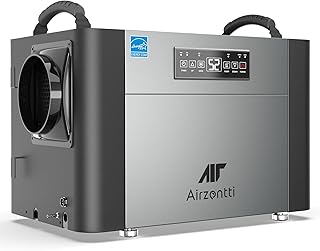
260 Pints Commercial Dehumidifier with Pump
This is the unit you deploy when a space is genuinely wet — post-flood, warehouse-scale, or a slab that never fully dries. The onboard pump and auto defrost mean it can run unattended through cold stretches, which is where lesser machines quietly stop working.
200 Pints Commercial Dehumidifier with Pump
A more sensible entry point for large residential basements and workshops that need industrial throughput without industrial bulk. Same pump-and-hose flexibility as its bigger sibling, with a footprint that tucks against a wall more gracefully.
DREO 110-Pint Smart Dehumidifier (711S)
Rated for roughly 4,500 sq ft, this is the crossover pick: commercial-adjacent extraction in a cabinet that looks intentional in a finished lower level. Constant mode plus a drain hose makes it a set-and-forget solution for storage rooms holding wood furniture or textiles.
DREO 73-Pint Energy Star Smart Dehumidifier
At 41 dB it is quiet enough for a basement guest suite or a home office, and the Energy Star rating keeps running costs reasonable for a unit that will operate most of the year. Auto humidity control holds a steady target instead of overshooting.
Midea Cube 20 Pint Dehumidifier
The Cube’s expanding reservoir solves the emptying problem more elegantly than anything else at this size, and Wi-Fi with Alexa support means you can check humidity without a trip downstairs. Best suited to conditioned rooms up to 1,500 sq ft rather than damp foundations.
Frequently Asked Questions
What humidity level protects wood furniture?
Aim for 40–50% relative humidity. Below 35% joints shrink and veneers lift; above 60% you invite mold and swelling. Stability matters more than hitting a precise number.
Do I need a pump, or is a hose enough?
Gravity drainage works only if the outlet sits above your drain. If the unit is on a slab with a floor drain across the room or a sink upstairs, a built-in pump is worth the premium.
Can these run continuously?
Commercial units are designed for it, particularly with continuous drainage and auto defrost. Clean the filter monthly and keep at least a foot of clearance around the intake.
Is a small unit enough for a bedroom or bath?
Often yes. The ToLife 1000 sq ft dehumidifier, with sleep mode and auto shutoff, handles a single damp room without the noise or draw of a commercial machine.
Final Thoughts
For serious water problems and unheated square footage, the 260-Pint commercial unit with pump is the one that will still be extracting in February. The DREO 711S is the smarter buy for a finished basement that needs real capacity without looking like equipment, and the Midea Cube remains the most livable choice for a single conditioned room.