Key takeaways
- Back height and headrest reach: Measure from your seat to the base of your skull while sitting upright. If the chair’s back is shorter than that, your head will cantilever forward the moment you recline. Independent power headrests solve this outright by tilting support to where you need it.
- Seat depth and height: Look for a seat pan around 21 inches deep so your thighs are supported to within a few inches of the knee, and a seat height near 20 inches so your feet rest flat without your knees riding high.
- Full extension length: Lay-flat and infinite-position mechanisms matter more than the number of preset positions. A chair that opens to 70 inches or more lets a 6’4″ frame stretch out instead of folding at the ankles.
- Motor count and weight capacity: Dual-motor designs move the backrest and footrest independently, which is what makes zero-gravity and true lay-flat postures possible. Confirm the rated capacity with real margin above your weight — oversized models typically handle 400 lbs.
- Placement and clearance: Standard recliners need several inches behind them; wall huggers reclaim that space by traveling forward instead. Either way, plan a clear path for the power cord and hand control before you commit to a corner.
What's inside
Furniture is engineered around an average that most tall people have never fit. Seat backs stop at the shoulder blades, seat pans end above the knee, and a footrest that looks generous in the showroom leaves your calves hanging in midair. Sit down for twenty minutes and the compromises show up as a stiff neck, a numb thigh, and a lower back doing work the chair was supposed to handle. For anyone past 6’2″, the fix isn’t a plusher cushion — it’s a chair built with more geometry to begin with: taller backs, deeper seats, longer extension, and motors strong enough to move all of it smoothly.
This guide focuses on recliners that actually accommodate long limbs and heavier frames, with an emphasis on power lift models where the seat rises to meet you. I’ve grouped picks by build — medium-frame chairs for tall-but-slim users, oversized big-and-tall models with wide seats and 400 lb-class capacities, and one genuine-leather wall hugger for rooms where space is tight. Below each card you’ll find what the chair does well and who it suits.
As an Amazon Associate we earn from qualifying purchases.


How to Choose a Recliner For Tall Person (2026)
- Back height and headrest reach: Measure from your seat to the base of your skull while sitting upright. If the chair’s back is shorter than that, your head will cantilever forward the moment you recline. Independent power headrests solve this outright by tilting support to where you need it.
- Seat depth and height: Look for a seat pan around 21 inches deep so your thighs are supported to within a few inches of the knee, and a seat height near 20 inches so your feet rest flat without your knees riding high.
- Full extension length: Lay-flat and infinite-position mechanisms matter more than the number of preset positions. A chair that opens to 70 inches or more lets a 6’4″ frame stretch out instead of folding at the ankles.
- Motor count and weight capacity: Dual-motor designs move the backrest and footrest independently, which is what makes zero-gravity and true lay-flat postures possible. Confirm the rated capacity with real margin above your weight — oversized models typically handle 400 lbs.
- Placement and clearance: Standard recliners need several inches behind them; wall huggers reclaim that space by traveling forward instead. Either way, plan a clear path for the power cord and hand control before you commit to a corner.
The Best Recliners For Tall People (2026), Reviewed
MCombo R7891 Oversized Dual Motor Lift Chair
This is the most complete big-and-tall option here: a large-wide fabric frame with dual motors, lay-flat travel, and heat plus massage across the back and seat. If you want one chair that handles both a full night’s sleep and a tall user’s stand-up assist, start with this one.
MCombo R7166 Oversized Lay-Flat Recliner
The R7166 pairs infinite positioning with lumbar and seat heating, which is a smarter arrangement than back-only warmth for anyone whose lower spine takes the brunt of a long day. The pet-friendly fabric is a genuine practical win in a household with animals.
MCombo 7890 Zero Gravity Lift Recliner
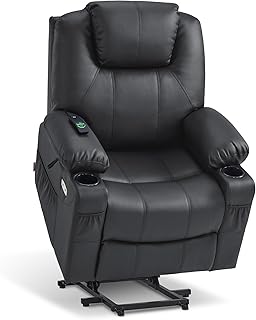
A medium-frame chair for tall users who aren’t broad, with a zero-gravity preset that lifts the legs above the heart to take pressure off the lumbar region. Breathable faux leather keeps it from getting clammy during extended sitting.
MCombo 7516 Large Power Lift Recliner
Purpose-built for tall seniors, with a larger frame, three positions, heat and massage, and the practical extras — cup holders, USB ports — that keep you from getting up. The simpler mechanism is easier to operate if a caregiver is assisting.
MCombo 7040 Power Lift Recliner
The most affordable entry point, and a sensible pick for a tall user under about 250 lbs who wants lift assist without the oversized footprint. Single-motor operation means fewer positions, so skip it if lay-flat sleeping is the goal.
Frequently Asked Questions
What seat height works best for someone over 6’2″?
Aim for roughly 20 to 21 inches from floor to cushion top. Lower than that and your knees rise above your hips, which rotates the pelvis back and strains the lumbar spine.
Do I need a dual-motor chair?
If you want to recline fully flat or hold a zero-gravity position, yes. Single-motor chairs move the back and footrest together on a fixed arc, which limits how far a tall frame can extend.
Can a tall person use a lift chair without mobility issues?
Plenty do. The lift function reduces the drop-and-heave motion of standing from a deep seat, which is useful for anyone with knee or hip sensitivity regardless of age.
What if I don’t have wall clearance?
Choose a wall hugger. The Watson & Whitely oversized genuine leather model reclines within a few inches of the wall and adds a power headrest, making it the strongest choice for tight living rooms.
Final Thoughts
For most tall buyers, the MCombo R7891 is the safest bet — dual motors, lay-flat travel, and a wide frame that doesn’t force you to sit narrow. The R7166 is the pick if lumbar heat and durable fabric matter more than sheer feature count, and the Watson & Whitely leather wall hugger earns its place in rooms where every inch behind the chair is already spoken for.