Key takeaways
- Opening diameter: If your whole hand plus a sponge won’t fit through the tank opening, you will never clean the corners properly. Top-fill designs with a lid that lifts off entirely beat any bottom-tank unit with a screw cap, regardless of what the marketing says.
- Interior material: Stainless steel resists biofilm and mineral staining far better than textured plastic, and it doesn’t hold odor over multiple seasons. Where plastic is used, look for BPA-free and, ideally, glossy rather than ribbed interior walls.
- Dishwasher-safe parts: This single spec collapses a fifteen-minute weekly ritual into loading a rack. Confirm which components qualify, since it’s usually the tank and lid, not the base or nebulizer housing.
- Fewer sealed seams: Every gasket, filter cartridge, and hidden channel is a place mineral scale hides. Filter-free ultrasonic units with a single removable transducer plate are the low-maintenance sweet spot for most bedrooms.
- Runtime versus tank size: A larger tank means fewer refills but heavier lifting and slower drying between cleanings. For a standard bedroom, 3.5L to 4.5L with 30 to 40 hours of output hits the balance; reserve 6L for open-plan rooms.
What's inside
Most humidifiers don’t fail because they stop working. They fail because cleaning them becomes a chore nobody wants to face on a Sunday morning. Narrow tank necks, hidden gaskets, textured plastic interiors that collect pink film within a week — these are design decisions, and they’re the reason so many units end up shoved into a closet by February. A humidifier you resent maintaining is a humidifier that stops running, and a stagnant tank is worse for your air than dry air ever was.
This guide approaches the category the way we’d approach any object that lives permanently in a bedroom or nursery: form, footprint, and honest serviceability. We prioritized wide-mouth top-fill designs, dishwasher-safe components, smooth interior surfaces, and tanks you can reach into with a full hand. Below are the models that earned their place on a nightstand in 2026, plus what actually matters when you compare them.
As an Amazon Associate we earn from qualifying purchases.


How to Choose an Easy Clean Humidifier (2026)
- Opening diameter: If your whole hand plus a sponge won’t fit through the tank opening, you will never clean the corners properly. Top-fill designs with a lid that lifts off entirely beat any bottom-tank unit with a screw cap, regardless of what the marketing says.
- Interior material: Stainless steel resists biofilm and mineral staining far better than textured plastic, and it doesn’t hold odor over multiple seasons. Where plastic is used, look for BPA-free and, ideally, glossy rather than ribbed interior walls.
- Dishwasher-safe parts: This single spec collapses a fifteen-minute weekly ritual into loading a rack. Confirm which components qualify, since it’s usually the tank and lid, not the base or nebulizer housing.
- Fewer sealed seams: Every gasket, filter cartridge, and hidden channel is a place mineral scale hides. Filter-free ultrasonic units with a single removable transducer plate are the low-maintenance sweet spot for most bedrooms.
- Runtime versus tank size: A larger tank means fewer refills but heavier lifting and slower drying between cleanings. For a standard bedroom, 3.5L to 4.5L with 30 to 40 hours of output hits the balance; reserve 6L for open-plan rooms.
The Best Easy Clean Humidifiers of 2026, Reviewed
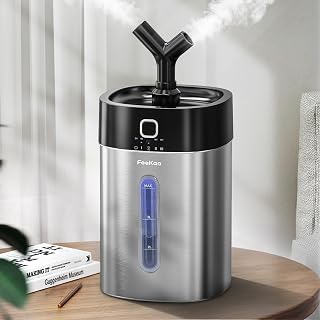
Feekaa Stainless Steel Humidifier, 4L (Black)
The stainless interior is the genuine differentiator here — it wipes clean in seconds and stays visually pristine through hard-water use, while the tank goes straight into the dishwasher. At 4L it covers a large bedroom comfortably, and the matte black shell reads more like a small appliance object than a nursery gadget.
Levoit NeoClassic 450
The most complete package in the group: 4.2L top-fill, 42-hour runtime, 21dB operation, dishwasher-safe tank, plus oil diffusion and a night light for shared rooms. If you want one unit that handles a primary bedroom without any compromise, this is the safe recommendation.
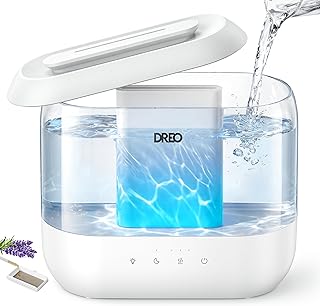
Dreo HM311, 4L
Dreo built this around refill and rinse ergonomics — a genuinely wide opening, BPA-free construction, and 36 hours per fill at 28dB. The soft nightlight and clean cylindrical profile make it the easiest pick for a nursery where you’re operating half-awake.
Everlasting Comfort 6L
For open-plan living rooms, high-ceiling bedrooms, or dry winter climates where smaller tanks run dry overnight, the 6L capacity and 60-hour runtime do the heavy lifting. Output is strong enough to notice within an hour, and the top-fill design keeps maintenance manageable at that size.
Homvana 3.6L Top-Fill (Grey)
The most design-forward option: a soft grey pebble form at 23dB that disappears into a considered interior. It doubles as an oil diffuser, and the 3.6L tank is the easiest of the group to lift, carry, and rinse one-handed.
Frequently Asked Questions
How often should I clean a humidifier?
Rinse and air-dry the tank daily if it’s running continuously, and do a full descale with white vinegar or citric acid weekly. Dishwasher-safe models let you substitute a cycle for the manual pass.
Is stainless steel actually better than plastic?
For cleaning, yes. Steel gives biofilm nothing to grip, resists mineral staining, and won’t retain smells after months of use. Plastic tanks work fine but demand more diligence.
Should I use distilled water?
If you have hard water, it’s worth it. Tap minerals cause white dust on surfaces and accelerate scale on the transducer, which is the part most likely to shorten a unit’s life.
Do I need a filter or a filter-free model?
Filter-free ultrasonic units are simpler to maintain and cost nothing to run, which is why every pick here is one. The tradeoff is that water quality matters more.
Final Thoughts
For most homes, the Feekaa Stainless Steel 4L is the smartest long-term buy — the steel interior solves the cleaning problem at the material level rather than papering over it, and it comes in black or white to suit the room. The Levoit NeoClassic 450 is the better all-rounder if you want longer runtime and diffuser functionality, while the Homvana 3.6L is the one to choose when the humidifier needs to look intentional on an open shelf.