Key takeaways
- Access speed under stress: Fingerprint readers should open in under a second and tolerate a partial or off-angle press. Look for units storing 20+ prints so you can enroll the same finger multiple times at different rotations — this matters more than the advertised maximum.
- Redundancy that isn’t theater: Biometrics plus keypad plus mechanical key override is the baseline. Battery-dead scenarios are the real failure mode, so confirm the key entry is genuinely reachable while the safe is mounted.
- Footprint versus interior: Measure your drawer or surface first, then the internal cavity. A compact shell often means a subcompact-only interior; anything with a light rail or optic needs published internal dimensions, not exterior ones.
- Silent mode and light discipline: Confirmation beeps and bright LCDs are useful in daylight and counterproductive at night. A mutable speaker and a soft interior light are worth prioritizing if you share the room.
- Anchoring and honest steel: Pre-drilled mounting holes and an included cable are the difference between secure storage and a portable box. Check gauge where it’s listed, and treat anchoring as mandatory rather than optional.
What's inside
The nightstand has quietly become the most designed object in the bedroom — a place for a ceramic lamp, a paperback, a glass of water, and increasingly, a locked steel box. That last item is where most bedrooms fall apart visually. Buyers who want fast, controlled access to a handgun at 2 a.m. usually end up with something that looks borrowed from a job site: powder-coated black, stamped branding, a keypad that glows like a smoke detector. It works, but it fights everything else on the surface.
This guide approaches bedside storage the way we’d approach any other piece of nightstand hardware — form, footprint, material, and how it behaves in a dark room. Below are six current biometric options that solve the access problem without wrecking the composition, from a clock-faced unit that hides in plain sight to an under-surface drop-down that disappears entirely. We cover what actually matters in a 2026 purchase, then review the standouts individually.
As an Amazon Associate we earn from qualifying purchases.




How to Choose a Nightstand Gun Safe (2026)
- Access speed under stress: Fingerprint readers should open in under a second and tolerate a partial or off-angle press. Look for units storing 20+ prints so you can enroll the same finger multiple times at different rotations — this matters more than the advertised maximum.
- Redundancy that isn’t theater: Biometrics plus keypad plus mechanical key override is the baseline. Battery-dead scenarios are the real failure mode, so confirm the key entry is genuinely reachable while the safe is mounted.
- Footprint versus interior: Measure your drawer or surface first, then the internal cavity. A compact shell often means a subcompact-only interior; anything with a light rail or optic needs published internal dimensions, not exterior ones.
- Silent mode and light discipline: Confirmation beeps and bright LCDs are useful in daylight and counterproductive at night. A mutable speaker and a soft interior light are worth prioritizing if you share the room.
- Anchoring and honest steel: Pre-drilled mounting holes and an included cable are the difference between secure storage and a portable box. Check gauge where it’s listed, and treat anchoring as mandatory rather than optional.
The Best Nightstand Gun Safes (2026) Reviewed
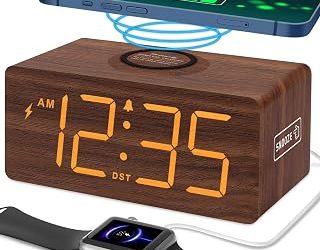
FTOP Biometric Clock Safe with 3-in-1 Wireless Charging
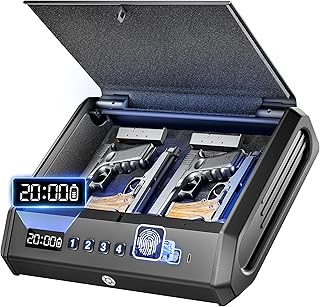
The most design-literate solution here: it reads as a bedside clock, charges a phone and watch on top, and reports temperature and humidity — meaning the visible object justifies its own footprint before you consider what’s inside. The concealment is genuine rather than gimmicky, though the trade-off is a shallower interior suited to a single compact handgun.
BILLCONCH Smart Safe with Fingerprint, App and Voice Guidance
Four access methods, app connectivity, and voice prompts make this the most feature-complete unit on the list, and the security cable means it can travel between bedroom and vehicle. Voice guidance is genuinely useful during enrollment, and can be silenced once you’re set up.
Quick Access Biometric Drop-Down Bedside Safe
Mounts beneath a nightstand, shelf, or bed frame and drops the contents into your hand — the cleanest option for anyone who wants zero visual footprint on the surface. Installation is the commitment here; once anchored, it’s the fastest natural-motion access of the group.
BILLCONCH Biometric Safe with Interior Light and USB Charging
A well-proportioned drawer-friendly box with fingerprint, PIN, and key entry, plus an interior light that makes the difference in a dark room. USB charging removes battery anxiety without giving up the mechanical override.
Large Biometric Safe with Internal Light and Silent Mode
Choose this when interior volume is the constraint — full-size pistols, spare magazines, documents, and cash fit comfortably, and it stores up to 100 prints for multi-user households. Silent mode and AA power keep it simple and quiet.
Frequently Asked Questions
Are biometric safes reliable enough for bedside use?
Modern capacitive readers are considerably better than early generations, but enrollment technique determines everything. Register each authorized finger three or four times at varied angles, and re-enroll seasonally if dry skin affects reads.
Should the safe be mounted or left loose in a drawer?
Mounted, always. An unanchored box can simply be carried away and opened later, which defeats the purpose. Most units here include hardware or a cable for exactly this reason.
How does this work in a home with children?
Locked, anchored storage is the minimum standard, and it should be paired with ammunition stored separately and age-appropriate conversations. No product substitutes for those practices.
What about local storage laws?
Requirements vary significantly by state and municipality, and some jurisdictions specify lock type or mandate separate ammunition storage. Verify your local rules before purchase — a compliant safe is the easy part.
Final Thoughts
For most bedrooms, the FTOP clock safe wins on design integration alone, earning its surface space as a charger and clock rather than announcing itself as a security product. If you’d rather see nothing at all, the drop-down bedside safe is the more elegant answer, and the BILLCONCH Smart Safe remains the pick for anyone who wants maximum redundancy and app oversight in a single unit.