Key takeaways
- Hide grade over hide marketing: “Genuine leather” is a category, not a compliment. Look for top-grain on contact surfaces — seat, back, armrest tops — and accept split leather or matched vinyl on the sides and rear, which is standard practice and keeps cost sane. Faux leather is a legitimate choice for households with pets or heavy sun exposure; it just won’t develop patina.
- Power versus manual: Power gives you infinite stopping points, a smoother transition, and independent headrest tilt, which matters if you read or watch at odd angles. Manual costs less, never needs an outlet, and has one fewer failure point. Choose manual if the sofa lives in a room where cord routing is ugly or impossible.
- Measure the back clearance, not the footprint: A conventional reclining sofa needs six to twelve inches behind it to open. Wall-hugger geometry moves the seat forward instead of tilting the frame back, so it can sit two to four inches off the baseboard — the difference between a floating layout and a usable one in a narrow room.
- Mechanism specifics: Dual motors let seat and headrest move independently; single-motor sofas link them. Check that reclining seats operate separately rather than as one bench, and look for steel-reinforced hardwood frames with sinuous spring or eight-way support under the seat deck.
- Console, ports, and scale: A center console adds roughly ten to fourteen inches of width and turns a three-seater into a two-plus-storage layout. USB-A and USB-C ports, hidden cup holders, and cable channels are cheap to include and genuinely useful — but confirm the total width clears your doorway and stair turns before you commit.
What's inside
Leather recliners spent years being the piece people apologized for. The compromise sofa. The one pushed into a basement so the living room could stay photogenic. That era is over: manufacturers finally figured out that a reclining mechanism doesn’t have to announce itself, and the current crop of three-seaters reads closer to a tailored track-arm sofa than a lounger. The catch is that the label “leather recliner” now covers everything from full-grain hide over a hardwood frame to bonded scraps glued onto foam — at prices that don’t always tell you which is which.
This guide sorts the 2026 field by what actually determines whether you’re happy in year three: hide quality, mechanism type, and how much wall clearance the frame demands. Below you’ll find six three-seat reclining sofas worth considering, from wall-hugger power models with dual motors and adjustable headrests to honest manual pull-handle designs that skip the electronics entirely. Each is a real fit for a specific room and budget, not a generic best-of.
As an Amazon Associate we earn from qualifying purchases.


How to Choose a Leather Sofa Recliner (2026)
- Hide grade over hide marketing: “Genuine leather” is a category, not a compliment. Look for top-grain on contact surfaces — seat, back, armrest tops — and accept split leather or matched vinyl on the sides and rear, which is standard practice and keeps cost sane. Faux leather is a legitimate choice for households with pets or heavy sun exposure; it just won’t develop patina.
- Power versus manual: Power gives you infinite stopping points, a smoother transition, and independent headrest tilt, which matters if you read or watch at odd angles. Manual costs less, never needs an outlet, and has one fewer failure point. Choose manual if the sofa lives in a room where cord routing is ugly or impossible.
- Measure the back clearance, not the footprint: A conventional reclining sofa needs six to twelve inches behind it to open. Wall-hugger geometry moves the seat forward instead of tilting the frame back, so it can sit two to four inches off the baseboard — the difference between a floating layout and a usable one in a narrow room.
- Mechanism specifics: Dual motors let seat and headrest move independently; single-motor sofas link them. Check that reclining seats operate separately rather than as one bench, and look for steel-reinforced hardwood frames with sinuous spring or eight-way support under the seat deck.
- Console, ports, and scale: A center console adds roughly ten to fourteen inches of width and turns a three-seater into a two-plus-storage layout. USB-A and USB-C ports, hidden cup holders, and cable channels are cheap to include and genuinely useful — but confirm the total width clears your doorway and stair turns before you commit.
The Best Leather Sofa Recliners (2026) Reviewed
CHITA Genuine Leather Power Recliner Sofa with Console
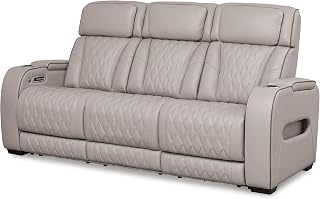
The most complete package here: wall-hugger frame, dual motors, power headrests, USB charging, and a saddle-tone hide that photographs warm without looking orange. If you want one sofa that solves a tight living room and a movie habit simultaneously, this is the pick.
Watson & Whitely Wall Hugger Power Reclining Sofa
Nearly identical brief to the CHITA but with USB-C alongside USB-A and a slimmer profile that suits apartments and RVs. The adjustable power headrests are the standout — real cervical support rather than a token hinge.
Genuine Leather Power Recliner Sofa with Hidden Cup Holders
A straightforward electric three-seater in mid-brown with generously padded arms and back, plus concealed cup holders that don’t interrupt the seat line. Best value if you want power recline and USB without paying for wall-hugger engineering.
Genuine Leather Manual 3-Seat Recliner Sofa, Vintage Brown
Clean-lined, cord-free, and the most architecturally restrained of the group — the vintage brown reads almost like a Chesterfield’s quieter cousin. Ideal for offices, studies, and meeting rooms where an outlet behind the sofa isn’t happening.
Faux Leather Mid-Century Modern Reclining Sofa
Overstuffed armrests and a tapered mid-century silhouette give this one real design presence at the entry tier. Faux upholstery makes it the sensible answer for sunrooms, kids, and dogs.
Frequently Asked Questions
Is genuine leather worth the premium over faux?
For daily-use sofas in stable indoor conditions, yes — leather breathes, softens, and ages rather than cracking. In direct sun, high humidity, or homes with clawed animals, quality faux leather is the more rational purchase.
How much space do I need behind a reclining sofa?
Plan on six to twelve inches for standard frames. Wall-hugger models like the CHITA and Watson & Whitely need only a few inches, which is why they dominate small-room recommendations.
Do power recliners work during a power outage?
Not without a backup. Many include a battery pack port that will cycle the mechanism a limited number of times — worth adding if you’d rather not be stuck reclined.
How do I keep leather from drying out?
Dust weekly, wipe spills immediately with a barely damp cloth, condition every six to twelve months, and keep the sofa out of direct sunlight and away from HVAC vents.
Final Thoughts
For most rooms, the CHITA Genuine Leather Power Recliner with Console is the strongest all-round choice — wall-hugger clearance plus dual-motor comfort covers nearly every scenario. Choose the Watson & Whitely if you need a slimmer footprint and USB-C, or the Genuine Leather Manual Recliner in vintage brown if you want the look without a single cable in sight.