Key takeaways
- Read the leather grade, not the leather label: Top-grain and full-grain hides develop patina and resist cracking for a decade or more. Bonded and split leather cost far less but tend to flake at stress points within a few years. Quality faux leather is often the smarter choice at the entry tier because it fails gracefully rather than peeling.
- Measure your wall clearance before anything else: Traditional recliners need 12 to 18 inches behind the frame to open. Wall-hugger mechanisms bring that down to roughly three inches, which is the difference between a floating sofa and one that sits flush in a small apartment or a media room.
- Decide whether power earns its premium: Power reclining adds infinite positioning, adjustable headrests, and USB or USB-C charging, and it removes the side lever that visually interrupts the arm. It also requires an outlet and introduces a motor that can eventually need service. Manual mechanisms are simpler and cheaper to keep running.
- Watch the arm proportions: Overstuffed armrests read cozy and traditional, and they add four to six inches of width per side without adding usable seating. Slimmer track arms suit contemporary and mid-century rooms and buy back floor space in narrow layouts.
- Skip the features you won’t use: Concealed cup holders and drop-down tables are genuinely useful in a dedicated TV room. In a formal living space they add seams and hardware to the center of the sofa where the eye naturally lands.
What's inside
Reclining furniture has spent decades apologizing for itself. The trade-off was understood: you either got a sofa that looked good in a room or one you actually wanted to sit in for three hours. That compromise has largely dissolved. The current generation of leather recliners hides its mechanism inside a tighter silhouette, trims the back profile so it can live closer to a wall, and routes power through the frame instead of a lever hanging off the arm. What hasn’t changed is how hard these pieces are to evaluate from a product page, where “genuine leather” can mean anything from full top-grain hide to a thin split layer bonded to backing, and where a listing photo flattens the visual bulk that will dominate your living room.
This guide looks at six leather and leather-look reclining sofas worth considering in 2026, spanning manual three-seaters under a modest budget to powered top-grain sets with charging ports and drop-down consoles. The focus is on the details that determine whether a recliner reads as intentional design or as a concession: upholstery grade, wall clearance, seat depth, and how visible the hardware is when the sofa is closed. Each pick is matched to a specific room condition rather than ranked on a single scale.
As an Amazon Associate we earn from qualifying purchases.


How to Choose a Leather Reclining Sofa (2026)
- Read the leather grade, not the leather label: Top-grain and full-grain hides develop patina and resist cracking for a decade or more. Bonded and split leather cost far less but tend to flake at stress points within a few years. Quality faux leather is often the smarter choice at the entry tier because it fails gracefully rather than peeling.
- Measure your wall clearance before anything else: Traditional recliners need 12 to 18 inches behind the frame to open. Wall-hugger mechanisms bring that down to roughly three inches, which is the difference between a floating sofa and one that sits flush in a small apartment or a media room.
- Decide whether power earns its premium: Power reclining adds infinite positioning, adjustable headrests, and USB or USB-C charging, and it removes the side lever that visually interrupts the arm. It also requires an outlet and introduces a motor that can eventually need service. Manual mechanisms are simpler and cheaper to keep running.
- Watch the arm proportions: Overstuffed armrests read cozy and traditional, and they add four to six inches of width per side without adding usable seating. Slimmer track arms suit contemporary and mid-century rooms and buy back floor space in narrow layouts.
- Skip the features you won’t use: Concealed cup holders and drop-down tables are genuinely useful in a dedicated TV room. In a formal living space they add seams and hardware to the center of the sofa where the eye naturally lands.
The Best Leather Reclining Sofas (2026) Reviewed
Watson & Whitely Genuine Leather Wall Hugger Power Reclining Sofa
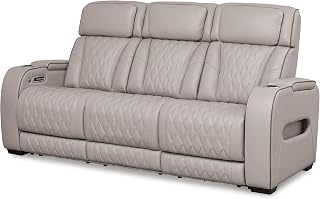
This is the most complete package here: genuine leather in a warm saddle tone, a wall-hugger frame that needs only a few inches of clearance, and independently adjustable power headrests that let taller and shorter sitters share the same sofa comfortably. The USB and USB-C ports are integrated cleanly rather than bolted on, and the compact footprint makes it one of the few reclining sofas that genuinely works in an RV or a tight urban living room.
THSUPER Top Grain Power Reclining Sofa and Loveseat Set
If you’re furnishing a full room in one purchase, this top-grain set is the strongest value proposition on the list, pairing a sofa and loveseat with power reclining, a drop-down table, and a high ergonomic backrest that supports the neck without a separate pillow. The beige colorway keeps the visual weight down, which matters when you’re placing two reclining pieces in the same sightline.
Genuine Leather Manual Reclining Sofa with Overstuffed Armrests
A real-hide option at a manual price point, with the deep armrests and generous seat depth that make a sofa feel broken-in from the first week. Choose this one if you want leather that ages well and would rather not manage a motor or an outlet.
Mid-Century Modern Faux Leather Reclining Sofa
The tapered legs and cleaner back profile give this one the most design-forward stance of the group, and the brown faux leather photographs and wears convincingly in low-traffic rooms. It’s the pick for a space where the sofa needs to look considered rather than purely functional.
Faux Leather Reclining Sofa with Concealed Cup Holders
Built for the room where comfort wins outright: black faux leather that hides wear, two hidden cup holders in the center seat, and overstuffed arms sized for long viewing sessions. Practical, easy to wipe down, and priced accordingly.
Frequently Asked Questions
Is genuine leather worth the extra cost over faux?
In a room used daily, yes. Top-grain leather softens rather than degrades and typically outlasts faux upholstery by several years. For a guest room, basement, or rental, quality faux leather delivers most of the look for a fraction of the outlay.
How much space does a reclining sofa really need?
Plan for 12 to 18 inches behind a standard mechanism and about three inches behind a wall hugger. Also allow roughly 30 inches of open floor in front so the footrest can extend fully.
Do power recliners hold up as well as manual ones?
The mechanisms are reliable, but they add electronic components that can fail outside the warranty window. Check the motor warranty specifically, since it’s often shorter than the frame coverage.
How do I keep leather from cracking?
Keep the sofa out of direct sunlight and away from heating vents, then condition the hide two or three times a year. Dust and wipe the seams monthly, since grit at the fold lines does most of the long-term damage.
Final Thoughts
For most rooms, the Watson & Whitely wall hugger is the pick that resolves the widest set of constraints at once: real leather, minimal clearance, and power features that stay visually quiet. Furnishing a larger space in a single go points to the THSUPER top-grain sofa and loveseat set, while the mid-century faux leather sofa remains the most design-conscious way into this category without stretching the budget.