Key takeaways
- Leather grade: Top grain is the durability benchmark — it keeps the hide’s natural surface and develops patina rather than wearing through. Split leather and leather-match constructions (hide on contact surfaces, vinyl on the sides and back) cut cost sensibly. Treat unspecified “genuine leather” as a prompt to check the listing details, and treat bonded leather as a short-term purchase.
- Power versus manual: Power reclining costs more and needs an outlet, but it stops at any angle and removes the body torque a manual handle requires. Manual mechanisms are lighter, cheaper, and have fewer parts to fail — a reasonable pick for a secondary room or a lower budget.
- Wall clearance: Conventional reclining frames want 12 to 18 inches behind them. Wall-hugger designs pull the seat forward on a track instead, dropping that requirement to a few inches. In a room where the sofa has to float against a wall, this single feature decides the layout.
- Headrest and lumbar adjustment: A power headrest matters most for anyone over six feet, since a fixed back angle pushes tall frames into a neck-forward slump. Independent headrest control also makes the reclined position usable for reading, not just napping.
- Consoles, ports, and clutter: Hidden cup holders, drop-down tables, and USB charging keep side tables out of the equation, which visually lightens a room. Note that a center console adds roughly 10 to 14 inches of width — measure before committing to one.
What's inside
Reclining furniture spent decades apologizing for itself. The trade-off was understood: you either got a sofa that looked good in a room or one that felt good at 9pm, and the overstuffed, bulge-armed recliner of the early 2000s made the choice easy for anyone with taste. That era is over. The current generation of leather reclining sofas borrows its proportions from mid-century seating — tighter arms, a cleaner back profile, mechanisms tucked behind the upholstery instead of announced by a lever the size of a door handle.
What still trips buyers up is the material and the mechanics underneath. “Leather” on a listing can mean full top-grain hide, a split-grain composite, or bonded material that will flake within three years. Meanwhile power motors, wall-hugger tracks, and adjustable headrests change the footprint and the feel far more than the color swatch does. This guide breaks down the specifications worth paying for in 2026, then reviews the reclining sofas that hold up on both fronts: how they sit, and how they look when nobody is sitting in them.
As an Amazon Associate we earn from qualifying purchases.


How to Choose a/an Leather Sofa Recliners (2026)
- Leather grade: Top grain is the durability benchmark — it keeps the hide’s natural surface and develops patina rather than wearing through. Split leather and leather-match constructions (hide on contact surfaces, vinyl on the sides and back) cut cost sensibly. Treat unspecified “genuine leather” as a prompt to check the listing details, and treat bonded leather as a short-term purchase.
- Power versus manual: Power reclining costs more and needs an outlet, but it stops at any angle and removes the body torque a manual handle requires. Manual mechanisms are lighter, cheaper, and have fewer parts to fail — a reasonable pick for a secondary room or a lower budget.
- Wall clearance: Conventional reclining frames want 12 to 18 inches behind them. Wall-hugger designs pull the seat forward on a track instead, dropping that requirement to a few inches. In a room where the sofa has to float against a wall, this single feature decides the layout.
- Headrest and lumbar adjustment: A power headrest matters most for anyone over six feet, since a fixed back angle pushes tall frames into a neck-forward slump. Independent headrest control also makes the reclined position usable for reading, not just napping.
- Consoles, ports, and clutter: Hidden cup holders, drop-down tables, and USB charging keep side tables out of the equation, which visually lightens a room. Note that a center console adds roughly 10 to 14 inches of width — measure before committing to one.
The Best Leather Sofa Recliners (2026)s Reviewed
CHITA Genuine Leather Power Recliner Sofa with Console, Saddle
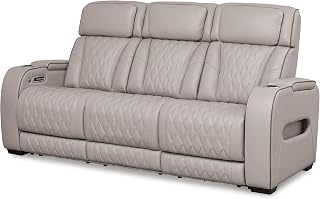
The most complete package here: dual motors, power headrests, wall-hugger geometry, and USB charging in a saddle-tone leather that reads warm rather than orange under lamplight. The console makes it a three-seater in name and a generous two-seater in practice, so buy it for the way you actually watch television.
CHITA Leather Power Recliner Sofa Wall Hugger, Dark Brown
Same engineering, consoleless, with a drop-down center table instead — the better choice if you need three real seats and want the surface only when guests aren’t using it. Dark brown hides wear and pet hair more forgivingly than any lighter hide will.
THSUPER Top Grain Leather Reclining Sofa and Loveseat Set
Top-grain hide at a set price is unusual, and the high ergonomic backrest is genuinely supportive rather than just tall. The beige finish suits lighter, plaster-and-oak interiors where brown leather would dominate, though it asks for more upkeep.
Genuine Leather Power Recliner Sofa, 3-Seat Brown
A straightforward electric three-seater with hidden cup holders and a USB port, aimed squarely at the buyer who wants power reclining without the console footprint. Arms are on the softer, fuller side, which suits traditional rooms better than minimal ones.
Genuine Leather Manual 3-Seat Recliner Sofa, Vintage Brown
Manual mechanisms, integrated headrests, and a distressed vintage-brown finish that suits a den, study, or office lounge. No cords, no motors, nothing to service — the pragmatic pick, and the easiest of these to move.
Frequently Asked Questions
Is genuine leather worth the premium over faux?
For a piece you sit in daily, yes — hide breathes, softens, and resists puncture better. That said, a well-made faux leather manual reclining sofa is a defensible choice for a guest room, basement, or rental where the sofa may not outlive the lease.
How much space does a reclining sofa really need?
Measure the fully extended depth, not the closed depth. Standard frames need a foot or more of rear clearance; wall-hugger models like the CHITA sofas need only a few inches, which can free up an entire walkway.
Do power recliners fail more often than manual ones?
They have more failure points, but motors and transformers are typically modular and replaceable. Dual-motor designs are more robust than single-motor systems doing double duty, and independent seat controls mean one fault doesn’t disable the whole sofa.
How do I keep leather from cracking?
Keep it out of direct sun and away from forced-air vents, dust it regularly, and condition it two or three times a year. Light shades like beige benefit from a protective treatment early, before the first stain rather than after.
Final Thoughts
For most rooms, the CHITA Genuine Leather Power Recliner Sofa with Console is the strongest all-around buy — wall-hugger clearance, power headrests, and charging built in. Choose the CHITA Wall Hugger in dark brown if you need three usable seats with a drop-down table, or the THSUPER top-grain sofa and loveseat set if you’re furnishing a full living room in one purchase and want the better hide.