Key takeaways
- Measure the clearance, not the table: Leave 36 inches between the table edge and the nearest wall or cabinet, and 42 to 48 inches where people walk past seated guests. Subtract that from your room dimensions first; whatever is left is your maximum diameter.
- Seating math is honest, marketing is not: Budget roughly 24 inches of edge per person. A 42-inch top seats four comfortably, 47 to 51 inches gives four real elbow room, and you need 59 inches before six people stop bumping arms.
- Base type decides comfort: Pedestal and single-column bases free up legroom and let you squeeze in an extra chair. Four-leg and X-frame bases are more stable under weight but fix where chairs can go, so check the leg span against your seat width.
- Match the surface to your household: Sintered stone resists heat, stains, and scratching, and suits anyone who cooks and serves at the table. Tempered glass keeps small rooms visually open but shows every fingerprint. Sealed or laminated wood tops are the forgiving middle ground.
- Plan for assembly and weight: Stone and glass tops routinely exceed 100 pounds and need two people plus a clear path. Confirm doorway widths and whether the base ships pre-assembled before you commit.
What's inside
Round tables get recommended constantly and bought badly. The usual mistake is treating diameter as the only spec that matters, then discovering that a 48-inch top swallows the walkway behind the chairs, or that a four-leg base puts a shin-height obstacle exactly where the fourth guest wants to sit. Circular tops are genuinely better at small-space conversation and traffic flow, but only when the base, the diameter, and the room are chosen together.
This guide looks at the round dining tables worth considering in 2026, from compact farmhouse designs with built-in storage to sintered stone slabs on carbon steel. Each pick is assessed on seating math, base geometry, surface durability, and the kind of room it actually suits, so you can match a table to your floor plan rather than to a photograph.
As an Amazon Associate we earn from qualifying purchases.


🛒 Best Price Today on Amazon
Prime members get fast, free shipping on everything above, plus member-only deals. New members get a 30-day free trial — cancel anytime.
How to Choose a Round Dining Table (2026)
- Measure the clearance, not the table: Leave 36 inches between the table edge and the nearest wall or cabinet, and 42 to 48 inches where people walk past seated guests. Subtract that from your room dimensions first; whatever is left is your maximum diameter.
- Seating math is honest, marketing is not: Budget roughly 24 inches of edge per person. A 42-inch top seats four comfortably, 47 to 51 inches gives four real elbow room, and you need 59 inches before six people stop bumping arms.
- Base type decides comfort: Pedestal and single-column bases free up legroom and let you squeeze in an extra chair. Four-leg and X-frame bases are more stable under weight but fix where chairs can go, so check the leg span against your seat width.
- Match the surface to your household: Sintered stone resists heat, stains, and scratching, and suits anyone who cooks and serves at the table. Tempered glass keeps small rooms visually open but shows every fingerprint. Sealed or laminated wood tops are the forgiving middle ground.
- Plan for assembly and weight: Stone and glass tops routinely exceed 100 pounds and need two people plus a clear path. Confirm doorway widths and whether the base ships pre-assembled before you commit.
The Best Round Dining Tables of 2026, Reviewed
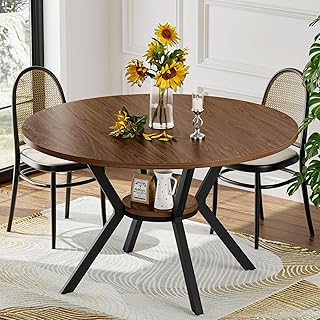
42″ Round Farmhouse Dining Table with Storage
The smartest option for apartments and eat-in kitchens, this one earns its footprint twice by tucking a storage shelf under a 42-inch rustic wood top on metal legs. At this diameter it seats four without crowding the walkway, and the open lower tier absorbs the serving pieces and linens a small kitchen has nowhere else to put.
Terra 59″ Transitional Round Pedestal Table
A walnut-finish pedestal design that reads mid-century without leaning theatrical, with a 1-inch tabletop that gives the edge some visual weight. The single sculpted base is the real argument here: at 59 inches you get uninterrupted legroom all the way around, so the stated four seats stretch to five when needed.
POVISON 59″ Sintered Stone Round Table
The most durable surface in this roundup by a clear margin. Glossy white sintered stone shrugs off hot pans, red wine, and cutlery marks, and the black carbon steel base keeps a 59-inch slab looking light rather than monumental. Chairs are sold separately, which is the right call at this level of finish.
jiteentarou 47″ Rustic Round Wood Table
A thickened, waterproof-coated top on a metal support frame, sized at 47 inches to seat four with genuine breathing room. It is the value pick for households that want warm wood tones and a sealed surface that tolerates spills, without the weight and freight of stone.
POVISON 51″ Round Glass Dining Table
Tempered glass over a black X-frame carbon steel base, and the least visually intrusive table here. In a compact or open-plan room the transparent top keeps sightlines and flooring visible, which makes the space read larger. Expect to keep a microfiber cloth nearby.
Frequently Asked Questions
What diameter do I need for six people?
Fifty-nine inches is the practical minimum for six adults, giving each person roughly 30 inches of edge. Anything smaller works for six place settings on paper but not for six people eating at once.
Is a pedestal base stable enough?
Yes, provided the base is weighted and its footprint is proportional to the top. A well-engineered pedestal or column base handles normal dining loads fine; the thing to avoid is leaning heavily on one edge of an oversized top with an undersized base.
How does sintered stone compare to marble?
Sintered stone is non-porous, heat resistant, and does not need sealing, so it handles daily family use better than natural marble while delivering a similar look. It is also less prone to etching from acidic foods.
Are round tables better than rectangular for small rooms?
Usually. No sharp corners means easier circulation, and everyone sits within conversational distance. The tradeoff is that round tops do not extend along a wall, so they waste more space in narrow galley-style rooms.
Final Thoughts
For most homes, the Terra 59″ pedestal table is the best balance of legroom, proportion, and design restraint. If durability leads your list, the POVISON 59″ sintered stone table is the surface that will still look new in five years, and for genuinely tight kitchens the 42″ farmhouse table with storage does more with less floor than anything else here.