Key takeaways
- Framing depth and stud math: Confirm the rough opening before anything else. Ultra-thin units that fit 2×4 walls save you from furring out a whole plane, while deeper inserts need 2×6 or a bump-out. Measure the vent clearance above the unit too, not just the box.
- Vent position: Front-facing top vents leave a visible slot in your finished surface. Hidden or downward-directed venting keeps the wall reading as one clean plane, which matters more on tile, stone, or microcement than on painted drywall.
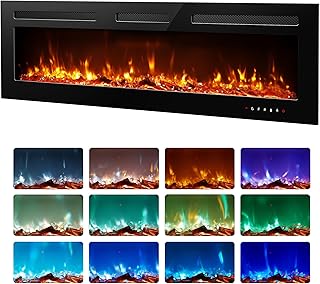
- Flame quality over color count: Nine or twelve color options sound generous, but most of them go unused. Judge the amber and orange settings, the flame height range, and whether the ember bed glows independently. Acrylic crystal beds refract light better than molded logs.
- Noise floor: These units live in living rooms and bedrooms where they compete with conversation. Look for models that advertise low-noise blowers or allow flame-only operation, so you can run the visual without the fan.
- Controls and heat delivery: A 750/1500W dual-stage heater on a standard 120V outlet suits most rooms. Thermostats beat simple on-off timers, and app or voice integration is worth having if the fireplace is going into an already-connected room.
What's inside
Linear fireplaces sit at an awkward intersection in most homes: they are architectural elements sold as appliances. Buyers plan a media wall around a 60-inch opening, then discover the unit they ordered runs a noisy blower, throws a flame that reads more purple neon than fire, or needs a 240V circuit nobody budgeted for. The spec sheets rarely surface any of that, which is why so many builds end up with drywall patched twice.
This guide looks at the current crop of recessed and wall-mount linear fireplaces through a design lens first and an engineering lens second: flame realism, bezel width, vent placement, acoustic behavior, and how forgiving each unit is about framing. Below are the models worth specifying in 2026, along with the details that actually determine whether the finished wall looks intentional.
As an Amazon Associate we earn from qualifying purchases.




How to Choose an Electric Linear Fireplace (2026)
- Framing depth and stud math: Confirm the rough opening before anything else. Ultra-thin units that fit 2×4 walls save you from furring out a whole plane, while deeper inserts need 2×6 or a bump-out. Measure the vent clearance above the unit too, not just the box.
- Vent position: Front-facing top vents leave a visible slot in your finished surface. Hidden or downward-directed venting keeps the wall reading as one clean plane, which matters more on tile, stone, or microcement than on painted drywall.
- Flame quality over color count: Nine or twelve color options sound generous, but most of them go unused. Judge the amber and orange settings, the flame height range, and whether the ember bed glows independently. Acrylic crystal beds refract light better than molded logs.
- Noise floor: These units live in living rooms and bedrooms where they compete with conversation. Look for models that advertise low-noise blowers or allow flame-only operation, so you can run the visual without the fan.
- Controls and heat delivery: A 750/1500W dual-stage heater on a standard 120V outlet suits most rooms. Thermostats beat simple on-off timers, and app or voice integration is worth having if the fireplace is going into an already-connected room.
The Best Electric Linear Fireplaces (2026), Reviewed
Dimplex IgniteXL 60″ Built-in (XLF60)
The IgniteXL remains the reference point for flame realism, with eight color themes, a diffused acrylic ember bed, and heat that exits downward so the finished wall above stays uninterrupted. It is the priciest option here and can be wired for 240V, but if the fireplace is the focal point of the room, this is the one designers keep specifying.
Vitesse 72″ Ultra Thin
Vitesse pairs a genuinely narrow bezel with a 72-inch span, which gives you that long horizontal slot look without a chunky frame breaking the line. The onboard touch screen, eight-hour sleep timer, and quiet blower make it a sensible bedroom or primary-suite choice at a fraction of the built-in cost.
72″ Ultra-Thin Silence Linear Fireplace
Built around low-noise operation, this one fits both 2×4 and 2×6 framing, which quietly solves the most common retrofit problem. Flame color and speed are both adjustable, and the 750/1500W heater covers a typical open living area without needing a dedicated circuit.
PuraFlame Bernice 42″
At 42 inches, the Bernice suits smaller rooms, hallway niches, and above-console installs where a 60-inch unit would overwhelm the wall. The hidden vent design is the standout detail, and Alexa and Google Assistant support means it can join existing evening scenes rather than needing its own remote.
Electactic 60″ Ultra-Thin Insert
This is the value pick that does not feel like one: a real thermostat instead of a basic timer, ultra-thin body for 2×4 walls, and both touch screen and remote control. Flame detail is a step behind the Dimplex, but the installation flexibility and price make it easy to justify.
Frequently Asked Questions
Do I need an electrician?
Most 120V models plug into a standard outlet, though you should place that outlet inside the framing cavity or beside the unit so no cord is visible. Hardwired and 240V configurations, including the Dimplex, do require a licensed electrician.
Can I mount a TV above one?
Yes, provided the fireplace vents downward or forward rather than straight up, and you respect the manufacturer’s clearance spec. Downward-venting units are the safer choice for media walls.
How much heat do these actually produce?
A 1500W setting warms roughly 400 square feet as supplemental heat. Treat it as zone comfort, not a furnace replacement.
Recessed or wall-mounted?
Recessed looks built-in and is worth the drywall work if you are already renovating. Wall-mount installs in an afternoon and works for rentals or later-stage projects. Several models here, including the EUHOMY 60-inch, support both.
Final Thoughts
For a wall that has to look architectural, the Dimplex IgniteXL 60″ earns its premium through flame quality and clean venting. The Vitesse 72″ delivers the widest, most minimal profile for the money, and the Electactic 60″ is the smartest pick if you want thermostat control and easy 2×4 installation without stretching the budget.