Key takeaways
- Match technology to the room, not the spec sheet: Peltier units run around 35dB with no compressor cycling, ideal beside a bed or in a closet. Compressor models pull vastly more water and suit basements, laundry rooms and open-plan floors where a soft hum is acceptable.
- Read pint ratings sceptically: Headline figures are measured in warm, saturated test conditions. A 30-pint unit in a cool 15°C basement will extract noticeably less, so size up rather than down if the space is unheated.
- Insist on continuous drainage: A drain hose port turns a twice-daily chore into a set-and-forget appliance. For any unit working in a basement or utility space, treat this as non-negotiable.
- Check the auto-restart behaviour: After a power interruption, a unit that resumes its previous mode protects the room while you are away. Combined with auto shut-off at tank capacity, it is the difference between a tool and a liability.
- Consider placement and sightlines: These machines live in the open. Matte white and grey cabinets recede against painted walls; a black finish reads better against dark timber or a slate hearth. Allow clearance on all sides for airflow, and remember that hard floors amplify vibration in a way rugs do not.
What's inside
Damp air announces itself before you can name it. A closet that smells faintly of last winter, a plaster wall that has gone chalky near the skirting, a bedroom window fogged at 7am in October. Most of us respond by buying the first dehumidifier with a good number on the box, then discover the real cost: a low mechanical drone that sits underneath every quiet evening, audible through a closed door, impossible to unhear once noticed. In a home where the furniture has been chosen with care, an appliance that hums like a small fridge is a design failure as much as an acoustic one.
This guide is about the quieter end of the category, and about being honest regarding what quiet actually means in 2026. Peltier (thermoelectric) units are near-silent but modest in capacity. Compressor units move far more moisture and will always make some sound, though the better ones have moved from intrusive to unremarkable. Below are six units worth considering across that spread, from a 30oz bathroom-scale device to a 105-pint basement workhorse, with notes on where each one genuinely belongs.
As an Amazon Associate we earn from qualifying purchases.


How to Choose a Silent Dehumidifier (2026)
- Match technology to the room, not the spec sheet: Peltier units run around 35dB with no compressor cycling, ideal beside a bed or in a closet. Compressor models pull vastly more water and suit basements, laundry rooms and open-plan floors where a soft hum is acceptable.
- Read pint ratings sceptically: Headline figures are measured in warm, saturated test conditions. A 30-pint unit in a cool 15°C basement will extract noticeably less, so size up rather than down if the space is unheated.
- Insist on continuous drainage: A drain hose port turns a twice-daily chore into a set-and-forget appliance. For any unit working in a basement or utility space, treat this as non-negotiable.
- Check the auto-restart behaviour: After a power interruption, a unit that resumes its previous mode protects the room while you are away. Combined with auto shut-off at tank capacity, it is the difference between a tool and a liability.
- Consider placement and sightlines: These machines live in the open. Matte white and grey cabinets recede against painted walls; a black finish reads better against dark timber or a slate hearth. Allow clearance on all sides for airflow, and remember that hard floors amplify vibration in a way rugs do not.
The Best Silent Dehumidifier (2026)s Reviewed
HOGARLABS 30 Pint Ultra Silent Dehumidifier
A well-judged middle option: enough capacity for a family bathroom, a hallway or a small basement, with three working modes and a legible digital panel rather than a row of cryptic icons. Overflow protection and auto restart make it a sensible choice for a space you visit weekly rather than daily.
KNKA 34 Pint Dehumidifier for Basement
The 2500 sq ft coverage claim is generous, but as a 34-pint unit for a single damp level of a house it performs consistently, and the intelligent humidity control means it targets a set point instead of running flat out. The 24-hour timer and dry-clothes mode earn their place if you air laundry indoors through winter.
Eva-Dry EDV-1200 Quiet Peltier Dehumidifier
This is the one to buy when silence genuinely outranks capacity. At roughly 35dB and 22.5W with no compressor, it is unobtrusive enough for a bedside table or a wardrobe, though the 30oz tank and 133 sq ft rating confine it to small, enclosed spaces.
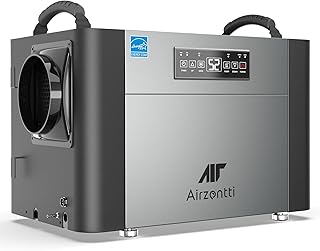
105 Pint Energy Star Dehumidifier, 5500 Sq Ft
Serious equipment for a large or persistently wet basement, and the Energy Star efficiency rating matters when a unit runs for months at a time. Expect audible operation; pair it with the drain hose, set the humidistat around 50%, and let it work behind a closed door.
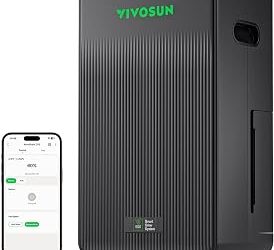
95oz Quiet Dehumidifier with 7-Color Ambient Light
Available in black or grey, this compact unit covers up to 1000 sq ft and runs quietly enough for a living room or nursery. The ambient light is a genuine asset in a hallway or on a landing, and it can be switched off entirely when you want the appliance to disappear.
Frequently Asked Questions
How quiet is quiet, really?
Peltier models sit near 35dB, close to a whisper and comparable to a quiet library. Compressor units typically land between 40 and 50dB, which is soft but perceptible in a silent room. No compressor dehumidifier is truly silent.
What humidity level should I set?
Between 45 and 55% suits most homes. Below 40% you risk shrinking timber and drying out plaster and joinery; above 60% mould finds a foothold within days.
Can I run one overnight in a bedroom?
Yes, with the right unit. A Peltier device is best for light-sleeper households; a compressor model is fine if you tolerate low background noise, or place it in an adjoining room with the door ajar.
Do I need a drain hose?
For anything running continuously, yes. Tank emptying is manageable in a small bathroom but becomes tedious in a basement, where a hose to a floor drain removes the maintenance entirely.
Final Thoughts
For most homes, the HOGARLABS 30 Pint strikes the best balance of capacity, quiet operation and clear controls. Choose the Eva-Dry EDV-1200 if genuine near-silence in a bedroom or closet is the priority, and the 105 Pint Energy Star model if a large, stubbornly damp basement is the problem you actually need to solve.